


[Reading level: C1 – Advanced]
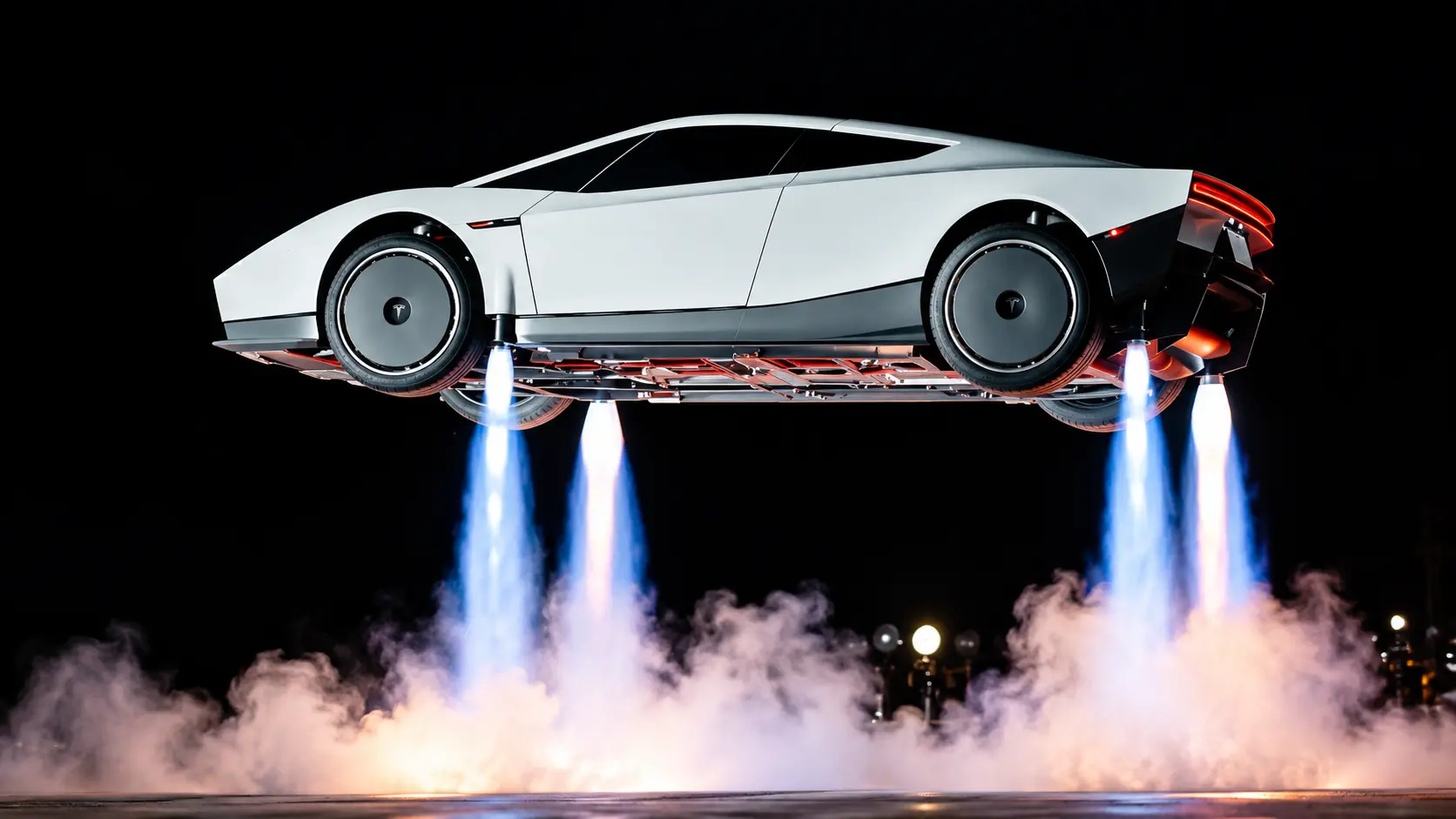
On October 15, 2026, Tesla astonished the world with a demonstration of its next-generation Roadster sports car, capable of accelerating at incredible speeds, lifting off the ground, and spinning in midair. The secret lies in a cold-gas thruster system developed with the assistance of engineers from SpaceX, Elon Musk’s aerospace company.
Unlike conventional rocket engines, which burn fuel to produce high-speed streams of hot gas, cold-gas thrusters do not require combustion. Instead, they use gas compressed to extremely high pressures, which is then released through nozzles to generate thrust.
The operating principle of this system is based on Newton’s third law of motion: When one object exerts a force on another, it experiences an equal force in the opposite direction. In the case of the Roadster, when compressed gas is forcefully expelled downward, the car experiences an upward force. If this thrust is strong enough to overcome gravity, the car can lift off the ground.
To generate such powerful thrust, the Roadster uses a system of high-pressure gas tanks known as COPVs (Composite Overwrapped Pressure Vessels). These tanks have a gas-tight inner liner and an outer layer reinforced with composite materials, typically carbon fiber. This structure allows the tanks to withstand extremely high pressures while remaining relatively lightweight.
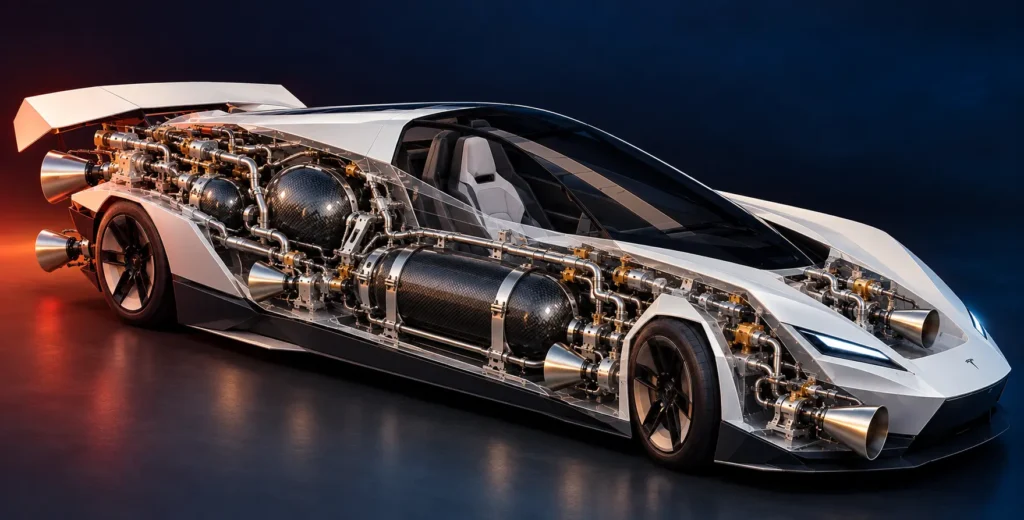
According to the specifications announced during the demonstration, the Roadster’s system can hold approximately 600 liters of compressed gas in its COPVs, at pressures reaching nearly 69 million pascals, equivalent to about 690 bar, or almost 680 times the atmospheric pressure at sea level.
When the system is activated, control valves open, allowing compressed gas to escape from the tanks and enter a network of pipes. The gas is then directed toward the nozzles, where the energy stored in the form of pressure is converted into the kinetic energy of a gas stream moving at extremely high speeds.
One important feature is that the thrust can be adjusted by changing the amount of gas released and selecting which nozzles are activated. The system is designed not only to propel the car forward but also to generate forces in different directions.
According to the described design, the Roadster Rocket version uses 10 cold-gas thrusters positioned around the vehicle. When the downward-facing nozzles are activated, they generate lift. When the rear nozzles operate, the car receives additional forward thrust, allowing it to accelerate faster than it could by relying solely on the grip between its tires and the road.
In particular, controlling nozzles at different positions can also generate torque, causing the car to rotate around its axes. For example, if the thrust forces acting on opposite sides of the vehicle are unbalanced, they can cause the car to tilt or spin. By precisely coordinating the timing, direction, and intensity of the gas jets, the system can control the car’s orientation while it is in the air.

However, this capability requires extremely high precision. If gas is not distributed evenly among the nozzles, the thrust may become unbalanced, causing the car to spin unintentionally. Therefore, the length, diameter, and flow characteristics of the piping system must be carefully calculated, while the valves must respond quickly and accurately.
To meet the requirements of withstanding high pressures while minimizing weight, the system’s pipes and nozzles are described as being made of titanium, while some gas distribution components are manufactured from Inconel, a high-strength superalloy.
Although cold-gas thrusters can generate enormous thrust for short periods, they also have a significant limitation: the supply of compressed gas is finite. Each time the system is activated, some of the gas is consumed, gradually reducing the pressure inside the tanks. Therefore, the system needs to be refilled after use and is not suitable for sustaining long flights like conventional aircraft engines.
WORD BANK:
astonish sb /əˈstɑː.nɪʃ/ [B2] (v): khiến ai kinh ngạc, sửng sốt
demonstration /ˌdem.ənˈstreɪ.ʃən/ [B2] (n): màn trình diễn; sự minh họa
accelerate /əkˈsel.ə.reɪt/ [C1] (v): tăng tốc
spin /spɪn/ [B2] (v): xoay, quay tròn
cold-gas thruster /ˌkoʊld ˈɡæs ˌθrʌs.tɚ/ (n): động cơ đẩy khí lạnh
aerospace /ˈer.oʊ.speɪs/ (adj, n): thuộc ngành hàng không vũ trụ; ngành hàng không vũ trụ
conventional /kənˈven.ʃən.əl/ [B2] (adj): thông thường, truyền thống
stream /striːm/ [B2] (n): dòng, luồng (khí, nước…)
combustion /kəmˈbʌs.tʃən/ (n): sự đốt cháy, quá trình cháy
compress /kəmˈpres/ (v): nén, ép lại
thrust /θrʌst/ (n): lực đẩy
operating principle /ˈɑː.pə.reɪ.t̬ɪŋ ˈprɪn.sə.pəl/ (n): nguyên lý hoạt động
exert /ɪɡˈzɝːt/ [C1] (v): tác dụng (lực); sử dụng (quyền lực, ảnh hưởng)
expel /ɪkˈspel/ [C2] (v): đẩy ra, tống ra ngoài
gravity /ˈɡræv.ə.t̬i/ [B2] (n): trọng lực
composite /kəmˈpɑː.zɪt/ (adj, n): làm từ nhiều vật liệu kết hợp; vật liệu tổng hợp
overwrap /ˌoʊ.vɚˈræp/ (v): bọc thêm một lớp vật liệu bên ngoài
pressure vessel /ˈpreʃ.ɚ ˈves.əl/ (n): bình chịu áp suất, bình chứa áp lực
gas-tight /ˈɡæs.taɪt/ (adj): kín khí, không để khí rò rỉ
inner /ˈɪn.ɚ/ [B2] (adj): bên trong, thuộc phần trong
liner /ˈlaɪ.nɚ/ (n): lớp lót bên trong
withstand sth /wɪðˈstænd/ [C2] (v): chịu đựng, chống chịu được cái gì
specifications /ˌspes.ə.fəˈkeɪ.ʃənz/ [C1] (n): các thông số kỹ thuật
pascal /pæˈskæl/ (n): pascal, đơn vị đo áp suất
equivalent to sth /ɪˈkwɪv.ə.lənt/ [B2] (adj): tương đương với cái gì
atmospheric pressure /ˌæt.məsˈfer.ɪk ˈpreʃ.ɚ/ (n): áp suất khí quyển
valve /vælv/ (n): van, van điều khiển
nozzle /ˈnɑː.zəl/ (n): vòi phun
kinetic energy /kɪˈnet̬.ɪk ˈen.ɚ.dʒi/ (n): động năng
adjust /əˈdʒʌst/ [B2] (v): điều chỉnh
propel /prəˈpel/ (v): đẩy, tạo lực đẩy khiến vật chuyển động
downward-facing /ˈdaʊn.wɚd ˈfeɪ.sɪŋ/ (adj): hướng xuống dưới
rear /rɪr/ [B2] (adj, n): ở phía sau; phần phía sau
solely /ˈsoʊl.li/ [C1] (adv): chỉ, duy nhất
grip /ɡrɪp/ [C1] (n): độ bám; sự bám chặt
torque /tɔːrk/ (n): mô-men xoắn
rotate /ˈroʊ.teɪt/ [C1] (v): quay, xoay quanh một trục
axis (plural: axes) /ˈæk.sɪs/ [C1] (n): trục quay, trục
tilt /tɪlt/ [C1] (v): nghiêng, làm nghiêng
precisely /prɪˈsaɪs.li/ [B2] (adv): một cách chính xác
coordinate /koʊˈɔːr.dən.eɪt/ [C1] (v): phối hợp, điều phối
timing /ˈtaɪ.mɪŋ/ [B2] (n): thời điểm; sự lựa chọn thời điểm thích hợp
intensity /ɪnˈten.sə.t̬i/ [C1] (n): cường độ, mức độ mạnh
gas jet /ˈɡæs dʒet/ (n): luồng khí phun mạnh, tia khí
distribute /dɪˈstrɪb.juːt/ [B2] (v): phân phối, phân bố
evenly /ˈiː.vən.li/ [B2] (adv): đồng đều, đều nhau
diameter /daɪˈæm.ə.t̬ɚ/ (n): đường kính
flow /floʊ/ [B1] (n, v): dòng chảy, luồng chuyển động; chảy
superalloy /ˈsuː.pɚˌæl.ɔɪ/ (n): siêu hợp kim
finite /ˈfaɪ.naɪt/ (adj): có giới hạn, hữu hạn
sustain sth /səˈsteɪn/ [C1] (v): duy trì, giữ cho cái gì tiếp diễn
ỦNG HỘ READ TO LEAD!
Chào bạn! Có thể bạn chưa biết, Read to Lead là một trang giáo dục phi lợi nhuận với mục đích góp phần phát triển cộng đồng người học tiếng Anh tại Việt Nam. Chúng tôi không yêu cầu người đọc phải trả bất kỳ chi phí nào để sử dụng các sản phẩm của mình để mọi người đều có cơ hội học tập tốt hơn. Tuy nhiên, nếu bạn có thể, chúng tôi mong nhận được sự hỗ trợ tài chính từ bạn để duy trì hoạt động của trang và phát triển các sản phẩm mới.
Bạn có thể ủng hộ chúng tôi qua 1 trong 2 cách dưới đây.
– Cách 1: Chuyển tiền qua tài khoản Momo.
Số điện thoại 0947.886.865 (Chủ tài khoản: Nguyễn Tiến Trung)
Nội dung chuyển tiền: Ủng hộ Read to Lead
hoặc
– Cách 2: Chuyển tiền qua tài khoản ngân hàng.
Ngân hàng VIB chi nhánh Hải Phòng
Số tài khoản: 012704060048394 (Chủ tài khoản: Nguyễn Tiến Trung)
Nội dung chuyển tiền: Ủng hộ Read to Lead
Lớp luyện thi IELTS online
Bạn đang có nhu cầu thi chứng chỉ IELTS cho đầu vào đại học, đi du học, xin việc hay xin cư trú và đang phân vân chưa biết học ở đâu?
Nếu bạn đang tìm kiếm dịch vụ luyện thi IELTS online với giáo viên uy tín và chất lượng, cũng như học phí phải chăng, thì lớp học online của thầy Trung (Admin và dịch giả chính của Read to Lead) có thể là một lựa chọn phù hợp dành cho bạn.
Hãy liên hệ (nhắn tin) tới trang Facebook cá nhân của mình (https://www.facebook.com/nguyen.trung.509) để tìm hiểu về lớp học và được tư vấn cũng như được học thử nha!


