


[Reading level: B2 – Upper Intermediate]
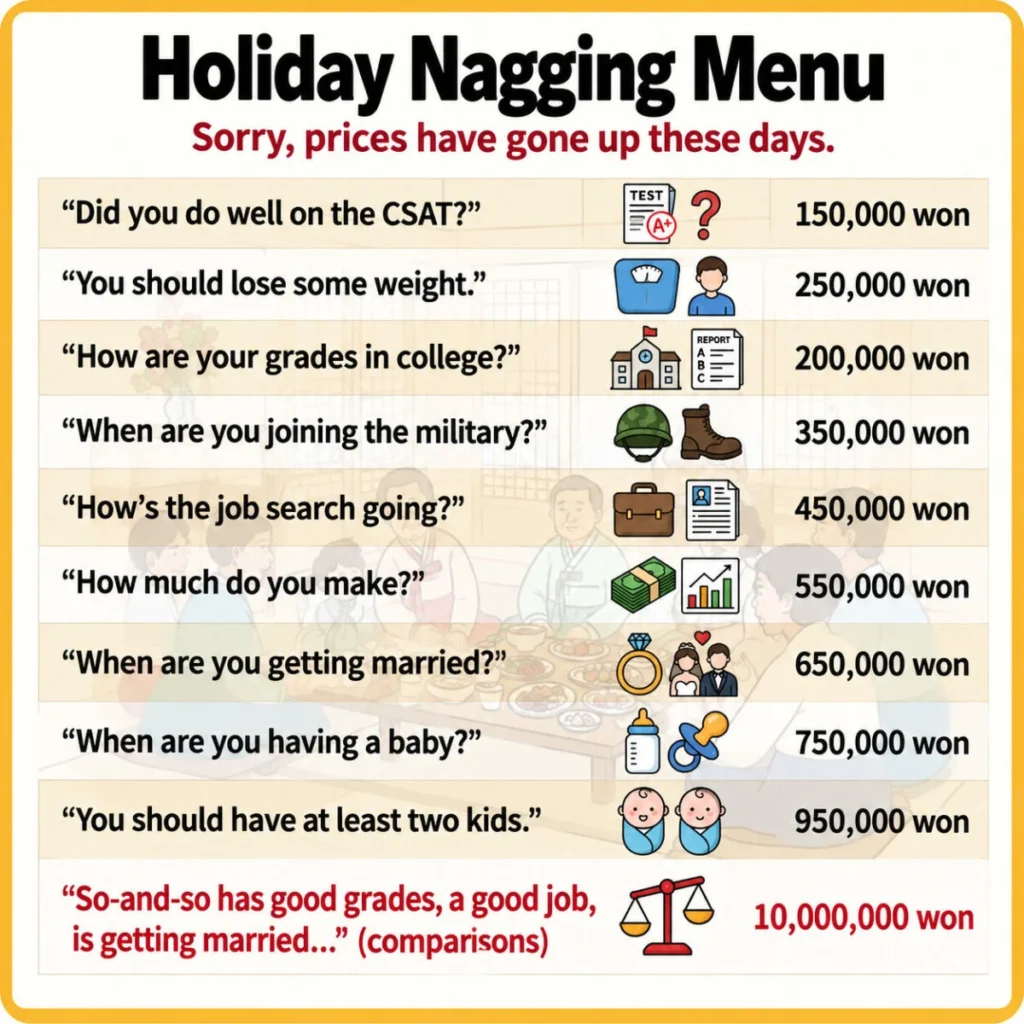
“How’s work going these days?” – 150,000 won.
“When are you getting married?” – 450,000 won.
“When are you going to have children?” – 950,000 won.
This is not the price list of a consulting service, but a “nagging menu” that many young South Koreans have been sharing on social media during Chuseok 2026. Each personal question from relatives comes with a price, and the more sensitive the question is, the higher the fee.
For example, asking about someone’s job costs 150,000 won, asking when they are getting married costs 450,000 won, while asking, “When are you going to have children?” can cost as much as 950,000 won.
Of course, hardly anyone actually intends to charge their relatives money. The price list is mainly a humorous way for young people to respond to a familiar problem: questions that are meant to show concern but can sometimes make the person being asked feel that their private life is being scrutinized.
When family reunions also bring pressure
Chuseok is one of South Korea’s most important holidays, when many people return to their hometowns to reunite with their families. But for many people in their 20s and 30s, such gatherings also mean having to answer a series of questions about their jobs, income, relationships, marriage, and plans to have children.
At a time when competition for jobs is fierce, housing prices are high, and the cost of living is increasingly expensive, seemingly harmless questions can sometimes touch on the very issues that worry young people the most.
A 2026 survey by research company PMI involving 1,000 adults found that nearly 49% of respondents wanted to get rid of excessive interference and personal questions from family members during holidays. Nearly 22% said that personal questions from relatives were the main reason they disliked the holiday.
From an online joke to a trend
The “nagging menu” quickly became a trend on social media.
An X user with the account name Ggooggoo created a tool that allows people to design their own personalized price lists by completing a short quiz. From last year’s holiday season to this year’s Chuseok, more than 67,000 “menus” have been created.
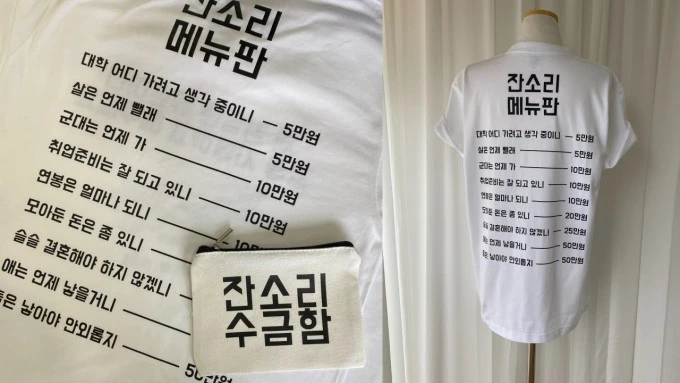
Many online platforms have also introduced fun quizzes about how people deal with uncomfortable questions during the holiday. E-commerce platforms have even started selling T-shirts printed with the price list for young people to wear when they return home to see their families.
What started as an online joke has therefore become a way for many young people to express a shared wish: family members should also respect certain boundaries when it comes to one another’s private lives.
Some choose not to go home
Not all young people choose to respond with humor. Some simply limit their participation in large family gatherings.
According to a Hankook Research survey of 1,000 adults, about 63% of respondents planned to visit their relatives during Chuseok 2026, down from 68% during Chuseok the previous year and 70% during Lunar New Year earlier this year.
As more young people stay in the city during the holiday, new ways of celebrating Chuseok are also emerging.
In Seoul’s Mapo district, Jeong Yu-jin, the owner of a bar called Hamut, organizes gatherings for people who do not want to return home. The events have been held since 2024, with each gathering attracting around 10 people in their 20s and 30s who come to enjoy traditional alcohol, have some snacks, and talk with one another.
In the Hongdae area, an event organizer called Taeyang has even created a program called “Battle for Holiday Money.” Young strangers form teams, play traditional games, and compete for prize money. They can still enjoy the atmosphere of Chuseok, just without questions about their salaries, jobs, or when they are going to get married.

Behind these “price lists,” which may seem to be nothing more than a joke, is a broader change in attitudes toward family and personal privacy.
For older generations, asking about someone’s job, salary, marriage, or children may simply be a way of showing concern. But for many young people, these are personal choices that they do not want to have to explain every time they meet their relatives.
And perhaps that is exactly what these price lists worth hundreds of thousands of won are trying to say: to make a family reunion more enjoyable, sometimes nothing special needs to be done – people simply need to know which questions not to ask.
WORD BANK:
consulting service /kənˈsʌl.t̬ɪŋ ˈsɝː.vɪs/ (n): dịch vụ tư vấn
nag /næɡ/ (v): cằn nhằn, càm ràm
nagging /ˈnæɡ.ɪŋ/ (n): sự cằn nhằn, càm ràm
relative /ˈrel.ə.t̬ɪv/ [B1] (n): họ hàng, người thân
come with a price /kʌm wɪð ə praɪs/ (v): đi kèm với một cái giá, phải trả giá
sensitive /ˈsen.sə.t̬ɪv/ [B2] (adj): nhạy cảm
charge sb /tʃɑːrdʒ/ [B1] (v): tính phí, thu tiền ai
humorous /ˈhjuː.mɚ.əs/ [C1] (adj): hài hước
scrutinize /ˈskruː.t̬ən.aɪz/ [C2] (v): xem xét, soi xét kỹ lưỡng
reunite with sb /ˌriː.juːˈnaɪt/ (v): đoàn tụ, gặp lại ai
gathering /ˈɡæð.ɚ.ɪŋ/ [B2] (n): buổi tụ họp, cuộc gặp mặt
fierce /fɪrs/ [B2] (adj): gay gắt, dữ dội
seemingly /ˈsiː.mɪŋ.li/ [C1] (adv): có vẻ, tưởng chừng như
harmless /ˈhɑːrm.ləs/ [B2] (adj): vô hại
touch on sth /tʌtʃ/ (v): đề cập, nói đến cái gì
respondent /rɪˈspɑːn.dənt/ (n): người tham gia trả lời khảo sát
get rid of sth /ɡet rɪd/ [B2] (v): loại bỏ, thoát khỏi cái gì
excessive /ɪkˈses.ɪv/ [C1] (adj): quá mức
interference /ˌɪn.t̬ɚˈfɪr.əns/ [C1] (n): sự can thiệp
quiz /kwɪz/ [B1] (v): hỏi dồn, hỏi kỹ
joke /dʒoʊk/ [B1] (n): câu nói đùa, trò đùa
boundary /ˈbaʊn.dɚ.i/ [B2] (n): ranh giới, giới hạn
when it comes to sth /wen ɪt kʌmz/ (phrase): khi nói đến, khi đề cập đến cái gì
do sth with humor /ˈhjuː.mɚ/ (phrase): làm gì đó một cách hài hước
emerge /ɪˈmɝːdʒ/ [B2] (v): xuất hiện, nổi lên
attitude toward sth /ˈæt̬.ə.tuːd/ [B1] (n): thái độ đối với cái gì
ỦNG HỘ READ TO LEAD!
Chào bạn! Có thể bạn chưa biết, Read to Lead là một trang giáo dục phi lợi nhuận với mục đích góp phần phát triển cộng đồng người học tiếng Anh tại Việt Nam. Chúng tôi không yêu cầu người đọc phải trả bất kỳ chi phí nào để sử dụng các sản phẩm của mình để mọi người đều có cơ hội học tập tốt hơn. Tuy nhiên, nếu bạn có thể, chúng tôi mong nhận được sự hỗ trợ tài chính từ bạn để duy trì hoạt động của trang và phát triển các sản phẩm mới.
Bạn có thể ủng hộ chúng tôi qua 1 trong 2 cách dưới đây.
– Cách 1: Chuyển tiền qua tài khoản Momo.
Số điện thoại 0947.886.865 (Chủ tài khoản: Nguyễn Tiến Trung)
Nội dung chuyển tiền: Ủng hộ Read to Lead
hoặc
– Cách 2: Chuyển tiền qua tài khoản ngân hàng.
Ngân hàng VIB chi nhánh Hải Phòng
Số tài khoản: 012704060048394 (Chủ tài khoản: Nguyễn Tiến Trung)
Nội dung chuyển tiền: Ủng hộ Read to Lead
Lớp luyện thi IELTS online
Bạn đang có nhu cầu thi chứng chỉ IELTS cho đầu vào đại học, đi du học, xin việc hay xin cư trú và đang phân vân chưa biết học ở đâu?
Nếu bạn đang tìm kiếm dịch vụ luyện thi IELTS online với giáo viên uy tín và chất lượng, cũng như học phí phải chăng, thì lớp học online của thầy Trung (Admin và dịch giả chính của Read to Lead) có thể là một lựa chọn phù hợp dành cho bạn.
Hãy liên hệ (nhắn tin) tới trang Facebook cá nhân của mình (https://www.facebook.com/nguyen.trung.509) để tìm hiểu về lớp học và được tư vấn cũng như được học thử nha!


