


The year is 100 CE, and 11-year-old Julia Lucilla is playing with her ivory doll Pompeia. Named after the Roman Emperor Trajan’s wife, Pompeia is only 20 centimeters tall, with joints at her arms, legs, knees, and elbows, and a bevy of miniature clothes and accessories.
With her doll in hand, Julia hosts elaborate dinner parties, helps Aeneas escape Troy, and accompanies her father on work trips to Egypt.
This ancient scene is likely familiar to any modern parent, and that’s because kids have been going on imaginary adventures with their toys for thousands of years.
While the most common ancient playthings would likely have been sticks and rocks, evidence of their use for play is archaeologically invisible. However, archaeologists have found material, visual, and written evidence for toys across the ancient world.
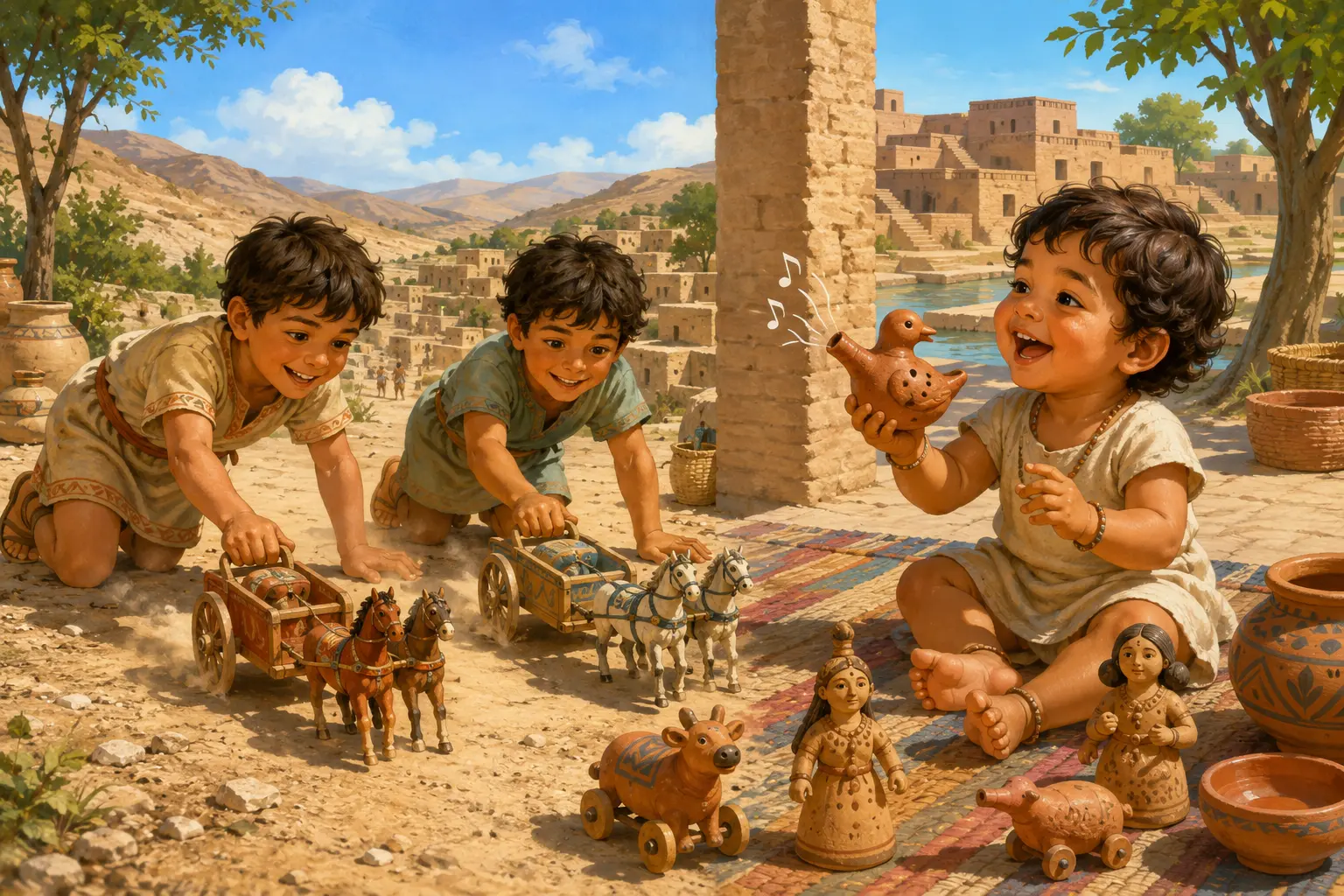
In Anatolia circa 3000 BCE, miniature toy carriages raced through the dirt at the hands of energetic youngsters.
A thousand years later, in the Indus Valley, a toddler giggled gleefully at the chirping sound created by their dove-shaped terracotta whistle.
Alongside whistles and wheeled toys, dolls are another common ancient plaything, though they can be a little harder to identify. While some archaeologists think ancient female figurines found across Afro-Eurasia may have been children’s toys, others believe them to be sacred fertility idols.
But we do know dolls like Pompeia were popular in Greece and Rome, with hair and clothes designed to reflect changing adult fashions.
And thousands of years later in the Arctic, Inuit children carried fur-clad dolls carved of wood or walrus tusk.
But perhaps the most common ancient toy is the humble ball. Thousands of years ago, children in ancient Egypt, China, Greece, and Mesoamerica kicked and threw balls made of everything from leather and linen to papyrus and palm fiber.
The rules for most of their games have been lost to time, however some kids may have imitated adult games we know more about.
For example, ancient Greek children might have played episkuros, a team sport where players competed to push their opponents outside the pitch by hurling the ball as far as possible.
Meanwhile, Mesoamerican kids might have played a game where players try to hit a rubber ball through a hoop using only their hips. Then again, in some cultures, this game had religious significance, so it’s possible those children steered clear of this sacred sport.
In any case, rougher, physical play was often limited by ancient gender expectations, with young girls being left out of rowdier ball games in Rome and Egypt.
Spartan girls circa 400 CE did engage in the same rigorous physical activities as boys, but largely because adults believed it would strengthen their bodies for childbearing.
Fortunately, this wasn’t the only reason ancient adults encouraged kids to play.
Athenian philosopher Plato observed that toys like building blocks and miniature farming implements were useful tools for learning the skills needed in adulthood.
That said, many ancient cultures expected children to give up their games and toys as they grew up.
A common Roman phrase described a child “giving up nuts” when taking up their adult responsibilities since nuts were used in a variety of simple games. And young Roman girls left their dolls as offerings to the gods as part of preparing for their wedding.
However, other childhood games resembled those men and women continued to enjoy into adulthood.
One, called knucklebones, was popular across the ancient Mediterranean. Usually crafted from the ankle bones of sheep or pigs, they could be used as jacks or dice, with different faces earning different point values.
In addition to games of chance, ancient adults played a variety of strategic board games, which may have been introduced during childhood.
Some particularly well-recorded examples include the Royal Game of Ur in ancient Mesopotamia, Go in China, Senet in Egypt, and Ludus latrunculorum— or, the Game of Soldiers— in Rome.
Today, playful kids follow the same instincts as their ancient ancestors. They continue to make up ball games, invent stories for their favorite dolls, and send toy cars skittering across the floor, because the simplest kinds of play never get old.
WORD BANK:
ivory /ˈaɪ.və.ri/ (n): ngà voi
name sb after sb /neɪm/ (v): đặt tên ai theo tên ai
elbow /ˈel.boʊ/ [B1] (n): khuỷu tay
a bevy of sth /ˈbev.i/ (phr): một nhóm lớn, nhiều, một bộ sưu tập
miniature /ˈmɪn.i.ə.tʃɚ/ [C1] (adj): thu nhỏ
accessory /əkˈses.ɚ.i/ [B2] (n): phụ kiện
elaborate /ɪˈlæb.ɚ.ət/ [B2] (adj): công phu, cầu kỳ
accompany sb /əˈkʌm.pə.ni/ [B1] (v): đi cùng ai
imaginary /ɪˈmædʒ.ə.ner.i/ [B1] (adj): tưởng tượng
adventure /ədˈven.tʃɚ/ [B1] (n): cuộc phiêu lưu
ancient /ˈeɪn.ʃənt/ [B2] (adj): cổ đại
archaeological /ˌɑːr.ki.əˈlɑː.dʒɪ.kəl/ [C1] (adj): thuộc khảo cổ học
archaeologist /ˌɑːr.kiˈɑː.lə.dʒɪst/ [C1] (n): nhà khảo cổ học
invisible /ɪnˈvɪz.ə.bəl/ [B2] (adj): vô hình, không nhìn thấy được
circa /ˈsɝː.kə/ (adv): khoảng, xấp xỉ (về thời gian)
miniature /ˈmɪn.i.ə.tʃɚ/ [C1] (n): vật thu nhỏ
carriage /ˈkær.ɪdʒ/ (n): xe ngựa
toddler /ˈtɑːd.lɚ/ (n): trẻ mới biết đi
giggle /ˈɡɪɡ.əl/ (v): cười khúc khích
gleefully /ˈɡliːf.əl.i/ (adv): một cách vui sướng
chirping sound /ˈtʃɝː.pɪŋ saʊnd/ (n): tiếng chim hót líu lo
terracotta /ˌter.əˈkɑː.t̬ə/ (n): đất nung
whistle /ˈwɪs.əl/ [B2] (n): còi
figurine /ˌfɪɡ.jəˈriːn/ (n): tượng nhỏ
Afro-Eurasia /ˌæf.roʊ.jʊˈreɪ.ʒə/ (n): lục địa Á – Âu – Phi
sacred /ˈseɪ.krɪd/ [B2] (adj): thiêng liêng
fertility /fɚˈtɪl.ə.t̬i/ [C1] (n): khả năng sinh sản
fur-clad /ˈfɝː klæd/ (adj): mặc áo lông thú
carve /kɑːrv/ [B2] (v): chạm khắc
walrus /ˈwɑːl.rəs/ (n): hải mã
tusk /tʌsk/ (n): ngà
humble /ˈhʌm.bəl/ [B2] (adj): giản dị, khiêm tốn
leather /ˈleð.ɚ/ [B1] (n): da thuộc
linen /ˈlɪn.ən/ (n): vải lanh
papyrus /pəˈpaɪ.rəs/ (n): giấy cói
palm fiber /pɑːm ˈfaɪ.bɚ/ (n): sợi cọ
imitate /ˈɪm.ə.teɪt/ [B2] (v): bắt chước
opponent /əˈpoʊ.nənt/ [B2] (n): đối thủ
pitch /pɪtʃ/ (n): sân chơi
hurl sth /hɝːl/ (v): ném mạnh cái gì
hoop /huːp/ (n): vòng tròn
hip /hɪp/ (n): hông
religious /rɪˈlɪdʒ.əs/ [B1] (adj): thuộc tôn giáo
steer clear of sth /stɪr klɪr əv/ (v): tránh xa cái gì
rough /rʌf/ [B1] (adj): thô ráp; dữ dội
rowdy /ˈraʊ.di/ (adj): ồn ào, huyên náo
rigorous /ˈrɪɡ.ɚ.əs/ [C1] (adj): nghiêm ngặt
childbearing /ˈtʃaɪldˌber.ɪŋ/ (n): việc sinh con
nut /nʌt/ [B1] (n): hạt
take up a responsibility /teɪk ʌp ə rɪˌspɑːn.səˈbɪl.ə.t̬i/ (v): đảm nhận trách nhiệm
offering /ˈɑː.fɚ.ɪŋ/ (n): lễ vật
resemble sth /rɪˈzem.bəl/ [B2] (v): giống cái gì
craft /kræft/ [B2] (n): nghề thủ công
ankle /ˈæŋ.kəl/ [B1] (n): mắt cá chân
jack /dʒæk/ (n): quân đánh chuyền
dice /daɪs/ (n): xúc xắc
strategic /strəˈtiː.dʒɪk/ [B2] (adj): mang tính chiến lược
playful /ˈpleɪ.fəl/ (adj): tinh nghịch
instinct /ˈɪn.stɪŋkt/ [B2] (n): bản năng
skitter /ˈskɪt̬.ɚ/ (v): chạy lướt nhanh
ỦNG HỘ READ TO LEAD!
Chào bạn! Có thể bạn chưa biết, Read to Lead là một trang giáo dục phi lợi nhuận với mục đích góp phần phát triển cộng đồng người học tiếng Anh tại Việt Nam. Chúng tôi không yêu cầu người đọc phải trả bất kỳ chi phí nào để sử dụng các sản phẩm của mình để mọi người đều có cơ hội học tập tốt hơn. Tuy nhiên, nếu bạn có thể, chúng tôi mong nhận được sự hỗ trợ tài chính từ bạn để duy trì hoạt động của trang và phát triển các sản phẩm mới.
Bạn có thể ủng hộ chúng tôi qua 1 trong 2 cách dưới đây.
– Cách 1: Chuyển tiền qua tài khoản Momo.
Số điện thoại 0947.886.865 (Chủ tài khoản: Nguyễn Tiến Trung)
Nội dung chuyển tiền: Ủng hộ Read to Lead
hoặc
– Cách 2: Chuyển tiền qua tài khoản ngân hàng.
Ngân hàng VIB chi nhánh Hải Phòng
Số tài khoản: 012704060048394 (Chủ tài khoản: Nguyễn Tiến Trung)
Nội dung chuyển tiền: Ủng hộ Read to Lead
Lớp luyện thi IELTS online
Bạn đang có nhu cầu thi chứng chỉ IELTS cho đầu vào đại học, đi du học, xin việc hay xin cư trú và đang phân vân chưa biết học ở đâu?
Nếu bạn đang tìm kiếm dịch vụ luyện thi IELTS online với giáo viên uy tín và chất lượng, cũng như học phí phải chăng, thì thầy Trung và Cô Thủy (Admin và dịch giả chính của Read to Lead) có thể là một lựa chọn phù hợp dành cho bạn.
Hãy liên hệ (nhắn tin) tới trang Facebook cá nhân của mình (https://www.facebook.com/nguyen.trung.509) để tìm hiểu về lớp học và được tư vấn cũng như được học thử nha!


