


[Reading level: C1 – Advanced]
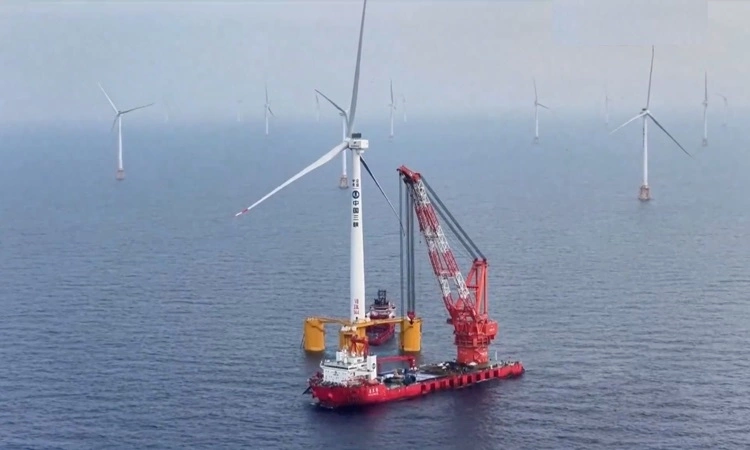
China Three Gorges Corporation (CTG) announced that it has installed the 16-megawatt (MW) floating wind turbine system called Three Gorges Pilot in deep waters near Yangjiang City, Guangdong Province. Mounted on a semi-submersible platform, the turbine features a rotor with a diameter of 252 meters, with the blade tips rising more than 270 meters above the sea surface. CTG’s new design follows the turbine model deployed last year by China Huaneng Group and Dongfang Electric Corporation, with the main improvements lying in the engineering level of the structure and system.
The turbine’s semi-submersible platform was designed to withstand harsh deep-sea conditions, including waves exceeding 20 meters in height and wind speeds of up to 264 km/h, equivalent to a Category 5 typhoon. It uses a complex mooring system combining suction anchors, anchor chains, and high-strength polyester cables, together with ballast and monitoring systems to keep the platform operating stably and prevent unintended drifting. The design also includes several features that help absorb and distribute the forces of wind and water, thereby increasing durability and extending the platform’s operational lifespan.
CTG engineers integrated a 66-kilovolt submarine cable into the turbine. This is a specialized underwater power cable used to transmit high voltage while moving and bending together with the rest of the semi-submersible platform. With a wave-shaped design, the cable is manufactured with ultra-flexible conductors and reinforced sheathing to improve tensile strength, insulation capability, and fatigue resistance.
According to Interesting Engineering, the turbine was fully assembled at Tieshan Port in Beihai, Guangxi Zhuang Autonomous Region. It was then towed across a long distance through the Qiongzhou Strait to its final location near Yangjiang. Once operational, the turbine is expected to generate around 44.65 million kilowatt-hours of electricity annually, enough to supply approximately 24,000 households.
According to Offshore Wind Industry, floating offshore wind turbines in Europe commonly operate at capacities of 8–10 MW per unit. The most powerful floating turbine currently in operation is the 10 MW Vestas turbine mounted on a floating platform in the Éoliennes Flottantes du Golfe du Lion (EFGL) project in France. Other projects include Hywind Tampen in Norway, with a capacity of around 8.6 MW per turbine, and WindFloat Atlantic in Portugal, with 8.4 MW units.
Floating wind turbines typically operate in water depths that are not feasible for conventional offshore wind farms, which require fixed foundations anchored to the seabed. Because they are mounted on massive floating platforms that can be moored in place, these turbines significantly expand the ocean areas available for wind energy exploitation.
Floating wind turbines pose numerous engineering challenges because they must withstand continuous movement from waves and currents without reducing transmission efficiency, while also surviving harsh marine weather conditions throughout their long operational lifespan.
CTG’s breakthrough has attracted attention not only because of its capacity, but also because of the technical challenges the engineers successfully addressed, such as large rotor loads, semi-submersible platform stability, dynamic mooring systems, and offshore grid connection. The project demonstrates China’s growing focus on developing large-scale offshore wind farms, particularly in deep-water regions. Solutions such as the Three Gorges Pilot help expand renewable energy beyond coastal areas and reduce dependence on fossil fuels.
Source: https://vnexpress.net/turbine-gio-noi-lon-nhat-the-gioi-5076598.html
WORD BANK:
announce /əˈnaʊns/ [B1] (v): công bố
floating wind turbine /ˈfloʊ.t̬ɪŋ wɪnd ˈtɝː.baɪn/ (n): tua-bin gió nổi
mounted on sth /ˈmaʊn.t̬ɪd ɑːn/ (adj): được lắp trên cái gì
semi-submersible platform /ˌsem.i səbˈmɝː.sə.bəl ˈplæt.fɔːrm/ (n): giàn bán chìm
feature /ˈfiː.tʃɚ/ [B1] (v): có đặc điểm
rotor /ˈroʊ.t̬ɚ/ (n): rô-to
diameter /daɪˈæm.ə.t̬ɚ/ [B2] (n): đường kính
blade /bleɪd/ (n): cánh quạt
blade tip /bleɪd tɪp/ (n): đầu cánh quạt
deploy sth /dɪˈplɔɪ/ [B2] (v): triển khai cái gì
engineering /ˌen.dʒəˈnɪr.ɪŋ/ [B2] (n): kỹ thuật
withstand sth /wɪðˈstænd/ [C1] (v): chịu đựng cái gì
exceed sth /ɪkˈsiːd/ [B2] (v): vượt quá cái gì
equivalent to sth /ɪˈkwɪv.ə.lənt tə/ [B2] (adj): tương đương với cái gì
moor /mʊr/ (v): neo đậu
mooring system /ˈmʊr.ɪŋ ˈsɪs.təm/ (n): hệ thống neo đậu
suction /ˈsʌk.ʃən/ (n): lực hút
anchor /ˈæŋ.kɚ/ (n): mỏ neo
anchor chain /ˈæŋ.kɚ tʃeɪn/ (n): dây xích neo
high-strength /ˌhaɪˈstreŋkθ/ (adj): có độ bền cao
ballast /ˈbæl.əst/ (n): vật dằn
drifting /ˈdrɪf.tɪŋ/ (n): sự trôi dạt
absorb sth /əbˈzɔːrb/ [B2] (v): hấp thụ cái gì
distribute /dɪˈstrɪb.juːt/ [B2] (v): phân bố
durability /ˌdʊr.əˈbɪl.ə.t̬i/ (n): độ bền
operational lifespan /ˌɑː.pəˈreɪ.ʃən.əl ˈlaɪf.spæn/ (n): tuổi thọ vận hành
integrate sth into sth /ˈɪn.t̬ə.ɡreɪt ˌɪn.t̬uː/ [B2] (v): tích hợp cái gì vào cái gì
submarine cable /ˌsʌb.məˈriːn ˈkeɪ.bəl/ (n): cáp ngầm dưới biển
transmit sth /trænzˈmɪt/ [B2] (v): truyền tải cái gì
bending /ˈben.dɪŋ/ (n): sự uốn cong
ultra-flexible /ˌʌl.trəˈflek.sə.bəl/ (adj): siêu linh hoạt
conductor /kənˈdʌk.t̬ɚ/ (n): dây dẫn
sheathing /ˈʃiː.ðɪŋ/ (n): lớp vỏ bọc
tensile strength /ˈten.saɪl streŋkθ/ (n): độ bền kéo
insulation /ˌɪn.səˈleɪ.ʃən/ (n): lớp cách điện
fatigue resistance /fəˈtiːɡ rɪˈzɪs.təns/ (n): khả năng chống mỏi
assemble /əˈsem.bəl/ [B2] (v): lắp ráp
autonomous region /ɔːˈtɑː.nə.məs ˈriː.dʒən/ (n): khu tự trị
tow /toʊ/ (v): kéo
across sth /əˈkrɑːs/ (pre): băng qua cái gì
strait /streɪt/ (n): eo biển
water depth /ˈwɔː.t̬ɚ depθ/ (n): độ sâu mực nước
feasible /ˈfiː.zə.bəl/ [C1] (adj): khả thi
conventional /kənˈven.ʃə.nəl/ [B2] (adj): truyền thống
seabed /ˈsiː.bed/ (n): đáy biển
in place /ɪn pleɪs/ (adv): tại chỗ
pose a challenge /poʊz ə ˈtʃæl.ɪndʒ/ (v): đặt ra thách thức
breakthrough /ˈbreɪk.θruː/ (n): bước đột phá
address sth /əˈdres/ [B2] (v): giải quyết cái gì
dynamic /daɪˈnæm.ɪk/ [B2] (adj): động
grid /ɡrɪd/ (n): lưới điện
ỦNG HỘ READ TO LEAD!
Chào bạn! Có thể bạn chưa biết, Read to Lead là một trang giáo dục phi lợi nhuận với mục đích góp phần phát triển cộng đồng người học tiếng Anh tại Việt Nam. Chúng tôi không yêu cầu người đọc phải trả bất kỳ chi phí nào để sử dụng các sản phẩm của mình để mọi người đều có cơ hội học tập tốt hơn. Tuy nhiên, nếu bạn có thể, chúng tôi mong nhận được sự hỗ trợ tài chính từ bạn để duy trì hoạt động của trang và phát triển các sản phẩm mới.
Bạn có thể ủng hộ chúng tôi qua 1 trong 2 cách dưới đây.
– Cách 1: Chuyển tiền qua tài khoản Momo.
Số điện thoại 0947.886.865 (Chủ tài khoản: Nguyễn Tiến Trung)
Nội dung chuyển tiền: Ủng hộ Read to Lead
hoặc
– Cách 2: Chuyển tiền qua tài khoản ngân hàng.
Ngân hàng VIB chi nhánh Hải Phòng
Số tài khoản: 012704060048394 (Chủ tài khoản: Nguyễn Tiến Trung)
Nội dung chuyển tiền: Ủng hộ Read to Lead
Lớp luyện thi IELTS online
Bạn đang có nhu cầu thi chứng chỉ IELTS cho đầu vào đại học, đi du học, xin việc hay xin cư trú và đang phân vân chưa biết học ở đâu?
Nếu bạn đang tìm kiếm dịch vụ luyện thi IELTS online với giáo viên uy tín và chất lượng, cũng như học phí phải chăng, thì thầy Trung và Cô Thủy (Admin và dịch giả chính của Read to Lead) có thể là một lựa chọn phù hợp dành cho bạn.
Hãy liên hệ (nhắn tin) tới trang Facebook cá nhân của mình (https://www.facebook.com/nguyen.trung.509) để tìm hiểu về lớp học và được tư vấn cũng như được học thử nha!


