


[Reading level: B2 – Upper Intermediate]
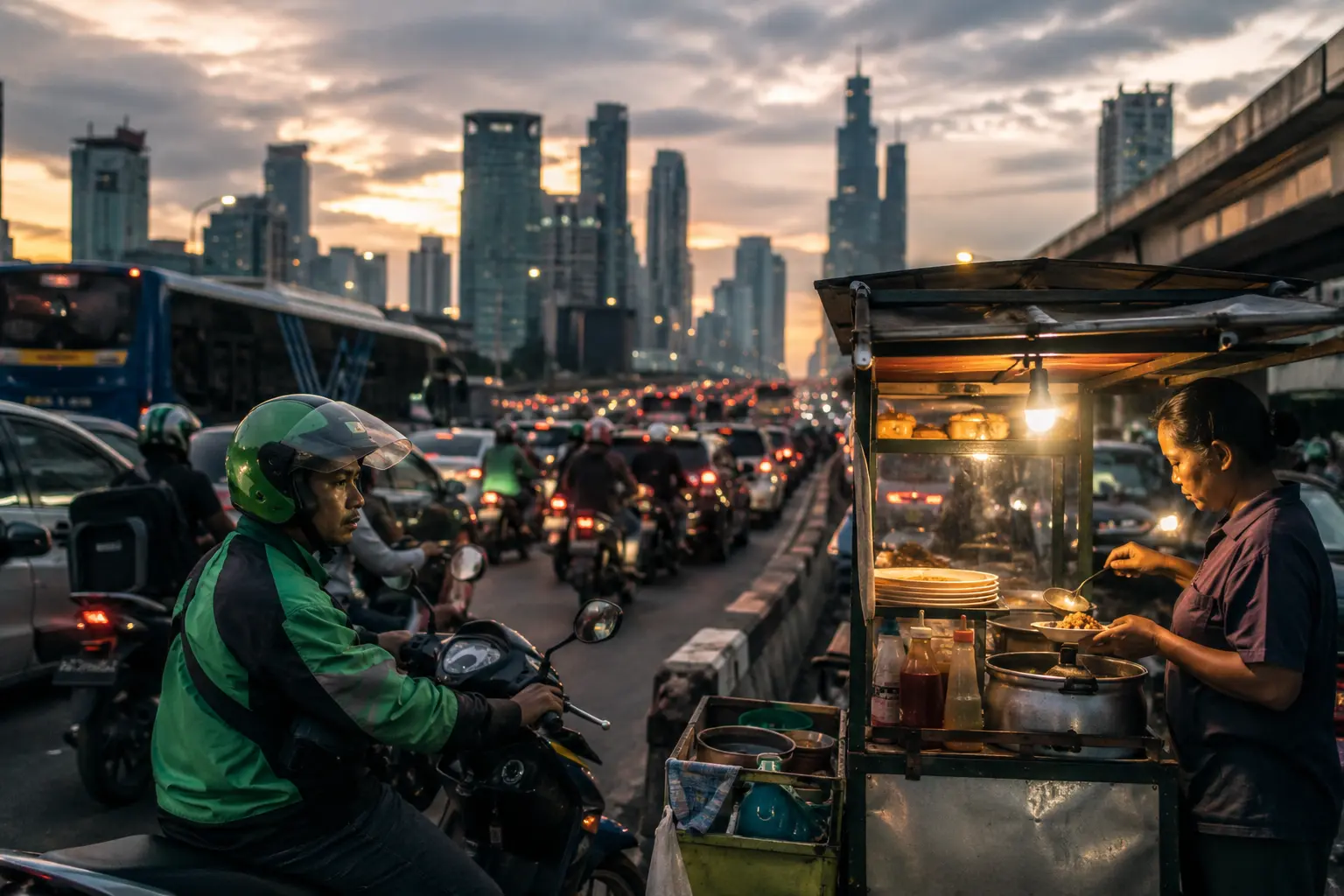
In front of modern glass skyscrapers and bustling financial districts, many people still live beneath bridges or struggle to make a living amid pollution and constantly congested roads. This stark contrast has become one of Jakarta’s defining features—a megacity where tens of millions of people work tirelessly every day in pursuit of a better life.
In December 2025, the United Nations recognized Jakarta, Indonesia, as the world’s largest city, with a population of around 42 million. One of the city’s most familiar sights is the more than one million ride-hailing motorcycle drivers in their bright green jackets weaving through the streets.
Like tens of millions of other Muslims in Indonesia, 48-year-old Dicky Rio Suprapto begins his day at 4 a.m. with morning prayers. After taking his two children to school, he spends about 12 hours working in one of the most traffic-congested cities in the world.
Although he was trained as an engineer, Suprapto lost his job in 2017. Following the COVID-19 pandemic, he became a ride-hailing driver. In addition to transporting passengers, he also delivers food and parcels across Jakarta.
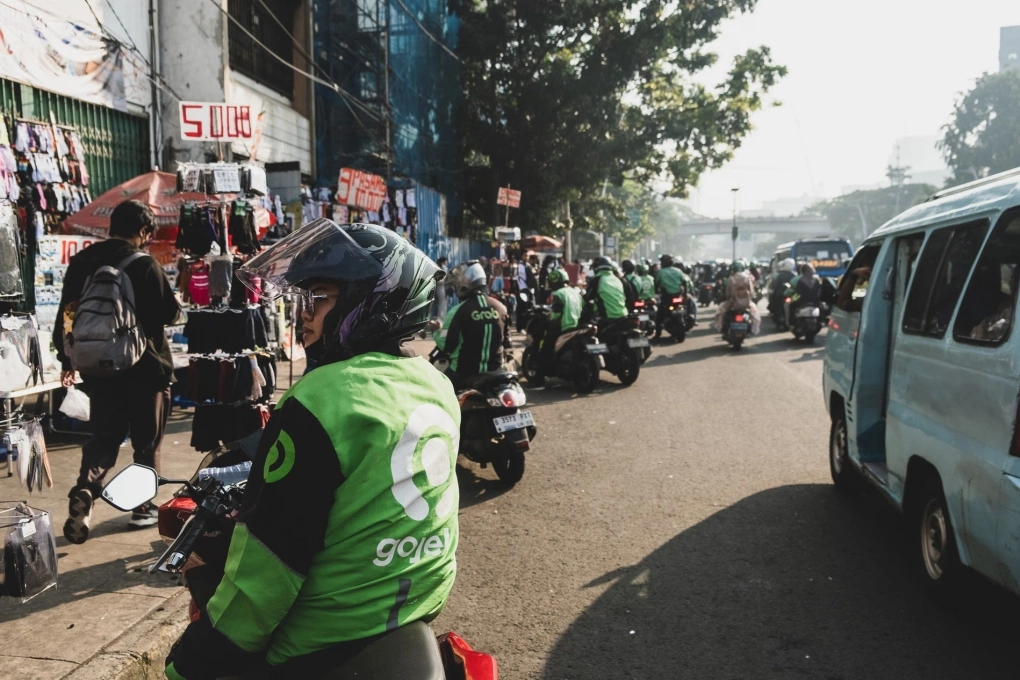
To cope with the city’s endless traffic jams, Suprapto does not rely entirely on digital maps. Instead, he depends on decades of experience navigating Jakarta’s maze-like road network.
“I’ve memorized all the roads, so I can choose faster routes,” he says. “My passengers use our service to get to work and earn a living. That’s why it’s my responsibility to help them reach their destinations as quickly as possible.”
Despite having to deal with pollution, heavy traffic, and long working hours every day, he always maintains a positive attitude. Because his eyesight is poor after dark, he usually stops working at sunset. Earning around 400,000 to 500,000 rupiah (about US$23–29) a day, he says the income is enough to support his family as long as they live simply.
Meanwhile, 22-year-old Dhewa Radya represents Jakarta’s younger, well-educated workforce employed in the city’s rapidly growing artificial intelligence sector. He rents a room in West Jakarta for about 1.6 million rupiah (US$92) a month and chooses to walk to work every day to avoid the traffic.
However, air pollution is impossible to escape. After living in Jakarta for one year, a medical check-up revealed spots on his lungs typically found in passive smokers. Although he admits Jakarta is not his favorite city, he still considers it the best place to begin his career because of the abundant job opportunities.
“In Jakarta, you can find everything, so it’s really a great place to start your career,” he says.
Originally from Central Java, Radya is one of millions of people who move to Jakarta every year in search of better opportunities. He considers himself fortunate to have found a job, especially at a time when Indonesia’s youth unemployment rate has reached 17%, including many university graduates.
In the long run, he hopes to work abroad before eventually returning home. “I hope I can come back to Indonesia with a better job and a better quality of life,” he says.
In the central Kuningan district, 45-year-old Neneng Muslimah runs a traditional riverside food stall that mainly serves office workers during lunchtime.
The river in front of her stall highlights Jakarta’s growing contrasts. On one side stand crowded residential neighborhoods, while on the other rise five-star hotels and towering glass office buildings.
Her stall opens at 5 a.m., with lunchtime being the busiest period. The menu features fried chicken served with spicy sambal, rice, vegetables, and egg dishes, with prices starting from just 10,000 rupiah (US$0.60). “At around noon, we serve about 100 meals,” she says.
What makes the stall unique is its pulley delivery system across the river. Customers can either shout their orders from the opposite bank or place them through WhatsApp before paying by scanning a QR code attached to the delivery basket.
“We prefer customers to use WhatsApp. If they just shout across the river, we sometimes misunderstand the order. They might ask for coffee, but we end up delivering a cold drink instead,” she says.
Although she has to cope with rising living costs, the constant threat of flooding caused by the city’s land subsidence, and increasingly heavy rainfall, Neneng still believes Jakarta has its own unique charm.
“People from other places only know Jakarta for its traffic jams, dust, and pollution. But once you actually live here and experience it, you’ll find it a pleasant place. The people here are very friendly and always willing to help one another,” she says.
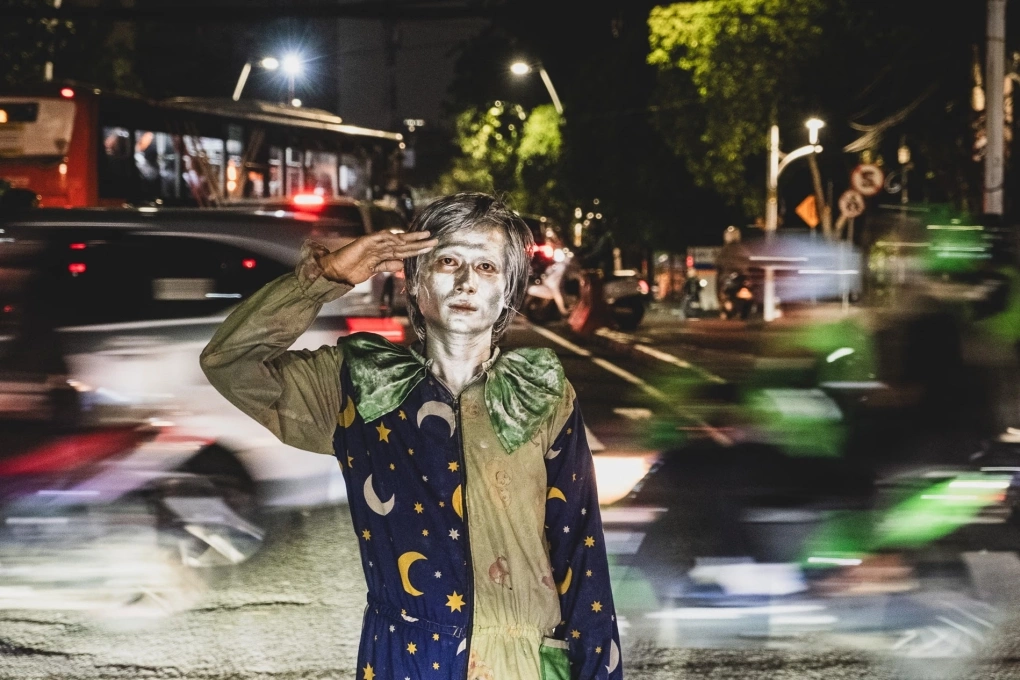
As rush hour begins, traffic once again fills the city’s streets. At a busy intersection near Jakarta’s National Monument (Monas), 28-year-old street performer Faqih Ibnu Ali paints his entire body silver before stepping into the traffic to perform. He is one of millions of informal workers trying to earn a living on Jakarta’s streets.
On a good day, Ali can earn about 200,000 rupiah (US$11). He works in the morning, takes a short break during the day, then resumes performing from the afternoon until late at night, sometimes even until midnight.
Ali was once a fisherman. However, a fire destroyed his boat, leaving him with nothing. Today, he lives beneath a bridge with his wife and children. Years earlier, the family also suffered the loss of their son in a traffic accident.
Ali says he often feels judged by others and left behind in the world’s largest city. “Even when people look at me, they only look at me with half an eye,” he says.
Even so, he refuses to give up. For Ali, every effort he makes is for the sake of his family and children. “We must never lose hope or give up. Everything we do is for our family,” he says.
Source: The Guardian
WORD BANK:
bustling /ˈbʌs.lɪŋ/ [B2] (adj): nhộn nhịp
struggle to do sth /ˈstrʌɡ.əl/ [B2] (v): chật vật để làm gì
make a living /ˌmeɪk ə ˈlɪv.ɪŋ/ [B2] (v): kiếm sống
amid sth /əˈmɪd/ [C1] (pre): giữa, giữa bối cảnh của cái gì
congested /kənˈdʒes.tɪd/ [C1] (adj): đông đúc, tắc nghẽn
stark contrast /ˌstɑːrk ˈkɑːn.træst/ (n): sự tương phản rõ rệt
defining /dɪˈfaɪ.nɪŋ/ [B2] (adj): đặc trưng
in pursuit of sth /ɪn pɚˈsuːt əv/ [C1] (pre): để theo đuổi cái gì
ride-hailing driver /ˈraɪd ˌheɪ.lɪŋ ˈdraɪ.vɚ/ (n): tài xế xe công nghệ
ride-hailing motorcycle driver /ˈraɪd ˌheɪ.lɪŋ ˈmoʊ.t̬ɚˌsaɪ.kəl ˈdraɪ.vɚ/ (n): tài xế xe ôm công nghệ
weave through /wiːv θruː/ [C1] (v): len lỏi qua
Muslim /ˈmʌz.lɪm/ [B1] (n): người Hồi giáo
prayer /prer/ [B1] (n): lời cầu nguyện
pandemic /pænˈdem.ɪk/ [B2] (n): đại dịch
parcel /ˈpɑːr.səl/ [B1] (n): bưu kiện
endless /ˈend.ləs/ [B2] (adj): bất tận, vô tận
navigate sth /ˈnæv.ə.ɡeɪt/ [B2] (v): di chuyển, xoay xở qua (giao thông)
maze-like /ˈmeɪz ˌlaɪk/ (adj): như mê cung
attitude /ˈæt̬.ə.tuːd/ [B1] (n): thái độ
well-educated /ˌwel ˈedʒ.ə.keɪ.t̬ɪd/ [B2] (adj): được giáo dục tốt
artificial intelligence /ˌɑːr.t̬əˈfɪʃ.əl ɪnˈtel.ə.dʒəns/ [B2] (n): trí tuệ nhân tạo
medical check-up /ˈmed.ɪ.kəl ˈtʃek.ʌp/ [B1] (n): kiểm tra sức khỏe
reveal sth /rɪˈviːl/ [B2] (v): tiết lộ, cho thấy cái gì
passive smoker /ˌpæs.ɪv ˈsmoʊ.kɚ/ (n): người hút thuốc thụ động
abundant /əˈbʌn.dənt/ [C1] (adj): dồi dào, phong phú
fortunate /ˈfɔːr.tʃə.nət/ [B2] (adj): may mắn
in the long run /ɪn ðə ˈlɔːŋ rʌn/ [B2] (idiom): về lâu dài
food stall /ˈfuːd stɑːl/ (n): quầy bán đồ ăn
towering /ˈtaʊ.ɚ.ɪŋ/ [C1] (adj): cao sừng sững
feature sth /ˈfiː.tʃɚ/ [B2] (v): có, nổi bật với cái gì
pulley /ˈpʊl.i/ (n): ròng rọc
shout /ʃaʊt/ [B1] (v): hét lên
bank /bæŋk/ [B1] (n): bờ sông
end up doing sth /ˌend ˈʌp/ [B1] (v): cuối cùng lại làm gì
threat /θret/ [B2] (n): mối đe dọa
land subsidence /ˈlænd səbˈsaɪ.dəns/ (n): tình trạng sụt lún đất
charm /tʃɑːrm/ [B2] (n): sức hấp dẫn
dust /dʌst/ [B1] (n): bụi
rush hour /ˈrʌʃ ˌaʊ.ɚ/ [B1] (n): giờ cao điểm
informal worker /ɪnˈfɔːr.məl ˈwɝː.kɚ/ (n): lao động phi chính thức
resume sth /rɪˈzuːm/ [B2] (v): tiếp tục lại cái gì
judge /dʒʌdʒ/ [B1] (v): đánh giá
for the sake of sb/sth /ˈseɪk/ [B2] (pre): vì lợi ích của ai/cái gì
ỦNG HỘ READ TO LEAD!
Chào bạn! Có thể bạn chưa biết, Read to Lead là một trang giáo dục phi lợi nhuận với mục đích góp phần phát triển cộng đồng người học tiếng Anh tại Việt Nam. Chúng tôi không yêu cầu người đọc phải trả bất kỳ chi phí nào để sử dụng các sản phẩm của mình để mọi người đều có cơ hội học tập tốt hơn. Tuy nhiên, nếu bạn có thể, chúng tôi mong nhận được sự hỗ trợ tài chính từ bạn để duy trì hoạt động của trang và phát triển các sản phẩm mới.
Bạn có thể ủng hộ chúng tôi qua 1 trong 2 cách dưới đây.
– Cách 1: Chuyển tiền qua tài khoản Momo.
Số điện thoại 0947.886.865 (Chủ tài khoản: Nguyễn Tiến Trung)
Nội dung chuyển tiền: Ủng hộ Read to Lead
hoặc
– Cách 2: Chuyển tiền qua tài khoản ngân hàng.
Ngân hàng VIB chi nhánh Hải Phòng
Số tài khoản: 012704060048394 (Chủ tài khoản: Nguyễn Tiến Trung)
Nội dung chuyển tiền: Ủng hộ Read to Lead
Lớp luyện thi IELTS online
Bạn đang có nhu cầu thi chứng chỉ IELTS cho đầu vào đại học, đi du học, xin việc hay xin cư trú và đang phân vân chưa biết học ở đâu?
Nếu bạn đang tìm kiếm dịch vụ luyện thi IELTS online với giáo viên uy tín và chất lượng, cũng như học phí phải chăng, thì thầy Trung và Cô Thủy (Admin và dịch giả chính của Read to Lead) có thể là một lựa chọn phù hợp dành cho bạn.
Hãy liên hệ (nhắn tin) tới trang Facebook cá nhân của mình (https://www.facebook.com/nguyen.trung.509) để tìm hiểu về lớp học và được tư vấn cũng như được học thử nha!


