



[Reading level: B2 – Upper Intermediate]
When you were a child, watching geckos scurry across walls or even hang upside down from ceilings, you may have wondered: Why don’t they fall to the ground? Could there be some special kind of glue under their feet, or tiny suction cups like those of an octopus?
It turns out that the secret lies neither in glue nor in suction cups, but in a physical phenomenon rooted in the quantum world, known as the van der Waals force.
To understand this, let’s first take a look at the structure of their feet.
Under a gecko’s toes are millions of extremely tiny hairs called setae. In the Tokay gecko, scientists estimate that there are around 6.5 million of these hairs. What makes them particularly remarkable is that each hair branches into hundreds of even smaller contact tips, measuring just nanometers in size.
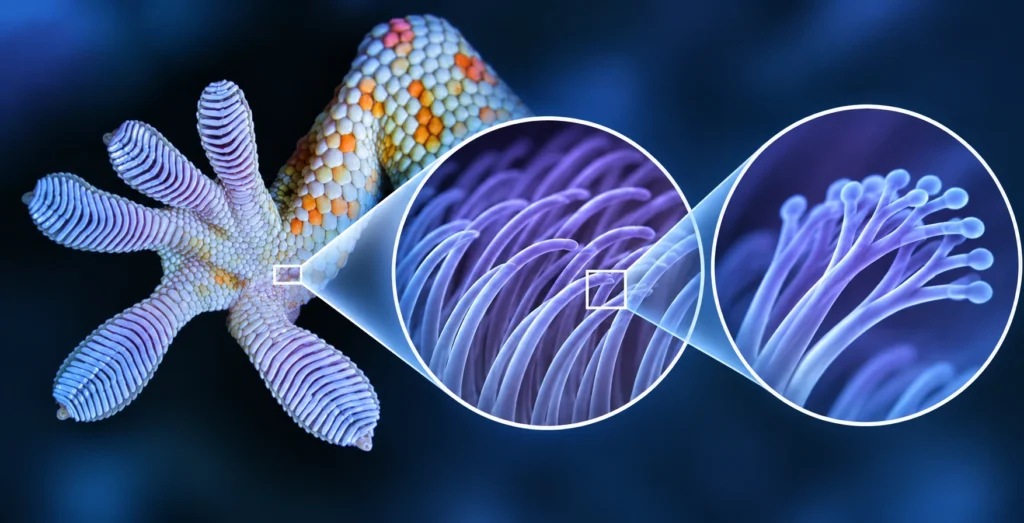
Thanks to this structure, when a gecko places its foot against a wall, countless microscopic contact tips can come extremely close to the surface, bringing them within a tiny distance of the molecules that make up the wall.
And this is precisely where the van der Waals force comes into play.
As we know, all matter is made up of atoms and molecules. Inside atoms, electrons are not stationary but exist in states of quantum motion and fluctuation. Their distribution of electric charge can fluctuate, creating temporary electric dipoles. These dipoles, in turn, influence nearby atoms and molecules, causing attractive forces to arise between them.
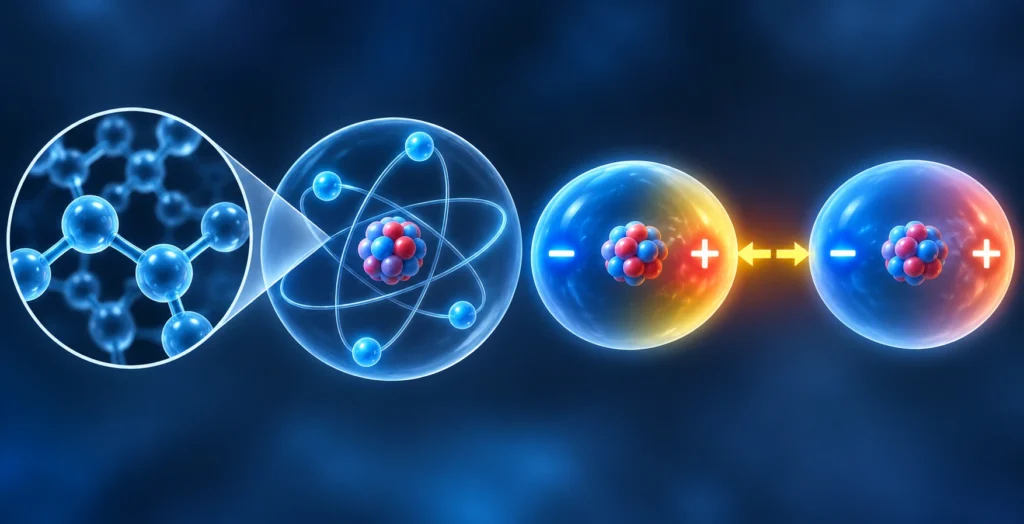
An important component of this interaction is known as the London dispersion force, which was explained by physicist Fritz London in 1930.
Between any individual pair of atoms or molecules, this attractive force is extremely weak. But imagine billions of microscopic contact points under a gecko’s feet pressing closely against the surface of a wall. When countless weak attractive forces act together, they produce enough adhesion to support the animal’s entire body, even when it is hanging upside down from a ceiling.
In 2000, a research team led by scientist Kellar Autumn published a remarkable finding in the journal Nature: a single microscopic hair on a gecko’s foot can generate an adhesive force of up to approximately 200 micronewtons under suitable experimental conditions.
This figure may sound insignificant, but if all 6.5 million hairs could exert their maximum adhesive force simultaneously, the total force could theoretically be equivalent to the weight of an object weighing around 130 kilograms. Of course, in reality, not all the hairs make contact or generate their maximum force at the same time.
Another interesting question is: If their feet can stick so firmly, how can geckos lift them so easily to move around?
The secret lies in how they adjust the contact angles of their tiny hairs. When a gecko needs to grip a surface, it positions these microscopic structures at the appropriate angle to generate adhesion. When it wants to lift its foot, it changes the angle and gradually detaches the contact tips from the surface, much like the way we peel a piece of adhesive tape off from one edge rather than pulling the entire piece away at once.
Thanks to this mechanism, geckos can repeatedly attach and detach their feet at remarkable speed, moving effortlessly across vertical walls or smooth ceilings without using too much energy.
So, while humans have only begun to understand the quantum foundations of these interactions over approximately the past century, nature has been exploiting them for millions of years.
WORD BANK:
gecko /ˈɡek.oʊ/ (n): tắc kè, thạch sùng
scurry /ˈskɝː.i/ (v): chạy nhanh, chạy thoăn thoắt
upside down /ˌʌp.saɪd ˈdaʊn/ (adv): lộn ngược, treo ngược
ceiling /ˈsiː.lɪŋ/ (n): trần nhà
glue /ɡluː/ (n): keo dán
suction cup /ˈsʌk.ʃən ˌkʌp/ (n): giác hút
octopus /ˈɑːk.tə.pəs/ (n): bạch tuộc
phenomenon /fəˈnɑː.mə.nɑːn/ [B2] (n): hiện tượng
rooted in sth /ˈruː.t̬ɪd/ (adj): bắt nguồn từ, có nguồn gốc từ cái gì
the quantum world /ˈkwɑːn.t̬əm wɝːld/ (n): thế giới lượng tử
branch into sth /bræntʃ/ (phr v): phân nhánh thành cái gì
contact tip /ˈkɑːn.tækt tɪp/ (n): đầu tiếp xúc
nanometer /ˈnæn.oʊˌmiː.t̬ɚ/ (n): nanomet (một phần tỷ mét)
countless /ˈkaʊnt.ləs/ [C1] (adj): vô số, không đếm xuể
microscopic /ˌmaɪ.krəˈskɑː.pɪk/ (adj): cực nhỏ, chỉ nhìn thấy qua kính hiển vi
molecule /ˈmɑː.lə.kjuːl/ (n): phân tử
precisely /prɪˈsaɪs.li/ [B2] (adv): chính xác, đúng là
matter /ˈmæt̬.ɚ/ (n): vật chất
atom /ˈæt̬.əm/ (n): nguyên tử
stationary /ˈsteɪ.ʃə.ner.i/ (adj): đứng yên, không chuyển động
motion /ˈmoʊ.ʃən/ [B2] (n): sự chuyển động
fluctuation /ˌflʌk.tʃuˈeɪ.ʃən/ (n): sự dao động, biến động
distribution /ˌdɪs.trəˈbjuː.ʃən/ [B2] (n): sự phân bố, phân phối
electric charge /ɪˈlek.trɪk tʃɑːrdʒ/ (n): điện tích
temporary /ˈtem.pə.rer.i/ [B2] (adj): tạm thời, nhất thời
electric dipole /ɪˈlek.trɪk ˈdaɪ.poʊl/ (n): lưỡng cực điện
attractive force /əˈtræk.tɪv fɔːrs/ (n): lực hút
component /kəmˈpoʊ.nənt/ [B2] (n): thành phần
dispersion force /dɪˈspɝː.ʒən fɔːrs/ (n): lực phân tán
physicist /ˈfɪz.ɪ.sɪst/ (n): nhà vật lý học
press closely against sth /pres ˈkloʊs.li/ (v): áp sát, ép chặt vào cái gì
adhesion /ədˈhiː.ʒən/ (n): sự bám dính, lực bám dính
micronewton /ˌmaɪ.kroʊˈnuː.tən/ (n): micronewton (một phần triệu newton)
experimental condition /ɪkˌsper.əˈmen.təl kənˈdɪʃ.ən/ (n): điều kiện thí nghiệm
exert a force /ɪɡˈzɝːt/ [B2] (v): tác dụng một lực
simultaneously /ˌsaɪ.məlˈteɪ.ni.əs.li/ [C1] (adv): đồng thời, cùng một lúc
equivalent to sth /ɪˈkwɪv.əl.ənt/ [B2] (adj): tương đương với cái gì
grip sth /ɡrɪp/ [C1] (v): bám chặt, nắm chặt cái gì
angle /ˈæŋ.ɡəl/ (n): góc, góc độ
detach /dɪˈtætʃ/ (v): tách ra, tháo rời
peel sth off /piːl/ (phr v): bóc, lột cái gì ra khỏi bề mặt
adhesive tape /ədˈhiː.sɪv teɪp/ (n): băng dính
edge /edʒ/ (n): mép, cạnh
at once /ət ˈwʌns/ (adv): cùng một lúc, ngay lập tức
mechanism /ˈmek.ə.nɪ.zəm/ [C1] (n): cơ chế
effortlessly /ˈef.ɚt.ləs.li/ (adv): một cách dễ dàng, không tốn nhiều sức
ỦNG HỘ READ TO LEAD!
Chào bạn! Có thể bạn chưa biết, Read to Lead là một trang giáo dục phi lợi nhuận với mục đích góp phần phát triển cộng đồng người học tiếng Anh tại Việt Nam. Chúng tôi không yêu cầu người đọc phải trả bất kỳ chi phí nào để sử dụng các sản phẩm của mình để mọi người đều có cơ hội học tập tốt hơn. Tuy nhiên, nếu bạn có thể, chúng tôi mong nhận được sự hỗ trợ tài chính từ bạn để duy trì hoạt động của trang và phát triển các sản phẩm mới.
Bạn có thể ủng hộ chúng tôi qua 1 trong 2 cách dưới đây.
– Cách 1: Chuyển tiền qua tài khoản Momo.
Số điện thoại 0947.886.865 (Chủ tài khoản: Nguyễn Tiến Trung)
Nội dung chuyển tiền: Ủng hộ Read to Lead
hoặc
– Cách 2: Chuyển tiền qua tài khoản ngân hàng.
Ngân hàng VIB chi nhánh Hải Phòng
Số tài khoản: 012704060048394 (Chủ tài khoản: Nguyễn Tiến Trung)
Nội dung chuyển tiền: Ủng hộ Read to Lead
Lớp luyện thi IELTS online
Bạn đang có nhu cầu thi chứng chỉ IELTS cho đầu vào đại học, đi du học, xin việc hay xin cư trú và đang phân vân chưa biết học ở đâu?
Nếu bạn đang tìm kiếm dịch vụ luyện thi IELTS online với giáo viên uy tín và chất lượng, cũng như học phí phải chăng, thì lớp học online của thầy Trung (Admin và dịch giả chính của Read to Lead) có thể là một lựa chọn phù hợp dành cho bạn.
Hãy liên hệ (nhắn tin) tới trang Facebook cá nhân của mình (https://www.facebook.com/nguyen.trung.509) để tìm hiểu về lớp học và được tư vấn cũng như được học thử nha!


