


[Reading level: B2 – Upper Intermediate]
Have you ever visited a Buddhist temple and noticed a rather unusual detail on statues of the Buddha? His head is often covered with hundreds of small, perfectly arranged curls that look remarkably like snail shells. This is not only a familiar feature in Buddhist art but is also associated with a fascinating legend that has been passed down for generations.
According to the legend, after leaving behind his royal life to follow a spiritual path, Prince Siddhartha cut off his hair as a symbol of renouncing worldly life. One day, while he was meditating under the scorching sun, a snail happened to crawl past and noticed the intense heat beating down directly on his head. It crawled onto his head and used its cool, moist body to protect part of his scalp from the sun.
Then another snail appeared, followed by another. According to one popular version of the legend, eventually as many as 108 snails crawled onto the Buddha’s head and completely covered it, forming a living “cap” that allowed him to continue meditating without being disturbed by the heat. The snails later died from exposure to the scorching sun. They are therefore remembered in the story as tiny creatures that sacrificed themselves to protect the Buddha. The shell-like curls seen on Buddha statues later came to be associated with this legend.
However, the story of the 108 snails is only a legend, not a historical explanation for the Buddha’s distinctive hair.
To understand the actual origins of these unusual curls, we need to go back to the first centuries CE, when human representations of the Buddha began to develop significantly in two important artistic centers: Gandhara and Mathura.
Gandhara was an ancient region located mainly in what is now Pakistan and Afghanistan. Having been strongly influenced by Hellenistic culture, its art displayed many characteristics reminiscent of Greek and Roman sculpture. Early Gandharan Buddha statues often featured relatively naturalistic faces, robes with deep folds, and, most notably, thick, wavy hair, sometimes gathered into a topknot.

At the same time, Mathura in northern India also became an important center in the development of the Buddha image. Over the centuries, the way the Buddha’s hair was represented continued to change and become increasingly stylized. Natural-looking locks gradually evolved into small, regular curls covering the head. In some later traditions of Buddhist art, these curls eventually came to look very much like the snail shells we commonly see on Buddha statues today.
On top of the Buddha’s head is also a raised feature known as the uṣṇīṣa (ushnisha). In Buddhist art, this is one of the Buddha’s distinctive physical features and gradually became a symbol associated with his wisdom and enlightenment. Therefore, this raised area should not simply be understood as an ordinary topknot.
The spiral curls themselves are also connected with a feature found in the traditional description of the 32 Marks of a Great Man. In early Buddhist texts, the hair of such a person is described as growing upward and curling to the right. Such symbolic descriptions also helped shape the way artists represented the Buddha’s hair throughout different periods.
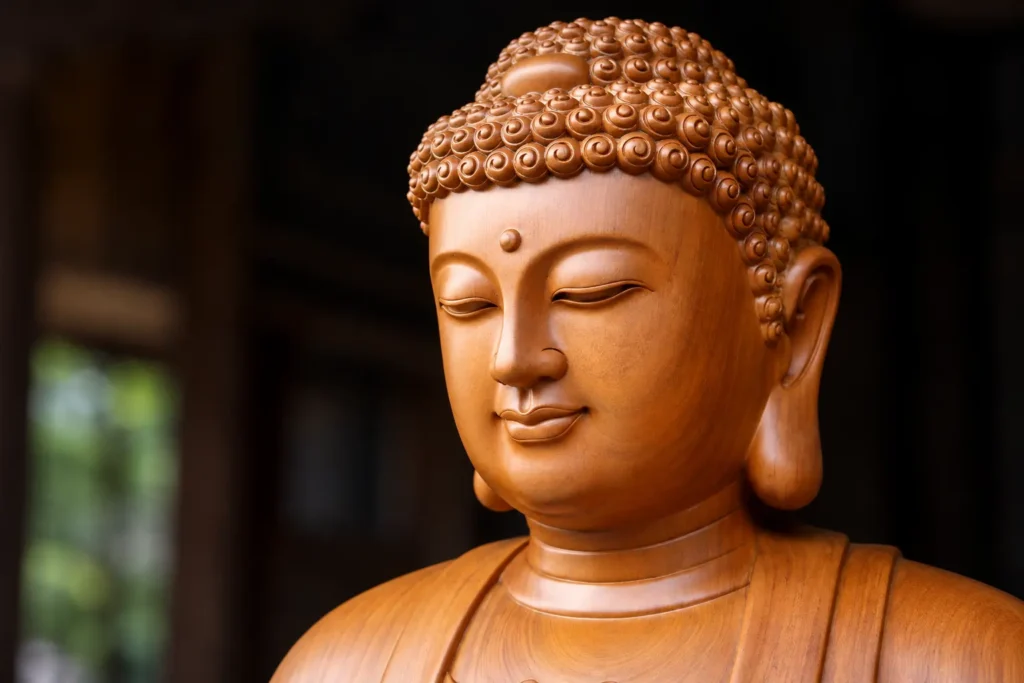
The number 108 in the story of the snails is not an arbitrary number either. It carries important significance in many Buddhist traditions and appears in various systems of Buddhist teachings, including classifications involving 108 forms of craving or mental defilements. However, there is no reliable historical evidence that artists deliberately created exactly 108 curls on Buddha statues to represent 108 snails. This connection should be understood as part of the legend rather than as a rule of Buddhist art.
The curls on the Buddha’s head can therefore be viewed in two very different ways. From the perspective of art history, they are the result of a centuries-long process in which representations of the Buddha developed and became increasingly stylized under the influence of different artistic centers and cultures.
In legend, however, those same curls became traces of 108 tiny creatures that sacrificed themselves to protect someone on his journey toward enlightenment. The story seems to convey a simple message: behind great achievements sometimes lie the quiet contributions and sacrifices.
WORD BANK:
Buddhist temple /ˈbʊd.ɪst ˈtem.pəl/ (n): chùa, ngôi chùa Phật giáo
Buddha /ˈbuː.də/ (n): Đức Phật
statue /ˈstætʃ.uː/ [B1] (n): tượng
perfectly arranged /ˈpɝː.fɪkt.li əˈreɪndʒd/ (adj): được sắp xếp hoàn hảo, đều tăm tắp
curl /kɝːl/ (n): lọn tóc xoăn
curl /kɝːl/ (v): xoăn, uốn cong, cuộn lại
associated with sth /əˈsoʊ.si.eɪ.t̬ɪd/ [B2] (adj): gắn liền với, có liên quan đến cái gì
legend /ˈledʒ.ənd/ [B2] (n): truyền thuyết
pass down /pæs daʊn/ (phr v): truyền lại từ thế hệ này sang thế hệ khác
spiritual path /ˈspɪr.ɪ.tʃu.əl pæθ/ (n): con đường tâm linh, con đường tu tập
renounce sth /rɪˈnaʊns/ [C2] (v): từ bỏ cái gì
worldly life /ˈwɝːld.li laɪf/ (n): cuộc sống thế tục
meditate /ˈmed.ə.teɪt/ (v): thiền, ngồi thiền
scorching /ˈskɔːr.tʃɪŋ/ (adj): nóng như thiêu đốt, nóng gay gắt
crawl /krɑːl/ [B2] (v): bò, trườn
intense /ɪnˈtens/ [B2] (adj): dữ dội, gay gắt
moist /mɔɪst/ (adj): ẩm
scalp /skælp/ (n): da đầu
cap /kæp/ [B1] (n): mũ, vật che phủ giống chiếc mũ
exposure to sth /ɪkˈspoʊ.ʒɚ/ [B2] (n): sự tiếp xúc, phơi mình trước cái gì
sacrifice /ˈsæk.rə.faɪs/ [B2] (v, n): hy sinh, sự hy sinh
distinctive /dɪˈstɪŋk.tɪv/ [C1] (adj): đặc trưng, khác biệt dễ nhận ra
representation /ˌrep.rɪ.zenˈteɪ.ʃən/ [B2] (n): sự thể hiện, hình tượng
ancient /ˈeɪn.ʃənt/ [B1] (adj): cổ xưa
Hellenistic /ˌhel.əˈnɪs.tɪk/ (adj): thuộc văn hóa Hy Lạp hóa
reminiscent of sth /ˌrem.əˈnɪs.ənt/ [C2] (adj): gợi nhớ đến, làm liên tưởng đến cái gì
sculpture /ˈskʌlp.tʃɚ/ [B1] (n): nghệ thuật điêu khắc; tác phẩm điêu khắc
robe /roʊb/ (n): áo choàng
wavy /ˈweɪ.vi/ (adj): gợn sóng, lượn sóng
topknot /ˈtɑːp.nɑːt/ (n): búi tóc trên đỉnh đầu
stylize /ˈstaɪ.laɪz/ (v): cách điệu
lock /lɑːk/ (n): lọn tóc
evolve into sth /ɪˈvɑːlv/ [B2] (v): phát triển, biến đổi thành cái gì
raised /reɪzd/ (adj): nhô cao, nổi lên
feature /ˈfiː.tʃɚ/ [B2] (n): đặc điểm, bộ phận
wisdom /ˈwɪz.dəm/ [B2] (n): trí tuệ
enlightenment /ɪnˈlaɪ.t̬ən.mənt/ (n): sự giác ngộ
spiral /ˈspaɪ.rəl/ (adj): có hình xoắn ốc
mark /mɑːrk/ (n): tướng tốt, dấu hiệu đặc trưng
a great man /ə ɡreɪt mæn/ (n): bậc Đại Trượng Phu
symbolic /sɪmˈbɑː.lɪk/ [C1] (adj): mang tính biểu tượng
description /dɪˈskrɪp.ʃən/ [B1] (n): sự mô tả, lời mô tả
arbitrary /ˈɑːr.bə.trer.i/ [C1] (adj): tùy ý, không dựa trên lý do hay quy luật rõ ràng
classification /ˌklæs.ə.fəˈkeɪ.ʃən/ [C1] (n): sự phân loại, hệ thống phân loại
craving /ˈkreɪ.vɪŋ/ (n): sự khao khát, ham muốn mãnh liệt
defilement /dɪˈfaɪl.mənt/ (n): sự ô nhiễm, sự vẩn đục
mental defilement /ˈmen.t̬əl dɪˈfaɪl.mənt/ (n): phiền não, sự ô nhiễm tâm thức
deliberately /dɪˈlɪb.ɚ.ət.li/ [B2] (adv): cố ý, có chủ đích
centuries-long /ˈsen.tʃər.iz lɑːŋ/ (adj): kéo dài hàng thế kỷ
trace /treɪs/ [C1] (n): dấu tích, dấu vết
convey a message /kənˈveɪ ə ˈmes.ɪdʒ/ [B2] (v): truyền tải một thông điệp
[somewhere] lie sth /laɪ/ (v): ẩn chứa, nằm ở đâu đó
ỦNG HỘ READ TO LEAD!
Chào bạn! Có thể bạn chưa biết, Read to Lead là một trang giáo dục phi lợi nhuận với mục đích góp phần phát triển cộng đồng người học tiếng Anh tại Việt Nam. Chúng tôi không yêu cầu người đọc phải trả bất kỳ chi phí nào để sử dụng các sản phẩm của mình để mọi người đều có cơ hội học tập tốt hơn. Tuy nhiên, nếu bạn có thể, chúng tôi mong nhận được sự hỗ trợ tài chính từ bạn để duy trì hoạt động của trang và phát triển các sản phẩm mới.
Bạn có thể ủng hộ chúng tôi qua 1 trong 2 cách dưới đây.
– Cách 1: Chuyển tiền qua tài khoản Momo.
Số điện thoại 0947.886.865 (Chủ tài khoản: Nguyễn Tiến Trung)
Nội dung chuyển tiền: Ủng hộ Read to Lead
hoặc
– Cách 2: Chuyển tiền qua tài khoản ngân hàng.
Ngân hàng VIB chi nhánh Hải Phòng
Số tài khoản: 012704060048394 (Chủ tài khoản: Nguyễn Tiến Trung)
Nội dung chuyển tiền: Ủng hộ Read to Lead
Lớp luyện thi IELTS online
Bạn đang có nhu cầu thi chứng chỉ IELTS cho đầu vào đại học, đi du học, xin việc hay xin cư trú và đang phân vân chưa biết học ở đâu?
Nếu bạn đang tìm kiếm dịch vụ luyện thi IELTS online với giáo viên uy tín và chất lượng, cũng như học phí phải chăng, thì lớp học online của thầy Trung (Admin và dịch giả chính của Read to Lead) có thể là một lựa chọn phù hợp dành cho bạn.
Hãy liên hệ (nhắn tin) tới trang Facebook cá nhân của mình (https://www.facebook.com/nguyen.trung.509) để tìm hiểu về lớp học và được tư vấn cũng như được học thử nha!


