



[Reading level: B2 – Upper Intermediate]
People often see the Moon as very large when it rises or sets, larger than when it is high in the sky, but this perception of its size is not accurate.
According to NASA, observers can check the Moon’s size in several ways. For example, they can extend their index finger and hold it next to the Moon to see that the fingernail and the celestial body are roughly the same size. They can also look at it through a paper tube, or bend down and look backward through their legs. When observed this way, Earth’s natural satellite will not appear as large as imagined. Another method is to photograph the Moon when it is near the horizon and when it is high in the sky. If the camera’s zoom level is kept unchanged, the photographer will find that the Moon has the same width in both images.
The phenomenon in which the Moon appears larger near the horizon than when it is high overhead is called “the Moon illusion.” This mysterious phenomenon has puzzled astronomers for thousands of years and still has no exact explanation today.
According to Live Science, the earliest explanations mentioned the magnifying properties of fog or the refraction of light in the atmosphere. Aristotle, the famous Greek scholar in the 4th century BC, believed that when people observed the Moon on the horizon, its light had to pass through a thicker layer of atmosphere, causing the celestial body to expand as if seen through a magnifying glass. However, modern photographs reject this hypothesis, showing that refraction causes the Moon to appear flattened rather than larger.
Neuroscientist Bart Borghuis said the Moon illusion is probably “something that happens inside the brain” when constructing the perception of size.
Other researchers have also proposed many explanations for how the brain is deceived. One hypothesis is that when near the horizon, the Moon is contrasted with smaller objects such as trees and buildings. However, according to astronomer Susanna Kohler, the Moon still appears larger even over flat surfaces such as the ocean, suggesting that the illusion is also influenced by many other factors.
The hypothesis supported by the most evidence and most frequently appearing in textbooks focuses on distortions in the way humans use distance to perceive size. Borghuis explained that this process involves two steps. First, the retina records the size of an object, then the observer evaluates that size while taking into account the perceived distance between the object and themselves.
This principle of visual perception is called Emmert’s Law and can also be applied to the Moon. In a study published in the journal Science, when a simulated image of the Moon appeared at the end of the horizon, people perceived it as larger because the landscape made it seem farther away. In contrast, when the image of the Moon appeared in a place without landscape features and lacking visual distance cues, the magnification illusion often disappeared.
According to IFL Science, a similar thing happens with the famous Ponzo illusion, in which two identical horizontal lines seem to differ in length because of the context created by surrounding converging lines. The context makes the brain perceive the upper horizontal line as farther away, and according to the brain’s logic, an object that is farther away but has the same apparent size must actually be larger.
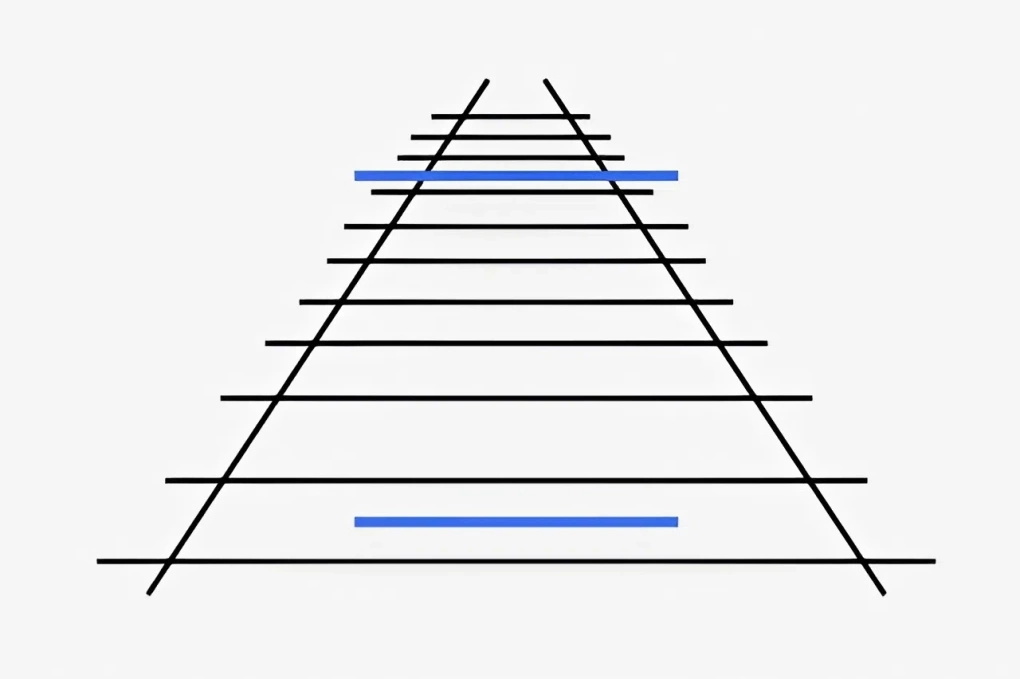
However, NASA believes this is still not a perfect explanation. The agency notes that astronauts in orbit also experience the Moon illusion despite having no foreground objects to provide distance clues. This suggests that the phenomenon involves even more complex causes.
“Although there is still no complete explanation for why humans see the Moon this way, we can agree that a gigantic Moon is a beautiful sight, whether real or illusory. So, until someone figures out exactly what is happening in the brain, perhaps it is best simply to enjoy the Moon illusion and the emotional, mystical, and sometimes eerie scenes it creates,” NASA wrote.
Source: https://vnexpress.net/ao-anh-mat-trang-chua-duoc-giai-ma-sau-hang-nghin-nam-5069631.html
WORD BANK:
perception /pɚˈsep.ʃən/ [C1] (n): sự nhận thức, tri giác
accurate /ˈæk.jɚ.ət/ [B2] (adj): chính xác
index finger /ˈɪn.deks ˌfɪŋ.ɡɚ/ (n): ngón tay trỏ
celestial body /səˈles.tʃəl ˌbɑː.di/ (n): thiên thể
roughly /ˈrʌf.li/ [B2] (adv): khoảng, xấp xỉ
bend down /bend daʊn/ (v): cúi xuống, cúi người xuống
the horizon /həˈraɪ.zən/ [C1] (n): đường chân trời
phenomenon /fəˈnɑː.mə.nɑːn/ [C1] (n): hiện tượng
illusion /ɪˈluː.ʒən/ [B2] (n): ảo ảnh, ảo giác
mysterious /mɪsˈtɪr.i.əs/ [B2] (adj): bí ẩn, huyền bí
puzzle sb /ˈpʌz.əl/ [C2] (v): làm ai đó bối rối, làm đau đầu
astronomer /əˈstrɑː.nə.mɚ/ (n): nhà thiên văn học
magnify /ˈmæɡ.nə.faɪ/ [C2] (v): phóng to, thổi phồng
property /ˈprɑː.pɚ.t̬i/ [B2] (n): tính chất, đặc tính
the refraction of light /ðə rɪˈfræk.ʃən əv laɪt/ (n): sự khúc xạ ánh sáng
magnifying glass /ˈmæɡ.nə.faɪ.ɪŋ ˌɡlæs/ (n): kính lúp
hypothesis /haɪˈpɑː.θə.sɪs/ [C1] (n): giả thuyết
flatten /ˈflæt.ən/ [C1] (v): làm cho bằng phẳng, dát mỏng
perception /pɚˈsep.ʃən/ [C1] (n): sự nhận thức, tri giác
perceive /pɚˈsiːv/ [C1] (v): nhận thức, cảm nhận
deceive /dɪˈsiːv/ [B2] (v): lừa dối, đánh lừa
be contrasted with sth /biː kənˈtræs.tɪd wɪð/ (v): được đặt tương phản với cái gì
distortion /dɪˈstɔːr.ʃən/ [C1] (n): sự méo mó, sự xuyên tạc
retina /ˈretɪnə/ (n): võng mạc
take into account sth [B2] (v): cân nhắc, tính đến cái gì
simulate /ˈsɪm.jə.leɪt/ (v): mô phỏng
magnification /ˌmæɡ.nə.fəˈkeɪ.ʃən/ (n): sự phóng đại, độ phóng đại
identical /aɪˈden.t̬ɪ.kəl/ [B2] (adj): giống hệt nhau
horizontal /ˌhɔːr.ɪˈzɑːn.t̬əl/ [C1] (adj): nằm ngang, thuộc chân trời
differ in sth /ˈdɪf.ɚ/ [B2] (v): khác nhau về cái gì
converge /kənˈvɝːdʒ/ (v): hội tụ, đồng quy
foreground /ˈfɔːr.ɡraʊnd/ (n): cận cảnh, tiền cảnh
gigantic /ˌdʒaɪˈɡæn.t̬ɪk/ [B2] (adj): khổng lồ, kếch xù
illusory /ɪˈluː.sər.i/ (adj): hão huyền, không thực, do ảo giác
mystical /ˈmɪs.tɪ.kəl/ (adj): thần bí, huyền bí
eerie /ˈɪr.i/ (adj): kỳ lạ, rợn người
ỦNG HỘ READ TO LEAD!
Chào bạn! Có thể bạn chưa biết, Read to Lead là một trang giáo dục phi lợi nhuận với mục đích góp phần phát triển cộng đồng người học tiếng Anh tại Việt Nam. Chúng tôi không yêu cầu người đọc phải trả bất kỳ chi phí nào để sử dụng các sản phẩm của mình để mọi người đều có cơ hội học tập tốt hơn. Tuy nhiên, nếu bạn có thể, chúng tôi mong nhận được sự hỗ trợ tài chính từ bạn để duy trì hoạt động của trang và phát triển các sản phẩm mới.
Bạn có thể ủng hộ chúng tôi qua 1 trong 2 cách dưới đây.
– Cách 1: Chuyển tiền qua tài khoản Momo.
Số điện thoại 0947.886.865 (Chủ tài khoản: Nguyễn Tiến Trung)
Nội dung chuyển tiền: Ủng hộ Read to Lead
hoặc
– Cách 2: Chuyển tiền qua tài khoản ngân hàng.
Ngân hàng VIB chi nhánh Hải Phòng
Số tài khoản: 012704060048394 (Chủ tài khoản: Nguyễn Tiến Trung)
Nội dung chuyển tiền: Ủng hộ Read to Lead
Lớp luyện thi IELTS online
Bạn đang có nhu cầu thi chứng chỉ IELTS cho đầu vào đại học, đi du học, xin việc hay xin cư trú và đang phân vân chưa biết học ở đâu?
Nếu bạn đang tìm kiếm dịch vụ luyện thi IELTS online với giáo viên uy tín và chất lượng, cũng như học phí phải chăng, thì thầy Trung và Cô Thủy (Admin và dịch giả chính của Read to Lead) có thể là một lựa chọn phù hợp dành cho bạn.
Hãy liên hệ (nhắn tin) tới trang Facebook cá nhân của mình (https://www.facebook.com/nguyen.trung.509) để tìm hiểu về lớp học và được tư vấn cũng như được học thử nha!


