


[Reading level: B2 – Upper Intermediate]
Today, cooking rice is probably one of the simplest tasks in the kitchen. Wash the rice, add water, place the inner pot in the cooker, and press a button—the entire process can be done in less than three minutes. After that, we can go to work, go to school, or do other things. By mealtime, a pot of hot, freshly cooked rice is already waiting for us. Many modern rice cookers can even be set in advance so that the rice finishes cooking just as the whole family comes home.
Yet less than a century ago, things were completely different.
In Japan, rice is a staple food, but cooking a good pot of rice once required a great deal of effort. The cook had to start a wood or charcoal fire, control the flame throughout the cooking process, and know exactly when to turn the heat up, turn it down, or put out the fire. A moment of carelessness could leave the rice undercooked, too soft, or burnt. In many households, women had to cook rice as many as three times a day and could spend hours on what now seems like such a simple task.

The idea of using electricity to cook rice actually appeared quite early. In 1923, Mitsubishi Electric developed a type of electric rice cooker for use on ships. In the years that followed, several Japanese companies continued experimenting with cookers that used electricity to generate heat. But they still had not solved the most important problem: the cooker did not know when the rice was done. People still had to watch it and switch it off themselves.
The turning point came in the early 1950s.
While traveling around Japan to promote household electrical appliances, Shogo Yamada of Toshiba often asked housewives which household chore they found the most difficult. The answer he received was not doing the laundry, but cooking rice. Yamada believed that if there were a cooker that could cook rice and automatically stop at exactly the right moment, it could truly change family life.
The task was eventually given to Yoshitada Minami, the owner of a small workshop that was producing water-heating equipment for Toshiba. Minami understood machinery and electricity, but there was one problem: he was not the person who cooked rice every day.
The person who understood that task better than he did was his wife, Fumiko Minami, a mother of six. And so, the Minami family’s kitchen gradually turned into a laboratory.

The couple, together with other members of their family, repeatedly cooked batches of rice, measured temperatures, changed the amount of water, and modified their prototypes. Surviving records show that they tested the cooker under many different conditions, sometimes even at 1 or 3 in the morning. The cooker was also tested in cold weather to make sure that it would work not only in a warm room but also reliably cook rice in different climates across Japan.
Through these repeated experiments, one important principle gradually became clear. Water itself could serve as the rice cooker’s natural “sensor.”
As long as there was still water in the pot, the temperature around the cooking area remained close to the boiling point of water, about 100°C. But once the necessary water had been absorbed or evaporated, the temperature began to rise rapidly above that point.
If the cooker could detect that exact moment when the temperature started to rise, it could also know that it was time to stop heating.
The solution was a bimetallic switch—a component made of two metals that expand at different rates. When the temperature reached a certain level, the switch would bend and cut off the electricity. The design, which used an inner pot surrounded by an outer water chamber, also provided a remarkably clever way of measuring cooking time: the water in the outer chamber boiled and kept the temperature stable; once that water had evaporated after the necessary amount of time, the temperature rose and the switch automatically cut off the power.
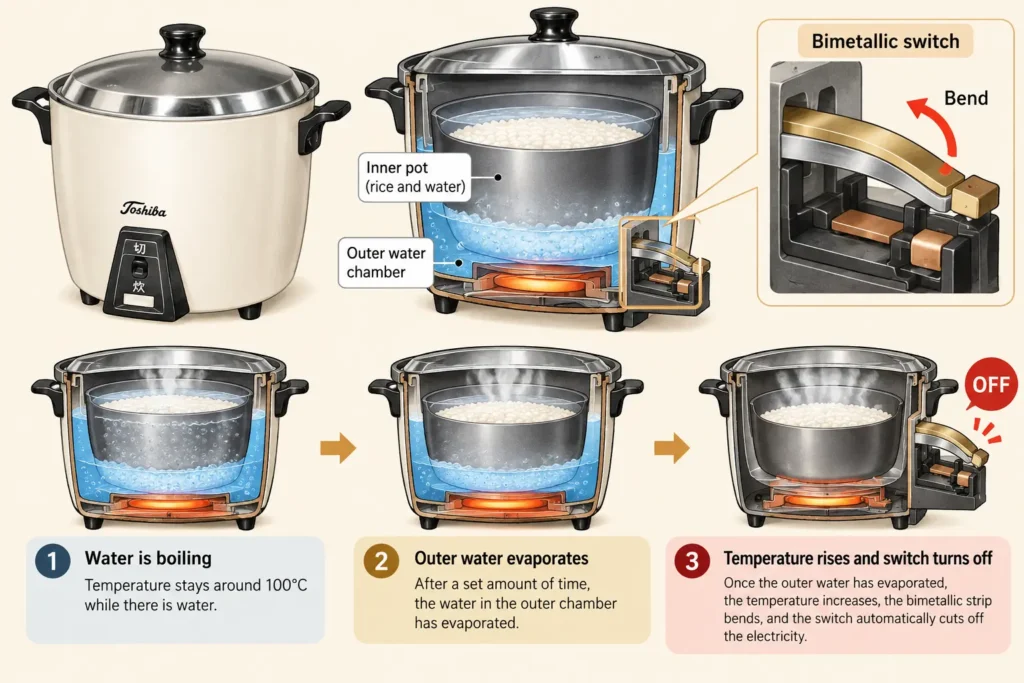
In other words, the cooker did not need an electronic timer, a digital sensor, or a microprocessor. The physical properties of water itself told it when to stop.
After about three years of development, the final design was completed. On December 10, 1955, Toshiba launched the ER-4, the company’s first automatic electric rice cooker and one of the most important milestones in the history of Japanese household appliances.
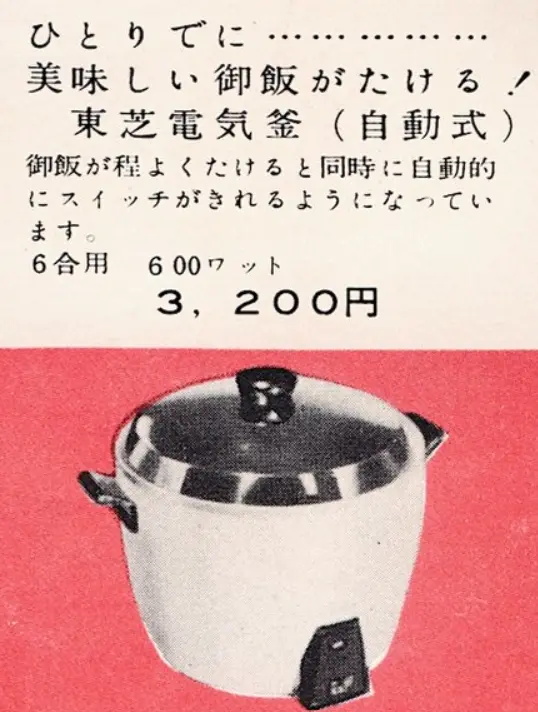
At first, not everyone believed it would succeed. At around 3,200 yen—roughly one-third of the average monthly salary in Japan at the time—the cooker was not cheap. But once consumers realized that they no longer had to sit beside the stove and watch the rice cook, what had seemed like a luxury quickly became an extremely practical household appliance.
According to Toshiba, within only about four years of its introduction, automatic electric rice cookers could be found in roughly half of all Japanese households.
From Japan, the electric rice cooker spread to many other Asian countries and gradually became a familiar appliance in hundreds of millions of kitchens. Today’s rice cookers have come a long way: they can be programmed in advance, keep rice warm, regulate temperature using microprocessors, cook porridge, steam food, bake cakes, and even adjust their cooking programs for different types of rice.
But the basic idea behind the invention began with one very simple question: How could you cook a good pot of rice without having someone stand beside the stove and watch it?
But behind that ordinary convenience were years of experimentation in a small workshop, pot after pot of rice cooked in the middle of the night and in freezing conditions, and an extraordinarily simple discovery about water and temperature.
Perhaps that is the most interesting thing about the electric rice cooker: one of the inventions that has had the greatest impact on Asian kitchens did not change what we eat—it changed how much of our time we have to spend cooking it.
WORD BANK:
inner /ˈɪn.ɚ/ (adj): bên trong
pot /pɑːt/ (n): nồi
set sth in advance /set/ (v): cài đặt, thiết lập trước
staple /ˈsteɪ.pəl/ (n): thực phẩm chính; thứ thiết yếu
cook /kʊk/ (v): nấu, nấu chín
charcoal /ˈtʃɑːr.koʊl/ (n): than củi
put out (a fire) /pʊt aʊt/ (v): dập, tắt (lửa)
undercooked /ˌʌn.dɚˈkʊkt/ (adj): chưa chín, nấu chưa kỹ
experiment with sth /ɪkˈsper.ə.ment/ [B2] (v): thử nghiệm với cái gì
switch off /swɪtʃ ɑːf/ [B1] (v): tắt (thiết bị, điện)
turning point /ˈtɝː.nɪŋ ˌpɔɪnt/ [B2] (n): bước ngoặt
household appliance /ˈhaʊs.hoʊld əˌplaɪ.əns/ (n): thiết bị gia dụng
chore /tʃɔːr/ [B2] (n): việc vặt, việc nhà
the laundry /ˈlɑːn.dri/ [B1] (n): việc giặt giũ; quần áo cần giặt
machinery /məˈʃiː.nɚ.i/ [B2] (n): máy móc
laboratory /ˈlæb.rə.tɔːr.i/ [B1] (n): phòng thí nghiệm
batch /bætʃ/ [C1] (n): một mẻ, một lượt (được làm/nấu cùng lúc)
modify sth /ˈmɑː.də.faɪ/ [B2] (v): sửa đổi, điều chỉnh cái gì
prototype /ˈproʊ.t̬ə.taɪp/ [C1] (n): nguyên mẫu, mẫu thử
surviving record /sɚˈvaɪ.vɪŋ ˈrek.ɚd/ (n): tài liệu, ghi chép còn lưu lại
reliable /rɪˈlaɪ.ə.bəl/ [B1] (adj): đáng tin cậy; ổn định
principle /ˈprɪn.sə.pəl/ [B2] (n): nguyên lý, nguyên tắc
sensor /ˈsen.sɚ/ (n): cảm biến
boiling point /ˈbɔɪ.lɪŋ ˌpɔɪnt/ (n): điểm sôi
absorb /əbˈzɔːrb/ [B2] (v): hấp thụ
evaporate /ɪˈvæp.ə.reɪt/ (v): bay hơi
detect sth /dɪˈtekt/ [B2] (v): phát hiện, nhận biết cái gì
bimetallic switch /ˌbaɪ.məˈtæl.ɪk swɪtʃ/ (n): công tắc lưỡng kim
bend /bend/ [B1] (v): uốn cong, cong đi
chamber /ˈtʃeɪm.bɚ/ [B2] (n): khoang, buồng
digital sensor /ˈdɪdʒ.ə.t̬əl ˈsen.sɚ/ (n): cảm biến kỹ thuật số
microprocessor /ˌmaɪ.kroʊˈprɑː.ses.ɚ/ (n): bộ vi xử lý
milestone /ˈmaɪl.stoʊn/ [C1] (n): cột mốc quan trọng
stove /stoʊv/ [B1] (n): bếp
luxury /ˈlʌɡ.ʒɚ.i/ [B1] (n): thứ xa xỉ; sự xa xỉ
roughly /ˈrʌf.li/ [B2] (adv): khoảng, xấp xỉ
porridge /ˈpɔːr.ɪdʒ/ (n): cháo
steam /stiːm/ (v): hấp
adjust /əˈdʒʌst/ [B2] (v): điều chỉnh
freshly cooked /ˌfreʃ.li ˈkʊkt/ (adj): vừa mới nấu xong, nóng hổi
perfectly ordinary /ˈpɝː.fekt.li ˈɔːr.dən.er.i/ (adj): hoàn toàn bình thường
take sth for granted [B2] (v): coi cái gì là điều hiển nhiên, không nhận ra hoặc trân trọng đầy đủ giá trị của nó
ỦNG HỘ READ TO LEAD!
Chào bạn! Có thể bạn chưa biết, Read to Lead là một trang giáo dục phi lợi nhuận với mục đích góp phần phát triển cộng đồng người học tiếng Anh tại Việt Nam. Chúng tôi không yêu cầu người đọc phải trả bất kỳ chi phí nào để sử dụng các sản phẩm của mình để mọi người đều có cơ hội học tập tốt hơn. Tuy nhiên, nếu bạn có thể, chúng tôi mong nhận được sự hỗ trợ tài chính từ bạn để duy trì hoạt động của trang và phát triển các sản phẩm mới.
Bạn có thể ủng hộ chúng tôi qua 1 trong 2 cách dưới đây.
– Cách 1: Chuyển tiền qua tài khoản Momo.
Số điện thoại 0947.886.865 (Chủ tài khoản: Nguyễn Tiến Trung)
Nội dung chuyển tiền: Ủng hộ Read to Lead
hoặc
– Cách 2: Chuyển tiền qua tài khoản ngân hàng.
Ngân hàng VIB chi nhánh Hải Phòng
Số tài khoản: 012704060048394 (Chủ tài khoản: Nguyễn Tiến Trung)
Nội dung chuyển tiền: Ủng hộ Read to Lead
Lớp luyện thi IELTS online
Bạn đang có nhu cầu thi chứng chỉ IELTS cho đầu vào đại học, đi du học, xin việc hay xin cư trú và đang phân vân chưa biết học ở đâu?
Nếu bạn đang tìm kiếm dịch vụ luyện thi IELTS online với giáo viên uy tín và chất lượng, cũng như học phí phải chăng, thì lớp học online của thầy Trung (Admin và dịch giả chính của Read to Lead) có thể là một lựa chọn phù hợp dành cho bạn.
Hãy liên hệ (nhắn tin) tới trang Facebook cá nhân của mình (https://www.facebook.com/nguyen.trung.509) để tìm hiểu về lớp học và được tư vấn cũng như được học thử nha!


