


[Reading level: B2 – Upper Intermediate]
When standing before a vast landscape, we can usually see nearby trees, fields, and hills in clear colours. However, mountain ranges farther away gradually turn blue or blue-grey, even though the rocks may be brown or grey and the trees growing on them are actually green.
This phenomenon does not occur because the mountains truly change their colour. The main reason lies in the thick layer of air separating us from the distant scenery.
A veil of air
When we look at a nearby object, the light reflected from it only has to pass through a thin layer of air before reaching our eyes. Therefore, we can still see its colours, outlines, and surface details quite clearly.
By contrast, light from a mountain tens of kilometres away has to travel through a much larger amount of air. Along the way, the light interacts with gas molecules, water vapour, dust, and various tiny particles suspended in the atmosphere.
This layer of air acts like a thin veil covering the mountain. The greater the distance, the thicker the veil becomes, causing the original colours of the scenery to fade and its outlines to appear less distinct. Atmospheric scattering makes distant mountains appear lighter, bluer, and hazier than nearby objects.
Blue light is scattered more strongly
Sunlight may appear white, but it actually consists of many different colours. Each colour corresponds to a particular range of wavelengths: red light has longer wavelengths, while blue and violet light have shorter ones.

When sunlight enters the atmosphere, gas molecules change the direction of some of the light. This phenomenon is known as Rayleigh scattering. Colours with shorter wavelengths are scattered more strongly than those with longer wavelengths. As a result, blue light is scattered throughout the sky and enters our eyes from many directions. This is also why the daytime sky usually appears blue.
When we look at a distant mountain, our eyes receive not only the light reflected directly from the mountain. Along the long distance between the mountain and the observer, some blue light scattered by the atmosphere also enters our eyes. This light mixes with the light from the landscape, creating a blue veil over the mountain.
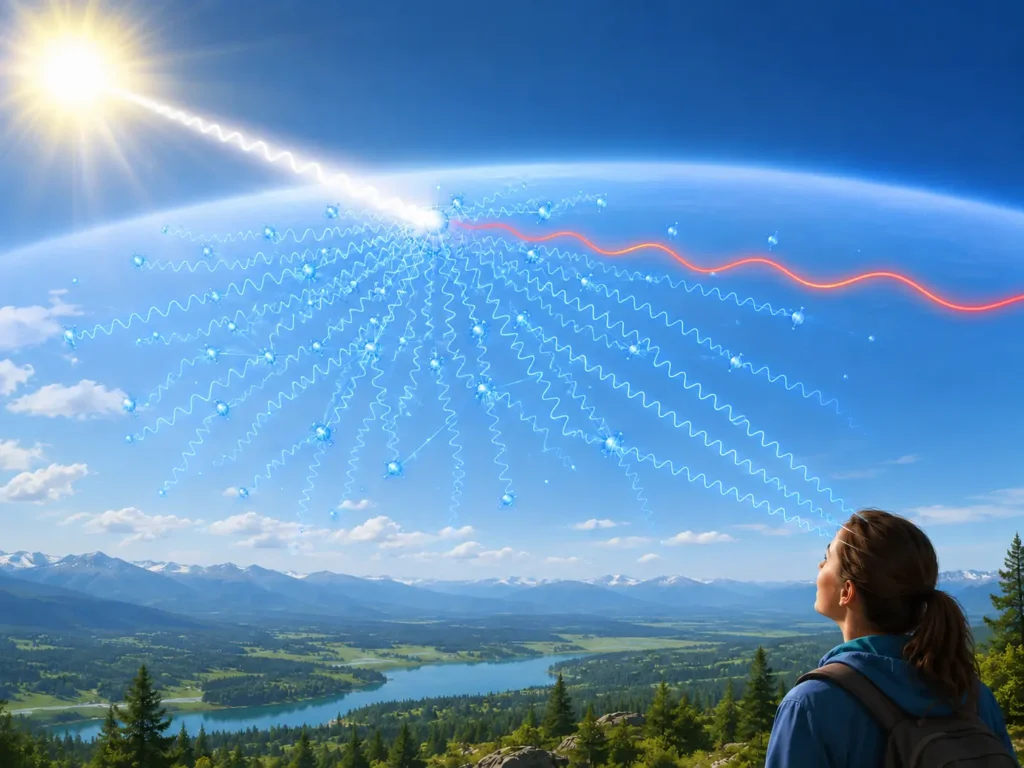
In other words, the blue colour we see does not come entirely from the mountain but largely from the mass of air in front of it.
Why do mountains become paler and bluer with distance?
The greater the distance, the more air there is between the observer and the mountain. This leads to two changes occurring at the same time.
First, some of the light reflected from the mountain is scattered away from its path before reaching our eyes. Therefore, the original colours of the rocks, soil, and trees gradually weaken.
Second, the greater the distance, the more light from the sky is scattered into our line of sight. This layer of blue light gradually overwhelms the mountain’s true colours.
Consequently, a nearby hill may appear with dark green trees, brown cliffs, and clearly defined areas of light and shadow. The mountain range behind it often turns blue-grey, while the most distant peaks may appear only as pale blue silhouettes that almost blend into the sky.
Distance also reduces contrast. The bright and dark areas on the mountain become more similar, making the mountain appear flatter and hazier. The brain uses these changes to perceive depth: scenery that is paler, has less contrast, and takes on the colour of the atmosphere is usually perceived as being farther away.
In art, this effect is known as atmospheric perspective. Artists often paint nearby objects with stronger colours and clearer details, while using pale blue-grey tones for distant mountains to create a sense of depth and space.
Therefore, the blue colour of distant mountains is essentially the colour of distance. The more air there is between our eyes and the scenery, the more its true colours are weakened, while the scattered light from the sky becomes increasingly visible.
WORD BANK:
vast /væst/ [B2] (adj): rộng lớn, bao la
mountain range /ˈmaʊn.tən reɪndʒ/ (n): dãy núi
blue-grey /ˌbluːˈɡreɪ/ (adj): có màu xanh xám
phenomenon /fəˈnɑː.mə.nɑːn/ [B2] (n): hiện tượng
lie in sth /laɪ ɪn/ (phr v): nằm ở, bắt nguồn từ cái gì
scenery /ˈsiː.nɚ.i/ [B1] (n): phong cảnh
outline /ˈaʊt.laɪn/ [B2] (n): đường nét, đường viền
gas molecule /ˈɡæs ˌmɑː.lə.kjuːl/ (n): phân tử khí
water vapour /ˈwɑː.t̬ɚ ˌveɪ.pɚ/ (n): hơi nước
dust /dʌst/ [B1] (n): bụi
tiny particle /ˈtaɪ.ni ˌpɑːr.t̬ə.kəl/ (n): hạt nhỏ li ti
suspended /səˈspen.dɪd/ (adj): lơ lửng
veil /veɪl/ (n): tấm màn, lớp màn che phủ
fade /feɪd/ [B2] (v): phai dần, mờ dần
distinct /dɪˈstɪŋkt/ [B2] (adj): rõ ràng, dễ nhận thấy
scatter /ˈskæt̬.ɚ/ [B2] (v): phân tán, tán xạ
atmospheric scattering /ˌæt.məˈsfer.ɪk ˈskæt̬.ɚ.ɪŋ/ (n): sự tán xạ trong khí quyển
hazy /ˈheɪ.zi/ (adj): mờ đục, phủ sương mờ
correspond to sth /ˌkɔːr.əˈspɑːnd/ [B2] (v): tương ứng với cái gì
wavelength /ˈweɪv.leŋθ/ (n): bước sóng
mass /mæs/ [B2] (n): khối
path /pæθ/ [B1] (n): đường đi, đường truyền
original /əˈrɪdʒ.ən.əl/ [B1] (adj): ban đầu, nguyên bản
line of sight /ˌlaɪn əv ˈsaɪt/ (n): đường nhìn, tầm nhìn
overwhelm sth /ˌoʊ.vɚˈwelm/ [C1] (v): lấn át cái gì
consequently /ˈkɑːn.sə.kwənt.li/ [B2] (adv): do đó, vì vậy
nearby /ˌnɪrˈbaɪ/ [B1] (adj, adv): gần đó, ở gần
cliff /klɪf/ [B1] (n): vách đá
defined /dɪˈfaɪnd/ (adj): rõ ràng, rõ nét
light and shadow /ˌlaɪt ən ˈʃæd.oʊ/ (n phr): ánh sáng và bóng tối, vùng sáng và tối
peak /piːk/ [B1] (n): đỉnh núi
silhouette /ˌsɪl.uˈet/ (n): bóng, hình bóng
blend into sth /blend ˈɪn.tuː/ (phr v): hòa lẫn vào cái gì
contrast /ˈkɑːn.træst/ [B2] (n): độ tương phản, sự tương phản
perceive sth /pɚˈsiːv/ [C1] (v): nhận thấy, cảm nhận cái gì
take on sth /teɪk ɑːn/ (phr v): mang, có thêm đặc điểm hoặc màu sắc gì
atmospheric perspective /ˌæt.məˈsfer.ɪk pɚˈspek.tɪv/ (n): phối cảnh khí quyển
essentially /ɪˈsen.ʃəl.i/ [B2] (adv): về cơ bản, thực chất là
increasingly /ɪnˈkriː.sɪŋ.li/ [B2] (adv): ngày càng
visible /ˈvɪz.ə.bəl/ [B1] (adj): có thể nhìn thấy, hữu hình
ỦNG HỘ READ TO LEAD!
Chào bạn! Có thể bạn chưa biết, Read to Lead là một trang giáo dục phi lợi nhuận với mục đích góp phần phát triển cộng đồng người học tiếng Anh tại Việt Nam. Chúng tôi không yêu cầu người đọc phải trả bất kỳ chi phí nào để sử dụng các sản phẩm của mình để mọi người đều có cơ hội học tập tốt hơn. Tuy nhiên, nếu bạn có thể, chúng tôi mong nhận được sự hỗ trợ tài chính từ bạn để duy trì hoạt động của trang và phát triển các sản phẩm mới.
Bạn có thể ủng hộ chúng tôi qua 1 trong 2 cách dưới đây.
– Cách 1: Chuyển tiền qua tài khoản Momo.
Số điện thoại 0947.886.865 (Chủ tài khoản: Nguyễn Tiến Trung)
Nội dung chuyển tiền: Ủng hộ Read to Lead
hoặc
– Cách 2: Chuyển tiền qua tài khoản ngân hàng.
Ngân hàng VIB chi nhánh Hải Phòng
Số tài khoản: 012704060048394 (Chủ tài khoản: Nguyễn Tiến Trung)
Nội dung chuyển tiền: Ủng hộ Read to Lead
Lớp luyện thi IELTS online
Bạn đang có nhu cầu thi chứng chỉ IELTS cho đầu vào đại học, đi du học, xin việc hay xin cư trú và đang phân vân chưa biết học ở đâu?
Nếu bạn đang tìm kiếm dịch vụ luyện thi IELTS online với giáo viên uy tín và chất lượng, cũng như học phí phải chăng, thì lớp học online của thầy Trung (Admin và dịch giả chính của Read to Lead) có thể là một lựa chọn phù hợp dành cho bạn.
Hãy liên hệ (nhắn tin) tới trang Facebook cá nhân của mình (https://www.facebook.com/nguyen.trung.509) để tìm hiểu về lớp học và được tư vấn cũng như được học thử nha!


