


[Reading level: B2 – Upper Intermediate]
In the previous article, we’ve learned about RFID – a technology that allows clothing stores to identify multiple products at the same time without having to scan each barcode individually. Thanks to this technology, at some stores, you can simply place an entire basket of clothes in the scanning area of a self-checkout machine, and the system can quickly identify the items inside.
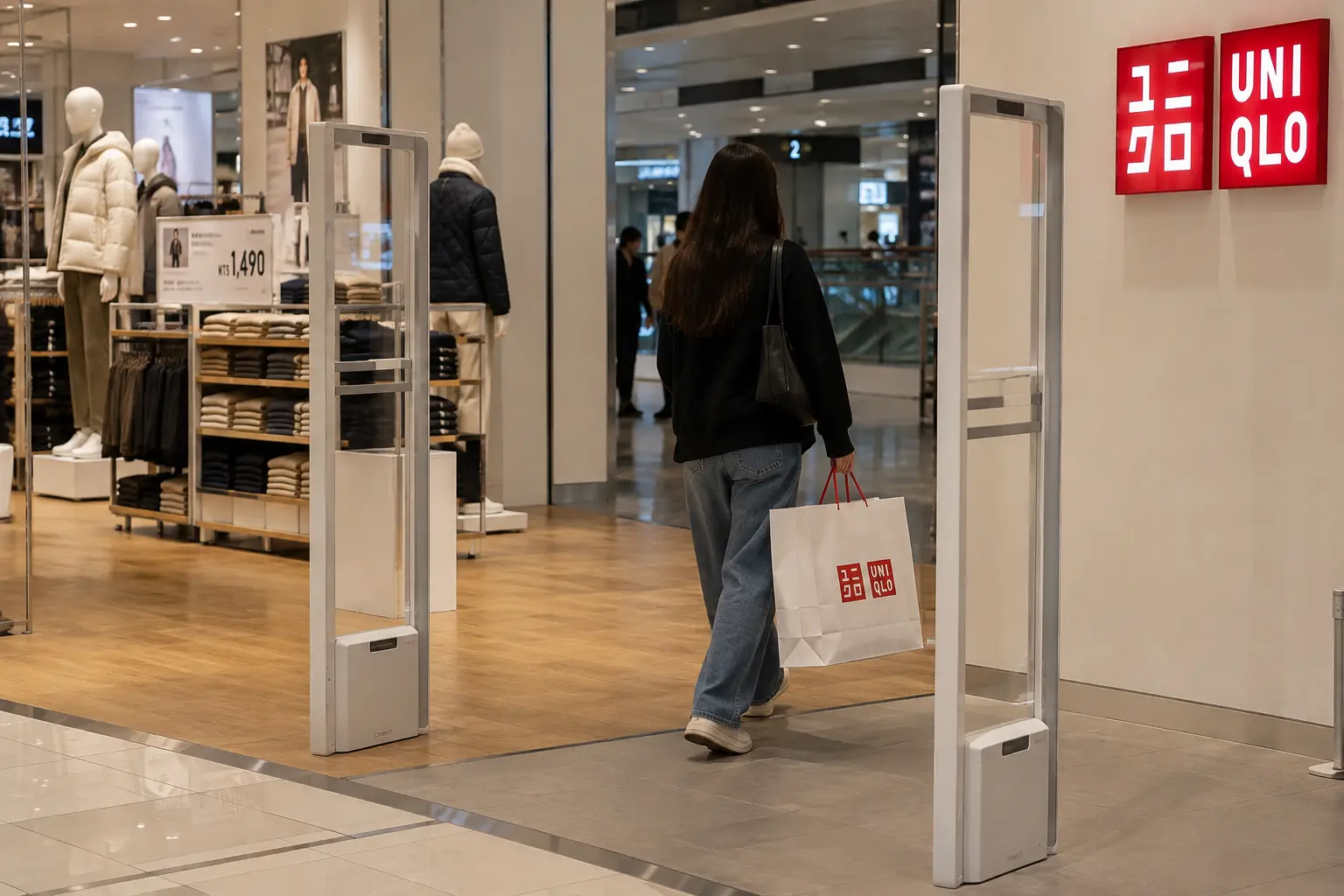
But RFID leads to another interesting question: If the RFID tag is still attached to the clothes after payment, why doesn’t the alarm go off when you take the item through the security gate at the exit?
In fact, the security gate does not necessarily just check whether “an RFID tag is passing through.” In RFID systems that are integrated with loss-prevention functions, the system can also determine the status of the item.
Each RFID tag carries a unique identification code. When a product is paid for at a checkout counter or self-checkout machine, the sales system records the item as sold/paid for, or updates its anti-theft status accordingly.
Therefore, when you walk through the gate, the reader may still receive a signal from the RFID tag. However, the system checks the product’s code and sees that the item has already been paid for, so it does not trigger an alarm.
On the other hand, if an unpaid item is taken through the gate, the system may recognize that its RFID code still belongs to a product that has not been recorded as sold and trigger an alarm.
But how can millions of mass-produced RFID tags have different identification codes?
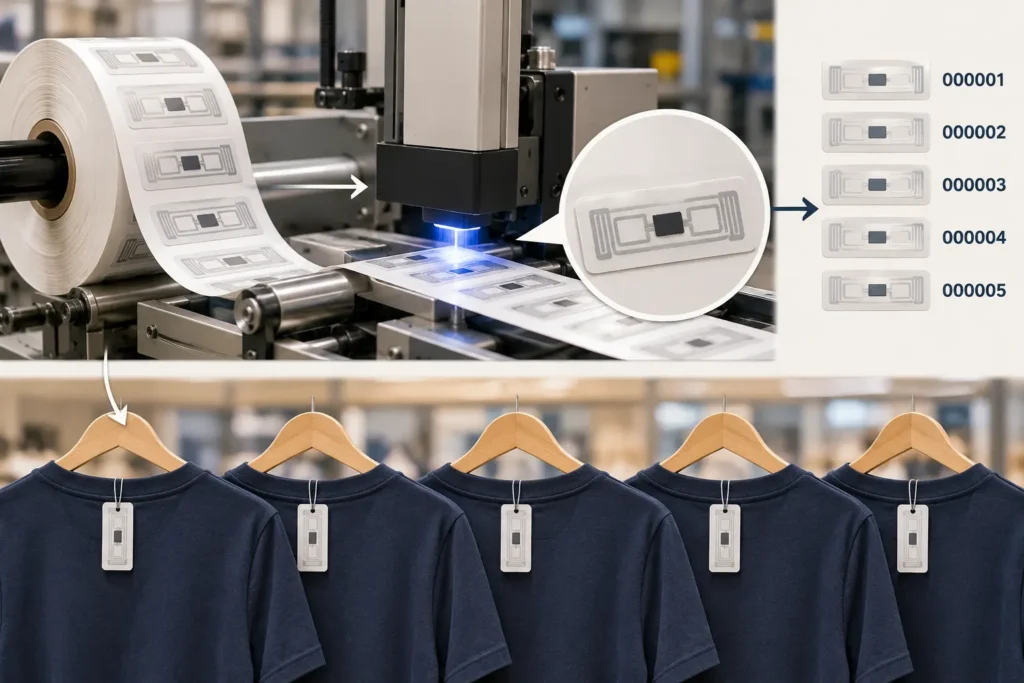
Interestingly, the tags may be identical in appearance and structure, but the data stored in their chips is not necessarily the same. During production or before the tags are attached to products, RFID machines can automatically write an EPC (Electronic Product Code) to each tag.
Therefore, even if 500 shirts have the same design, color, and size, each one can still be assigned a unique EPC so that the system can distinguish each individual item. This process takes place automatically at high speed: the tags move continuously along a roll and are encoded and checked one by one before being put into use.
However, not every anti-theft gate in a store uses RFID. Many retailers still use EAS (Electronic Article Surveillance), in which anti-theft tags are removed or deactivated when customers pay. Some modern systems may combine RFID with other loss-prevention solutions.
Interestingly, a tiny RFID tag can be involved in many different processes: tracking inventory, locating products in the store, supporting self-checkout and, in some systems, helping detect unpaid items as they leave the store.
WORD BANK:
article /ˈɑːr.t̬ɪ.kəl/ [B1] (n): bài viết
scan /skæn/ (v): quét
barcode /ˈbɑːr.koʊd/ (n): mã vạch
basket /ˈbæs.kɪt/ [A2] (n): giỏ
self-checkout machine /ˌself ˈtʃek.aʊt məˌʃiːn/ (n): máy tự thanh toán
identify sth /aɪˈden.t̬ə.faɪ/ [B1] (v): xác định, nhận diện cái gì
attach sth to sth /əˈtætʃ/ [B1] (v): gắn cái gì vào cái gì
go off /ɡoʊ ɑːf/ [B1] (phr v): kêu, phát tín hiệu (chuông, báo động)
not necessarily /ˌnes.əˈser.əl.i/ [B2] (adv): không nhất thiết
integrate /ˈɪn.t̬ə.ɡreɪt/ [B2] (v): tích hợp
loss-prevention function /ˌlɔːs prɪˈven.ʃən ˈfʌŋk.ʃən/ (n): chức năng chống thất thoát
determine /dɪˈtɝː.mɪn/ [B1] (v): xác định
identification code /aɪˌden.t̬ə.fəˈkeɪ.ʃən koʊd/ (n): mã định danh
checkout counter /ˈtʃek.aʊt ˌkaʊn.t̬ɚ/ (n): quầy thanh toán
anti-theft /ˌæn.t̬iˈθeft/ (adj): chống trộm
accordingly /əˈkɔːr.dɪŋ.li/ [C1] (adv): theo đó, tương ứng
trigger sth /ˈtrɪɡ.ɚ/ [C1] (v): kích hoạt, gây ra cái gì
mass-produced /ˌmæs.prəˈduːst/ (adj): được sản xuất hàng loạt
identical /aɪˈden.t̬ɪ.kəl/ [B2] (adj): giống hệt nhau
assign /əˈsaɪn/ [B2] (v): gán, chỉ định
distinguish /dɪˈstɪŋ.ɡwɪʃ/ [B2] (v): phân biệt
roll /roʊl/ (n): cuộn
encode /ɪnˈkoʊd/ (v): mã hóa, ghi mã
retailer /ˈriː.teɪ.lɚ/ [B2] (n): nhà bán lẻ
deactivate /diˈæk.tə.veɪt/ (v): vô hiệu hóa
ỦNG HỘ READ TO LEAD!
Chào bạn! Có thể bạn chưa biết, Read to Lead là một trang giáo dục phi lợi nhuận với mục đích góp phần phát triển cộng đồng người học tiếng Anh tại Việt Nam. Chúng tôi không yêu cầu người đọc phải trả bất kỳ chi phí nào để sử dụng các sản phẩm của mình để mọi người đều có cơ hội học tập tốt hơn. Tuy nhiên, nếu bạn có thể, chúng tôi mong nhận được sự hỗ trợ tài chính từ bạn để duy trì hoạt động của trang và phát triển các sản phẩm mới.
Bạn có thể ủng hộ chúng tôi qua 1 trong 2 cách dưới đây.
– Cách 1: Chuyển tiền qua tài khoản Momo.
Số điện thoại 0947.886.865 (Chủ tài khoản: Nguyễn Tiến Trung)
Nội dung chuyển tiền: Ủng hộ Read to Lead
hoặc
– Cách 2: Chuyển tiền qua tài khoản ngân hàng.
Ngân hàng VIB chi nhánh Hải Phòng
Số tài khoản: 012704060048394 (Chủ tài khoản: Nguyễn Tiến Trung)
Nội dung chuyển tiền: Ủng hộ Read to Lead
Lớp luyện thi IELTS online
Bạn đang có nhu cầu thi chứng chỉ IELTS cho đầu vào đại học, đi du học, xin việc hay xin cư trú và đang phân vân chưa biết học ở đâu?
Nếu bạn đang tìm kiếm dịch vụ luyện thi IELTS online với giáo viên uy tín và chất lượng, cũng như học phí phải chăng, thì lớp học online của thầy Trung (Admin và dịch giả chính của Read to Lead) có thể là một lựa chọn phù hợp dành cho bạn.
Hãy liên hệ (nhắn tin) tới trang Facebook cá nhân của mình (https://www.facebook.com/nguyen.trung.509) để tìm hiểu về lớp học và được tư vấn cũng như được học thử nha!


