


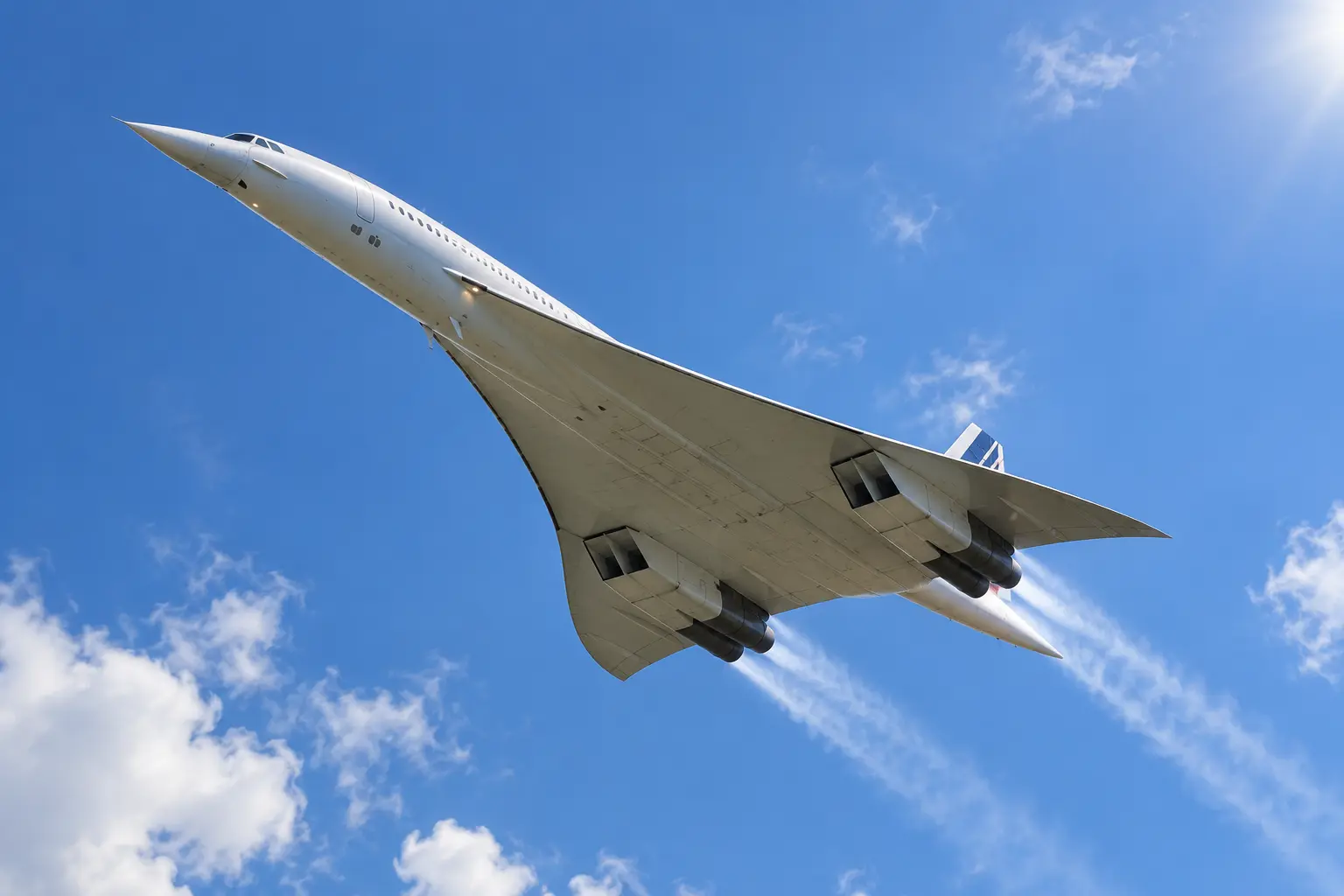
In 1996, a British Airways plane flew from New York to London in a record-breaking two hours and 53 minutes. Today, however, passengers flying the same route can expect to spend no less than six hours in the air—twice as long. So why, in a world where everything seems to be getting faster, have commercial flights lagged behind?
The British-and-French-made Concorde began shuttling passengers across the sky in the 1970s. Jetting between destinations like New York, Paris, Bahrain, and Singapore, it clocked in at over 2,000 kilometers per hour, more than twice the speed of a normal airliner.
However, this was also about 800 kilometers per hour faster than the speed of sound. And that created a surprising problem for people on the ground.
When an object moves at supersonic speed, it generates a continuous moving shockwave known as a sonic boom. This produces a loud, startling noise, as well as rattling windows and dislodging structural elements of buildings.
Since a plane flying at an altitude of 15 kilometers can affect an area with an 80 kilometer diameter on the ground below, complaints and concerns from residents in the Concorde’s flight path restricted it to mostly ocean routes.
Because of these restrictions and other fuel and engineering requirements, supersonic flights turned out to be very expensive for both airlines and passengers. A single transatlantic round-trip could cost the equivalent of more than $10,000 today.
With additional strain on the airline industry due to decreased demand for flights after September 11th, 2001, this became unsustainable, and the Concorde was retired in 2003. So even when superfast flights existed, they weren’t standard commercial flights.
And while we might think that advances in flight technology would make fast flights less expensive, this hasn’t necessarily been the case. One of the biggest concerns is fuel economy.
Over the decades, jet engines have become a lot more efficient, taking in more air and achieving more thrust—traveling further for every liter of fuel.
But this efficiency is only achieved at speeds of up to around 900 kilometers per hour—less than half the speed of the Concorde. Going any faster would increase air intake and burn more fuel per kilometer flown.
A standard transatlantic flight still uses as much as 150,000 liters of fuel, amounting to over 20% of an airline’s total expenses. So any reduction in fuel economy and increase in speed would significantly increase both flight costs and environmental impact.
What about ways to make a plane faster without burning lots of fuel?
Adjusting the wing sweep, or the angle at which wings protrude from the fuselage, to bring the wings closer in can make an aircraft faster by reducing aerodynamic drag.
But this means the wings must be longer to achieve the same wingspan, and that means more materials and more weight, which in turn means burning more fuel.
So while airplanes could be designed to be more aerodynamic, this would make them more expensive. And generally, airlines have found that customer demand for faster flights is not sufficient to cover these costs.
So while military aircraft conduct high speed flights over water and at high altitudes, supersonic commercial flights seemed like a brief and failed experiment.
But recent advances may make them feasible again. Research by NASA and DARPA has shown that modifying an aircraft’s shape can reduce the impact of its sonic boom by one-third.
Extending the nose with a long spike can break the shockwave into smaller ones, while another proposed design features two sets of wings producing waves that cancel each other out.
And new technologies may solve the energy efficiency problem with alternative and synthetic fuels, or even hybrid-electric planes. It may yet turn out that the last few decades of steady flying were just a brief rest stop.
Source: TED-Ed
WORD BANK:
route /ruːt/ [B1] (n): tuyến đường, lộ trình
lag behind /læɡ bɪˈhaɪnd/ (phr v): tụt lại phía sau, chậm hơn
shuttle /ˈʃʌt̬.əl/ (v): di chuyển qua lại, vận chuyển qua lại
jet /dʒet/ (v): di chuyển rất nhanh, bay bằng máy bay phản lực
clock in at … /klɑːk ɪn æt/ (phr v): đạt mức, được ghi nhận ở mức…
airliner /ˈerˌlaɪ.nɚ/ (n): máy bay chở khách
supersonic /ˌsuː.pɚˈsɑː.nɪk/ (adj): siêu thanh, nhanh hơn tốc độ âm thanh
shockwave /ˈʃɑːkˌweɪv/ (n): sóng xung kích
sonic boom /ˈsɑː.nɪk ˌbuːm/ (n): tiếng nổ siêu thanh
startle /ˈstɑːr.t̬əl/ (v): làm giật mình
rattle /ˈræt̬.əl/ (v): làm rung, làm phát ra tiếng lạch cạch
dislodge /dɪˈslɑːdʒ/ (v): làm bật ra, làm rời khỏi vị trí
structural element /ˈstrʌk.tʃɚ.əl ˈel.ə.mənt/ (n): bộ phận kết cấu, thành phần cấu trúc
altitude /ˈæl.tə.tuːd/ [B2] (n): độ cao
diameter /daɪˈæm.ə.t̬ɚ/ (n): đường kính
flight path /ˈflaɪt ˌpæθ/ (n): đường bay, quỹ đạo bay
restrict /rɪˈstrɪkt/ [B2] (v): hạn chế, giới hạn
turn out to do sth /tɝːn aʊt/ [B2] (phr): hóa ra là, hóa ra làm gì
transatlantic /ˌtræn.zætˈlæn.t̬ɪk/ (adj): xuyên Đại Tây Dương
round-trip /ˈraʊndˌtrɪp/ (adj, n): khứ hồi; chuyến đi khứ hồi
the equivalent of sth /ɪˈkwɪv.ə.lənt/ [B2] (n): thứ tương đương với cái gì
unsustainable /ˌʌn.səˈsteɪ.nə.bəl/ (adj): không bền vững, không thể duy trì lâu dài
not necessarily /ˌnes.əˈser.ə.li/ [B2] (adv): không nhất thiết
take in /teɪk ɪn/ [B2] (phr v): hút vào, đưa vào
thrust /θrʌst/ (n): lực đẩy
intake /ˈɪnˌteɪk/ (n): cửa hút, lượng hút vào
amount to sth /əˈmaʊnt tuː/ [B2] (phr v): lên tới, tương đương với
adjust sth /əˈdʒʌst/ [B2] (v): điều chỉnh cái gì
wing sweep /ˈwɪŋ ˌswiːp/ (n): góc quét cánh
protrude from sth /proʊˈtruːd/ (v): nhô ra, chìa ra khỏi cái gì
fuselage /ˈfjuː.sə.lɑːʒ/ (n): thân máy bay
aerodynamic /ˌer.oʊ.daɪˈnæm.ɪk/ (adj): thuộc khí động học, có tính khí động học
aerodynamic drag /ˌer.oʊ.daɪˌnæm.ɪk ˈdræɡ/ (n): lực cản khí động
wingspan /ˈwɪŋˌspæn/ (n): sải cánh
sufficient /səˈfɪʃ.ənt/ [B2] (adj): đủ
conduct sth /kənˈdʌkt/ [B2] (v): tiến hành, thực hiện cái gì
brief /briːf/ [B2] (adj): ngắn, ngắn gọn
experiment /ɪkˈsper.ə.mənt/ [B1] (n): thí nghiệm
feasible /ˈfiː.zə.bəl/ (adj): khả thi
spike /spaɪk/ (n): vật nhọn, mũi nhọn
shockwave /ˈʃɑːkˌweɪv/ (n): sóng xung kích
propose /prəˈpoʊz/ [B2] (v): đề xuất
cancel out sth /ˈkæn.səl aʊt/ (phr v): triệt tiêu, làm mất tác dụng của cái gì
alternative /ɑːlˈtɝː.nə.t̬ɪv/ [B2] (n, adj): phương án thay thế; thay thế
synthetic /sɪnˈθet̬.ɪk/ (adj): tổng hợp, nhân tạo
hybrid-electric /ˌhaɪ.brɪd ɪˈlek.trɪk/ (adj): lai điện, kết hợp động cơ thông thường và động cơ điện
rest stop /ˈrest ˌstɑːp/ (n): điểm dừng nghỉ, trạm dừng nghỉ
ỦNG HỘ READ TO LEAD!
Chào bạn! Có thể bạn chưa biết, Read to Lead là một trang giáo dục phi lợi nhuận với mục đích góp phần phát triển cộng đồng người học tiếng Anh tại Việt Nam. Chúng tôi không yêu cầu người đọc phải trả bất kỳ chi phí nào để sử dụng các sản phẩm của mình để mọi người đều có cơ hội học tập tốt hơn. Tuy nhiên, nếu bạn có thể, chúng tôi mong nhận được sự hỗ trợ tài chính từ bạn để duy trì hoạt động của trang và phát triển các sản phẩm mới.
Bạn có thể ủng hộ chúng tôi qua 1 trong 2 cách dưới đây.
– Cách 1: Chuyển tiền qua tài khoản Momo.
Số điện thoại 0947.886.865 (Chủ tài khoản: Nguyễn Tiến Trung)
Nội dung chuyển tiền: Ủng hộ Read to Lead
hoặc
– Cách 2: Chuyển tiền qua tài khoản ngân hàng.
Ngân hàng VIB chi nhánh Hải Phòng
Số tài khoản: 012704060048394 (Chủ tài khoản: Nguyễn Tiến Trung)
Nội dung chuyển tiền: Ủng hộ Read to Lead
Lớp luyện thi IELTS online
Bạn đang có nhu cầu thi chứng chỉ IELTS cho đầu vào đại học, đi du học, xin việc hay xin cư trú và đang phân vân chưa biết học ở đâu?
Nếu bạn đang tìm kiếm dịch vụ luyện thi IELTS online với giáo viên uy tín và chất lượng, cũng như học phí phải chăng, thì lớp học online của thầy Trung (Admin và dịch giả chính của Read to Lead) có thể là một lựa chọn phù hợp dành cho bạn.
Hãy liên hệ (nhắn tin) tới trang Facebook cá nhân của mình (https://www.facebook.com/nguyen.trung.509) để tìm hiểu về lớp học và được tư vấn cũng như được học thử nha!


