


[Reading level: B2 – Upper Intermediate]
In Vietnam, China, and Japan, lifting a rice bowl close to the mouth is a familiar sight at mealtimes. This way of eating is both convenient and helps prevent food from being dropped. In South Korea, however, people usually leave their rice and soup bowls on the table. At formal meals, lifting a bowl may even be considered impolite.
This seemingly minor difference stems from eating utensils, the material from which the bowls are made, and beliefs that have developed over many centuries.
Korea’s distinctive spoon-and-chopstick set
One of the most important reasons lies in Korea’s traditional set of eating utensils, known as sujeo. The name combines sutgarak, meaning spoon, and jeotgarak, meaning chopsticks.
Unlike people in many East Asian countries, who mainly use chopsticks to eat rice, Koreans often use a long-handled spoon to eat rice, soup, and stews. Chopsticks are used to pick up meat, vegetables, and side dishes, collectively known as banchan.
Thanks to the spoon, diners can easily bring rice and soup to their mouths without lifting their bowls. Over time, leaving bowls on the table has become not only a habit but also part of proper dining etiquette.
On a traditional dining table, the rice bowl is usually placed on the left, the soup bowl on the right, and the side dishes in the middle for everyone to share. Diners alternate between using a spoon for rice and soup and chopsticks for the side dishes. This arrangement makes lifting the bowls unnecessary.
Metal bowls that are difficult to hold
The material used to make bowls has also contributed to this rule.
Since feudal times, royalty and members of the upper class on the Korean Peninsula have used bowls and dishes made from a traditional alloy of copper and tin. These utensils were durable, sturdy, and could be sterilised with boiling water. However, metal conducts heat very quickly, so bowls containing hot rice or soup were often difficult to hold.
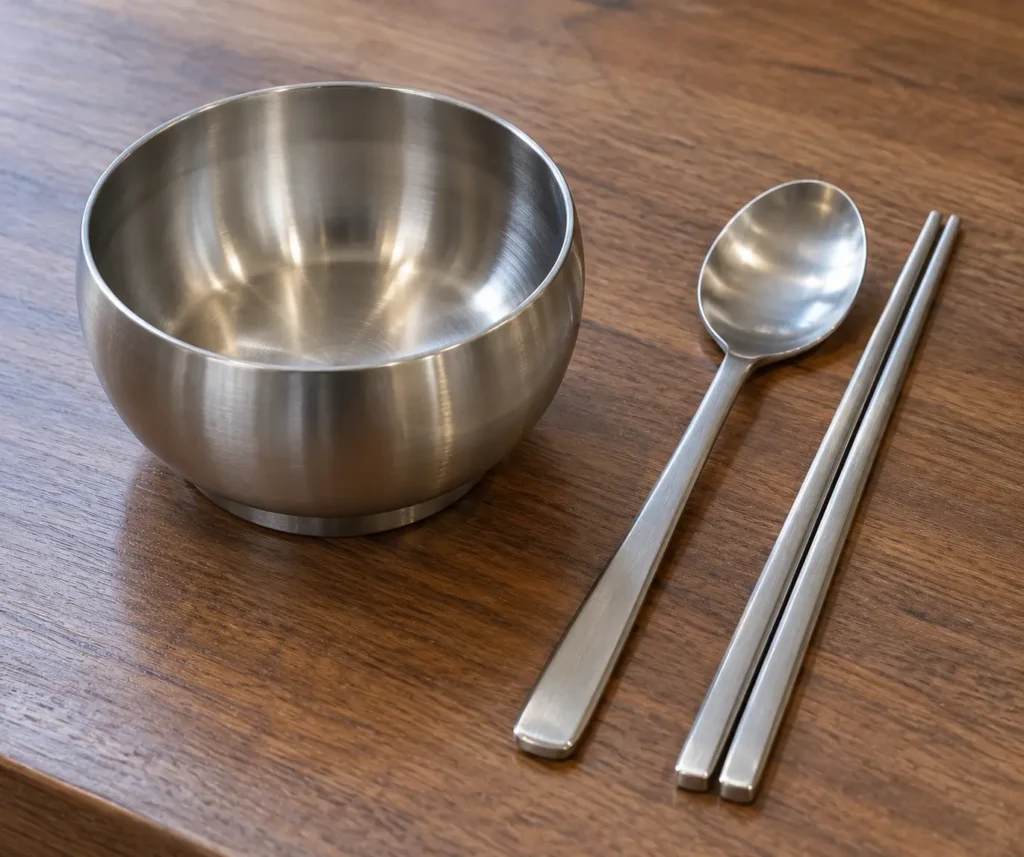
During the Joseon period, developments in metal mining and craftsmanship made bronze bowls increasingly common among ordinary people. They were even traditionally given by brides to their husbands’ families as wedding gifts.
Today, many Korean households and restaurants use stainless-steel bowls because they are durable, inexpensive, and easy to clean. Although the material has changed, its heat-conducting properties still make holding a bowl of hot food inconvenient. Diners therefore usually leave their bowls on the table and eat with a spoon.
An image associated with poverty
Besides these practical reasons, another explanation comes from a traditional belief.
In Korean society in the past, people who had dining tables usually placed their bowls down while eating. By contrast, holding a bowl was sometimes associated with poor people who had nowhere proper to sit and eat or who had to beg for food.
As a result, some families teach children that lifting a bowl while eating resembles the behaviour of a beggar. However, there is not enough historical evidence to confirm that this belief was the original or most important reason behind the custom of not holding bowls.
Therefore, the Korean practice of “avoiding” holding bowls does not simply arise from superstition or taboo. It is the result of spoon use, bowl materials, and social norms passed down through generations. It may be a very small gesture at the dining table, but behind it lies a long story about the history and food culture of Korea.
Source: Vnexpress.net
WORD BANK:
minor /ˈmaɪ.nɚ/ [B2] (adj): nhỏ, không đáng kể
stem from sth /stem frəm/ [C1] (phr.v): bắt nguồn từ cái gì
eating utensil /ˈiː.t̬ɪŋ juːˌten.səl/ (n): dụng cụ ăn uống
chopstick /ˈtʃɑːp.stɪk/ (n): chiếc đũa
long-handled /ˌlɑːŋˈhæn.dəld/ (adj): có cán dài
stew /stuː/ (v): hầm; (n): món hầm
side dish /ˈsaɪd ˌdɪʃ/ (n): món ăn kèm
dining etiquette /ˈdaɪ.nɪŋ ˈet̬.ɪ.kət/ (n): phép tắc, quy tắc ứng xử khi ăn uống
diner /ˈdaɪ.nɚ/ (n): người ăn, thực khách
alternate between sth and sth /ˈɑːl.tɚ.neɪt/ [C1] (v): luân phiên, xen kẽ giữa cái gì và cái gì
feudal /ˈfjuː.dəl/ (adj): thuộc chế độ phong kiến
feudal times /ˈfjuː.dəl taɪmz/ (n): thời phong kiến
the upper class /ði ˌʌp.ɚ ˈklæs/ (n): tầng lớp thượng lưu
peninsula /pəˈnɪn.sə.lə/ (n): bán đảo
alloy /ˈæl.ɔɪ/ (n): hợp kim
copper /ˈkɑː.pɚ/ (n): đồng
tin /tɪn/ (n): thiếc
durable /ˈdʊr.ə.bəl/ [C1] (adj): bền, có độ bền cao
sturdy /ˈstɝː.di/ (adj): chắc chắn, bền chắc
sterilize /ˈster.ə.laɪz/ (v): khử trùng, tiệt trùng
conduct heat /kənˈdʌkt hiːt/ (v): dẫn nhiệt
heat-conducting property /ˈhiːt kənˌdʌk.tɪŋ ˈprɑː.pɚ.t̬i/ (n): đặc tính dẫn nhiệt
craftsmanship /ˈkræfts.mən.ʃɪp/ (n): tay nghề thủ công, kỹ thuật chế tác
ordinary people /ˈɔːr.dən.er.i ˈpiː.pəl/ (n): người dân bình thường
bride /braɪd/ [B1] (n): cô dâu
stainless-steel /ˌsteɪn.ləs ˈstiːl/ (adj): làm bằng thép không gỉ, inox
associated with sb/sth /əˈsoʊ.si.eɪ.t̬ɪd wɪð/ [B2] (adj): có liên quan đến ai/cái gì
proper /ˈprɑː.pɚ/ [B1] (adj): đúng đắn, phù hợp
beg for sth /beɡ fɔːr/ [B1] (v): cầu xin, van xin cái gì
beggar /ˈbeɡ.ɚ/ (n): người ăn xin
resemble /rɪˈzem.bəl/ [C1] (v): giống, trông giống
arise from /əˈraɪz frəm/ [C1] (v): phát sinh từ, bắt nguồn từ
superstition /ˌsuː.pɚˈstɪʃ.ən/ (n): sự mê tín, điều mê tín
taboo /təˈbuː/ (n): điều cấm kỵ
social norm /ˈsoʊ.ʃəl nɔːrm/ (n): chuẩn mực xã hội
behind sth lie sth (phrase): đằng sau cái gì là cái gì; cái gì là nguyên nhân/nền tảng ẩn sau cái gì
ỦNG HỘ READ TO LEAD!
Chào bạn! Có thể bạn chưa biết, Read to Lead là một trang giáo dục phi lợi nhuận với mục đích góp phần phát triển cộng đồng người học tiếng Anh tại Việt Nam. Chúng tôi không yêu cầu người đọc phải trả bất kỳ chi phí nào để sử dụng các sản phẩm của mình để mọi người đều có cơ hội học tập tốt hơn. Tuy nhiên, nếu bạn có thể, chúng tôi mong nhận được sự hỗ trợ tài chính từ bạn để duy trì hoạt động của trang và phát triển các sản phẩm mới.
Bạn có thể ủng hộ chúng tôi qua 1 trong 2 cách dưới đây.
– Cách 1: Chuyển tiền qua tài khoản Momo.
Số điện thoại 0947.886.865 (Chủ tài khoản: Nguyễn Tiến Trung)
Nội dung chuyển tiền: Ủng hộ Read to Lead
hoặc
– Cách 2: Chuyển tiền qua tài khoản ngân hàng.
Ngân hàng VIB chi nhánh Hải Phòng
Số tài khoản: 012704060048394 (Chủ tài khoản: Nguyễn Tiến Trung)
Nội dung chuyển tiền: Ủng hộ Read to Lead
Lớp luyện thi IELTS online
Bạn đang có nhu cầu thi chứng chỉ IELTS cho đầu vào đại học, đi du học, xin việc hay xin cư trú và đang phân vân chưa biết học ở đâu?
Nếu bạn đang tìm kiếm dịch vụ luyện thi IELTS online với giáo viên uy tín và chất lượng, cũng như học phí phải chăng, thì lớp học online của thầy Trung (Admin và dịch giả chính của Read to Lead) có thể là một lựa chọn phù hợp dành cho bạn.
Hãy liên hệ (nhắn tin) tới trang Facebook cá nhân của mình (https://www.facebook.com/nguyen.trung.509) để tìm hiểu về lớp học và được tư vấn cũng như được học thử nha!


Thank you
Thank u ^^