


[Reading level: B2 – Upper Intermediate]
A bottle of water, a cup of coffee, a boxed meal, a few pastries, or a packet of tissues – most of the things sold at 7-Eleven are not worth very much individually. Customers can also easily find them at supermarkets, grocery stores, or nearby eateries. Yet it is precisely from millions of small transactions like these that 7-Eleven has built one of the most remarkable retail models in the world.
What is special about 7-Eleven’s business model is that the company does not simply sell goods. What it really sells is convenience.
A bottle of water at a convenience store may not be as cheap as one at a supermarket. A boxed meal may not necessarily cost less than a meal at an inexpensive local restaurant. Yet customers are willing to pay because they do not have to travel far, spend much time shopping, or worry about when they can find what they need.
That is why store density plays such an important role. 7-Eleven stores can be found in residential areas, near schools and offices, at tourist destinations, and at gas stations, while many locations operate 24 hours a day. Once the network becomes dense enough, shopping no longer necessarily needs to be planned in advance. Someone can buy a coffee on the way to work, pick up lunch at noon, and return for a snack in the evening.
The power of constant repetition
Each of these transactions may be small. But 7-Eleven’s advantage lies in frequency.
People may buy a new phone only once every few years and a house only once every few decades, but they need to eat and drink every day. So instead of trying to make as much money as possible from a single transaction, the convenience-store model aims to get a huge number of customers to come back as often as possible.
Short distances create convenience. Convenience becomes a habit. And habits create repeat transactions.
7-Eleven also keeps creating more reasons for customers to walk through its doors. A modern store is no longer simply a miniature grocery store. It can simultaneously serve as a place to buy breakfast, a coffee shop, a bill-payment point, a parcel collection point, and a food delivery hub.
This creates an important economic effect: each service has the potential to lead to another transaction. Someone who walks into a store to pay a bill may pick up a bottle of water while they are there. Someone collecting a parcel may buy a coffee. A customer stopping by for dinner may also pick up milk, snacks, or other household essentials.
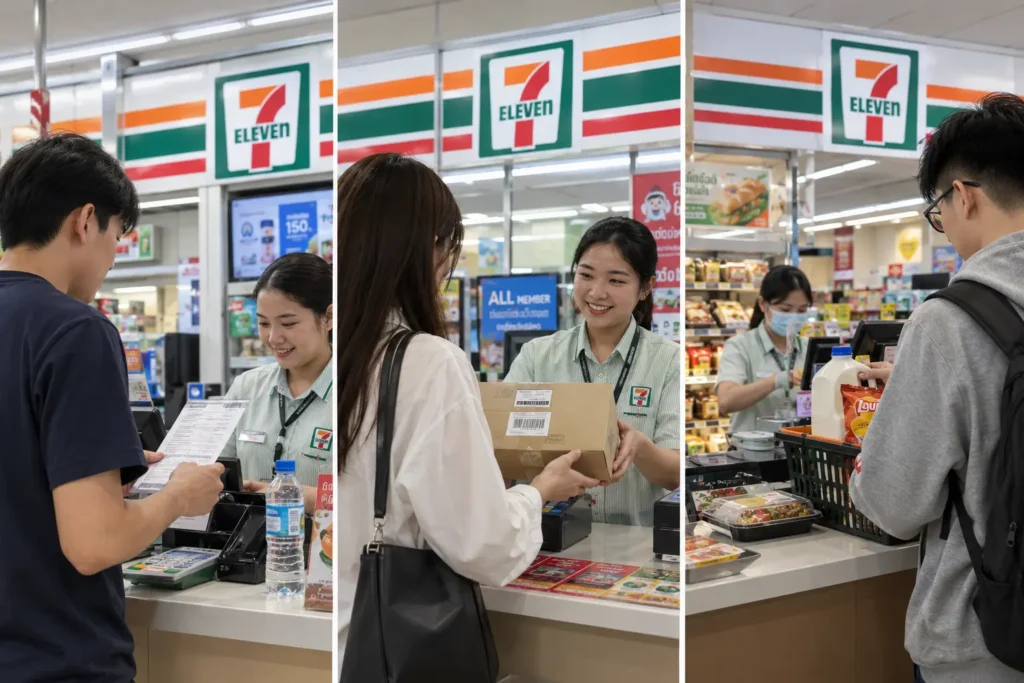
The more reasons customers have to visit a store, the greater the opportunity to sell them something else.
Another major shift has been the move from packaged goods towards prepared food. Boxed meals, sandwiches, sausages, coffee, hot snacks, and frozen foods mean that 7-Eleven no longer competes only with grocery stores and supermarkets. It has also begun competing with coffee shops, street-food vendors, and inexpensive restaurants.
Food is particularly attractive from an economic perspective because it generates demand that is repeated at a very high frequency. Consumers do not need to buy shampoo, toothpaste, or laundry detergent every day, but they do need to eat every day. If 7-Eleven can become the place where someone regularly buys breakfast or lunch, the number of times that person enters the store increases significantly.
When data showcases its power
But operating thousands of small stores also creates another challenge. Unlike supermarkets, convenience stores have limited space. Every square metre of floor space, every refrigerator, and every position on a shelf must be used efficiently. Stocking the wrong product means wasting valuable space; stocking too little means losing sales, while stocking too much food can result in products expiring before they are sold.
This is where data becomes one of the system’s greatest advantages.
Transaction data allows the company to know when a particular store sells the most coffee, which areas consume the most boxed meals, which products are commonly purchased together, and how demand changes across different days of the week. This information helps the system forecast demand and decide which products, and how much of each, should be delivered to individual stores.
Membership programmes such as All Member also help the company better understand customer behaviour and personalise promotions. While a traditional grocery store often relies heavily on the owner’s experience when deciding what to stock, a large chain can make decisions based on data accumulated from an enormous number of transactions.
The larger the scale, the stronger this advantage becomes.
A network of thousands of stores can purchase goods in larger quantities, increase its bargaining power with suppliers, and spread the costs of technology, logistics, marketing, and product development across the entire system. In the case of 7-Eleven in Thailand, the wider ecosystem behind the chain also includes food production, logistics, and distribution. As a result, the company does not merely own retail outlets; it also controls a significant part of the system that moves products from where they are produced to the end consumer.

This is an advantage that an independent grocery store finds extremely difficult to replicate. A small shop may sell the same soft drinks or instant noodles and may even offer lower prices. But it is very difficult to compete simultaneously in terms of network size, supply chains, technology, data, proprietary products, and the range of services offered.
7-Eleven also does not want to stop at “emergency” purchases. Larger stores with parking spaces are adding fresh food, frozen products, household goods, and larger packaged products. This allows the chain to take another step: moving from serving immediate needs to capturing a share of households’ regular shopping budgets.
At its core, the growth equation behind this model can be reduced to a fairly simple formula:
more stores × more customers × more frequent visits × larger baskets = more revenue.
The model is also particularly well suited to the changes taking place in modern society. As urbanisation increases, households become smaller, more people live alone, and workers become increasingly busy, the need to buy large quantities of goods for storage may give way to a pattern of buying smaller amounts more frequently. A meal for one, a takeaway coffee, or a store just a few minutes from home becomes increasingly compatible with the pace of urban life.

Seen this way, 7-Eleven is not simply a chain made up of a huge number of small stores. It is a system designed to shorten the distance between the moment a need arises and the moment that need is met.
Store density solves the problem of distance. Twenty-four-hour operations solve the problem of time. Prepared food increases purchasing frequency. Additional services give customers more reasons to enter the store. Data helps reduce excess inventory and waste. And scale makes the entire system increasingly efficient and difficult to replicate.
A grocery store may sell the same bottle of water, the same packet of snacks, or the same carton of milk as 7-Eleven. But what 7-Eleven has really built is not merely a range of products. It is a network of convenience.
And that is the economics of 7-Eleven: each transaction may be small, but when convenience is standardised, scaled up, and repeated millions of times, those small transactions can build a retail empire.
WORD BANK:
pastry /ˈpeɪ.stri/ [B1] (n): bánh ngọt
be worth sth /wɝːθ/ [B1]: đáng giá, đáng để bỏ tiền/công sức
grocery store /ˈɡroʊ.sɚ.i stɔːr/ (n): cửa hàng tạp hóa, cửa hàng thực phẩm
eatery /ˈiː.t̬ɚ.i/ (n): quán ăn
transaction /trænˈzæk.ʃən/ [B2] (n): giao dịch
retail /ˈriː.teɪl/ [B2] (n/adj): hoạt động bán lẻ; thuộc về bán lẻ
retail model /ˈriː.teɪl ˌmɑː.dəl/ (n): mô hình bán lẻ
not necessarily /ˌnes.əˈser.ə.li/ [B2]: không nhất thiết
be willing to do sth /ˈwɪl.ɪŋ/ [B1]: sẵn lòng, sẵn sàng làm gì
density /ˈden.sə.t̬i/ [C1] (n): mật độ
dense /dens/ [C1] (adj): dày đặc
in advance /ədˈvæns/ [B1]: trước, từ trước
frequency /ˈfriː.kwən.si/ [B2] (n): tần suất
miniature /ˈmɪn.i.ə.tʃɚ/ [C1] (adj): thu nhỏ, có kích thước rất nhỏ
simultaneously /ˌsaɪ.məlˈteɪ.ni.əs.li/ [C1] (adv): đồng thời
bill-payment point /ˈbɪl ˌpeɪ.mənt pɔɪnt/ (n): điểm thanh toán hóa đơn
parcel collection point /ˈpɑːr.səl kəˈlek.ʃən pɔɪnt/ (n): điểm nhận hàng, điểm nhận bưu kiện
food delivery /ˈfuːd dɪˌlɪv.ɚ.i/ (n): dịch vụ giao đồ ăn
hub /hʌb/ [C1] (n): trung tâm, đầu mối
street-food vendor /ˈstriːt fuːd ˌven.dɚ/ (n): người bán đồ ăn đường phố
from an economic perspective [C1]: xét từ góc độ kinh tế
laundry detergent /ˈlɑːn.dri dɪˌtɝː.dʒənt/ (n): nước/bột giặt
shelf /ʃelf/ [B1] (n): kệ
stock sth /stɑːk/ [C1] (v): nhập và trữ hàng để bán; bày bán cái gì
stocking /ˈstɑː.kɪŋ/ (n): việc nhập và trữ hàng
expire /ɪkˈspaɪr/ [B2] (v): hết hạn
purchase /ˈpɝː.tʃəs/ [B2] (n/v): sự mua hàng; mua
forecast sth /ˈfɔːr.kæst/ [B2] (v): dự báo cái gì
personalise sth /ˈpɝː.sən.əl.aɪz/ (v): cá nhân hóa cái gì
promotion /prəˈmoʊ.ʃən/ [B2] (n): chương trình khuyến mại
chain /tʃeɪn/ [B2] (n): chuỗi cửa hàng/doanh nghiệp
accumulate /əˈkjuː.mjə.leɪt/ [C1] (v): tích lũy
enormous /ɪˈnɔːr.məs/ [B1] (adj): khổng lồ, rất lớn
in larger quantities /ˈkwɑːn.t̬ə.t̬iz/: với số lượng lớn hơn
bargaining power /ˈbɑːr.ɡə.nɪŋ ˌpaʊ.ɚ/ (n): sức mạnh, vị thế đàm phán
distribution /ˌdɪs.trəˈbjuː.ʃən/ [B2] (n): sự phân phối
merely /ˈmɪr.li/ [B2] (adv): chỉ, đơn thuần
retail outlet /ˈriː.teɪl ˌaʊt.let/ (n): điểm bán lẻ, cửa hàng bán lẻ
end consumer /ˌend kənˈsuː.mɚ/ (n): người tiêu dùng cuối cùng
replicate /ˈrep.lə.keɪt/ [C1] (v): sao chép, tái tạo
simultaneously /ˌsaɪ.məlˈteɪ.ni.əs.li/ [C1] (adv): đồng thời
proprietary product /prəˈpraɪə.ter.i ˌprɑː.dʌkt/ (n): sản phẩm độc quyền, sản phẩm riêng của doanh nghiệp
capture sth /ˈkæp.tʃɚ/ [C1] (v): giành được, chiếm được cái gì
budget /ˈbʌdʒ.ɪt/ [B2] (n): ngân sách
at its core /kɔːr/ [C1]: về bản chất, về cốt lõi
growth equation /ˈɡroʊθ ɪˌkweɪ.ʒən/ (n): phương trình, công thức tăng trưởng
fairly /ˈfer.li/ [B1] (adv): khá, tương đối
formula /ˈfɔːr.mjə.lə/ [B2] (n): công thức
well suited to sth /ˈsuː.t̬ɪd/ [C1]: rất phù hợp với cái gì
give way to sth /ˌɡɪv ˈweɪ/ [C1]: nhường chỗ cho, dần được thay thế bởi cái gì
pattern /ˈpæt̬.ɚn/ [B1] (n): kiểu, mô hình, xu hướng lặp lại
takeaway /ˈteɪk.ə.weɪ/ [B1] (adj): mang đi
arise /əˈraɪz/ [B2] (v): phát sinh, xuất hiện
meet sth /miːt/ [B1] (v): đáp ứng cái gì
carton /ˈkɑːr.t̬ən/ [B2] (n): hộp giấy, hộp carton
the economics of … /ˌek.əˈnɑː.mɪks/ (n): khía cạnh kinh tế, cơ chế kinh tế của…
standardize /ˈstæn.dɚ.daɪz/ [C1] (v): tiêu chuẩn hóa
scale up /ˌskeɪl ˈʌp/ (phr v): mở rộng quy mô
empire /ˈem.paɪr/ [B2] (n): đế chế
ỦNG HỘ READ TO LEAD!
Chào bạn! Có thể bạn chưa biết, Read to Lead là một trang giáo dục phi lợi nhuận với mục đích góp phần phát triển cộng đồng người học tiếng Anh tại Việt Nam. Chúng tôi không yêu cầu người đọc phải trả bất kỳ chi phí nào để sử dụng các sản phẩm của mình để mọi người đều có cơ hội học tập tốt hơn. Tuy nhiên, nếu bạn có thể, chúng tôi mong nhận được sự hỗ trợ tài chính từ bạn để duy trì hoạt động của trang và phát triển các sản phẩm mới.
Bạn có thể ủng hộ chúng tôi qua 1 trong 2 cách dưới đây.
– Cách 1: Chuyển tiền qua tài khoản Momo.
Số điện thoại 0947.886.865 (Chủ tài khoản: Nguyễn Tiến Trung)
Nội dung chuyển tiền: Ủng hộ Read to Lead
hoặc
– Cách 2: Chuyển tiền qua tài khoản ngân hàng.
Ngân hàng VIB chi nhánh Hải Phòng
Số tài khoản: 012704060048394 (Chủ tài khoản: Nguyễn Tiến Trung)
Nội dung chuyển tiền: Ủng hộ Read to Lead
Lớp luyện thi IELTS online
Bạn đang có nhu cầu thi chứng chỉ IELTS cho đầu vào đại học, đi du học, xin việc hay xin cư trú và đang phân vân chưa biết học ở đâu?
Nếu bạn đang tìm kiếm dịch vụ luyện thi IELTS online với giáo viên uy tín và chất lượng, cũng như học phí phải chăng, thì lớp học online của thầy Trung (Admin và dịch giả chính của Read to Lead) có thể là một lựa chọn phù hợp dành cho bạn.
Hãy liên hệ (nhắn tin) tới trang Facebook cá nhân của mình (https://www.facebook.com/nguyen.trung.509) để tìm hiểu về lớp học và được tư vấn cũng như được học thử nha!


