


[Reading level: C1 – Advanced]
There is one fact that you have probably experienced: food always tastes better when you are hungry. After a long day without having the chance to eat, even a bowl of rice with a fried egg can become unusually appealing. In fact, the food has not changed at all. It is your body and brain that have changed the way you perceive it.
Hunger does not arise simply because your stomach is empty. It results from coordination between the digestive system, hormones, and the brain. When you have not eaten for a long time, levels of ghrelin, a hormone produced mainly in the stomach, usually rise. Ghrelin sends signals to the hypothalamus—the area of the brain that helps regulate hunger and maintain energy balance. It also affects the brain’s reward system, increasing your motivation to seek food.
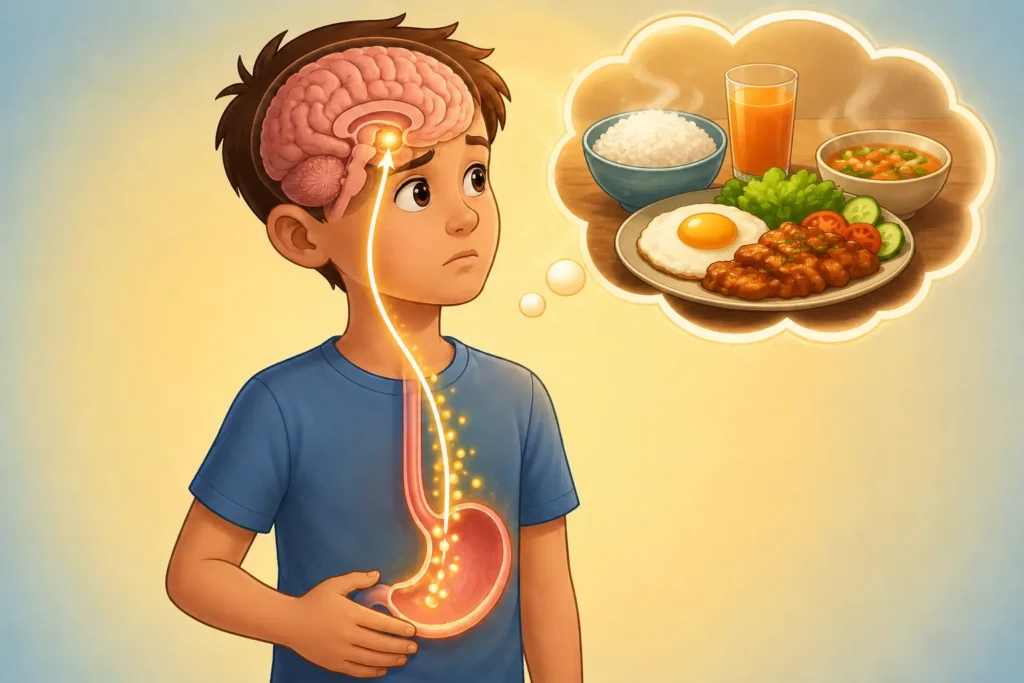
When you are hungry, sweetness does not necessarily become sweeter, nor does saltiness necessarily become stronger. What changes most noticeably is the level of pleasure that the brain associates with those flavours. The food still has the same characteristics as before, but we enjoy it more.
The phenomenon in which a sensation becomes pleasant or unpleasant depending on the body’s internal state is known as alliesthesia. For example, a glass of cool water may seem quite ordinary when you are not thirsty but feel extremely refreshing after exercising in hot weather. Similarly, food usually provides more pleasure when you are hungry and gradually becomes less appealing as you become full.
Studies show that the brain processes a food’s characteristics and its pleasantness in ways that are not entirely the same. After eating until you are full, the food may retain the same taste, but you no longer find it as appealing as before. The orbitofrontal cortex, a region involved in evaluating rewards, plays an important role in this change.
Hunger also affects the sense of smell. Much of the experience that we call “flavour” is actually created through a combination of taste and smell. Research shows that ghrelin can increase the ability to detect odours and encourage sniffing behaviour in the search for food. Therefore, when you are hungry, the smell of freshly baked bread or frying food may become particularly noticeable. The brain is prioritising signals that could lead you to a source of energy.
Dopamine also takes part in this process by helping the brain identify which rewards deserve attention and motivating us to act to obtain them. One experiment found that after fasting for 24 hours, participants rated food as more appealing, were willing to make a greater effort to obtain it, and ultimately ate more than when they were full.
This also explains why the first few bites often seem to taste the best. When you begin a meal while hungry, the body’s need for energy and the reward value of food are both high. The aroma, flavour, and energy provided by the food all signal that this need is about to be met, creating a powerful feeling of satisfaction.
As you continue eating, the stomach gradually expands, nutrients enter the digestive tract, and signals of fullness begin to appear. Ghrelin levels fall, while the brain gradually reduces the food’s reward value. Therefore, the food may retain the same flavour but no longer taste as good as it did at the beginning.
The saying “anything tastes good when you are hungry” therefore has a clear scientific basis. When the body needs energy, hormones and the brain make us pay more attention to food, desire it more, and find it more appealing. It could be said that the special seasoning of a meal sometimes lies not in the kitchen, but within the body of the person enjoying it.
WORD BANK:
appealing /əˈpiː.lɪŋ/ [B2] (adj): hấp dẫn, lôi cuốn
perceive sth /pɚˈsiːv/ [C1] (v): nhận thấy, cảm nhận cái gì
arise /əˈraɪz/ [C1] (v): phát sinh, xuất hiện
digestive system /daɪˈdʒes.tɪv ˌsɪs.təm/ (n): hệ tiêu hóa
ghrelin /ˈɡrel.ɪn/ (n): ghrelin, hormone kích thích cảm giác đói
hypothalamus /ˌhaɪ.poʊˈθæl.ə.məs/ (n): vùng dưới đồi
regulate sth /ˈreɡ.jə.leɪt/ [C1] (v): điều chỉnh, điều hòa cái gì
saltiness /ˈsɑːl.t̬i.nəs/ (n): vị mặn, độ mặn
pleasure /ˈpleʒ.ɚ/ [B1] (n): niềm vui, sự thích thú
associate sth with sth /əˈsoʊ.si.eɪt/ [B2] (v): liên hệ cái gì với cái gì
phenomenon /fəˈnɑː.mə.nɑːn/ [B2] (n): hiện tượng
sensation /senˈseɪ.ʃən/ [B2] (n): cảm giác
internal /ɪnˈtɝː.nəl/ [B2] (adj): bên trong, nội tại
state /steɪt/ [B1] (n): trạng thái, tình trạng
ordinary /ˈɔːr.dən.er.i/ [B1] (adj): bình thường, thông thường
retain sth /rɪˈteɪn/ [C1] (v): giữ lại, duy trì cái gì
orbitofrontal cortex /ˌɔːr.bɪ.toʊˈfrʌn.təl ˈkɔːr.teks/ (n): vỏ não ổ mắt–trán
detect sth /dɪˈtekt/ [B2] (v): phát hiện, nhận ra cái gì
odour /ˈoʊ.dɚ/ [C1] (n): mùi
sniff /snɪf/ [C2] (v): ngửi, hít vào bằng mũi
freshly baked /ˌfreʃ.li ˈbeɪkt/ (adj): vừa mới nướng
identify sth /aɪˈden.t̬ə.faɪ/ [B1] (v): xác định, nhận diện cái gì
deserve sth /dɪˈzɝːv/ [B1] (v): xứng đáng nhận được cái gì
obtain sth /əbˈteɪn/ [B2] (v): đạt được, có được cái gì
experiment /ɪkˈsper.ə.mənt/ [B1] (n): thí nghiệm
fast /fæst/ (v): nhịn ăn
fasting /ˈfæs.tɪŋ/ (n): việc nhịn ăn
ultimately /ˈʌl.tə.mət.li/ [C1] (adv): cuối cùng, xét cho cùng
aroma /əˈroʊ.mə/ (n): hương thơm
be about to do sth /bi əˈbaʊt tə/ [B1] (phrase): sắp sửa làm gì
digestive tract /daɪˈdʒes.tɪv trækt/ (n): đường tiêu hóa
desire sth /dɪˈzaɪr/ [B2] (v): mong muốn, khao khát cái gì
seasoning /ˈsiː.zən.ɪŋ/ (n): gia vị
ỦNG HỘ READ TO LEAD!
Chào bạn! Có thể bạn chưa biết, Read to Lead là một trang giáo dục phi lợi nhuận với mục đích góp phần phát triển cộng đồng người học tiếng Anh tại Việt Nam. Chúng tôi không yêu cầu người đọc phải trả bất kỳ chi phí nào để sử dụng các sản phẩm của mình để mọi người đều có cơ hội học tập tốt hơn. Tuy nhiên, nếu bạn có thể, chúng tôi mong nhận được sự hỗ trợ tài chính từ bạn để duy trì hoạt động của trang và phát triển các sản phẩm mới.
Bạn có thể ủng hộ chúng tôi qua 1 trong 2 cách dưới đây.
– Cách 1: Chuyển tiền qua tài khoản Momo.
Số điện thoại 0947.886.865 (Chủ tài khoản: Nguyễn Tiến Trung)
Nội dung chuyển tiền: Ủng hộ Read to Lead
hoặc
– Cách 2: Chuyển tiền qua tài khoản ngân hàng.
Ngân hàng VIB chi nhánh Hải Phòng
Số tài khoản: 012704060048394 (Chủ tài khoản: Nguyễn Tiến Trung)
Nội dung chuyển tiền: Ủng hộ Read to Lead
Lớp luyện thi IELTS online
Bạn đang có nhu cầu thi chứng chỉ IELTS cho đầu vào đại học, đi du học, xin việc hay xin cư trú và đang phân vân chưa biết học ở đâu?
Nếu bạn đang tìm kiếm dịch vụ luyện thi IELTS online với giáo viên uy tín và chất lượng, cũng như học phí phải chăng, thì lớp học online của thầy Trung (Admin và dịch giả chính của Read to Lead) có thể là một lựa chọn phù hợp dành cho bạn.
Hãy liên hệ (nhắn tin) tới trang Facebook cá nhân của mình (https://www.facebook.com/nguyen.trung.509) để tìm hiểu về lớp học và được tư vấn cũng như được học thử nha!


thank you