


[Reading level: B2 – Upper Intermediate]
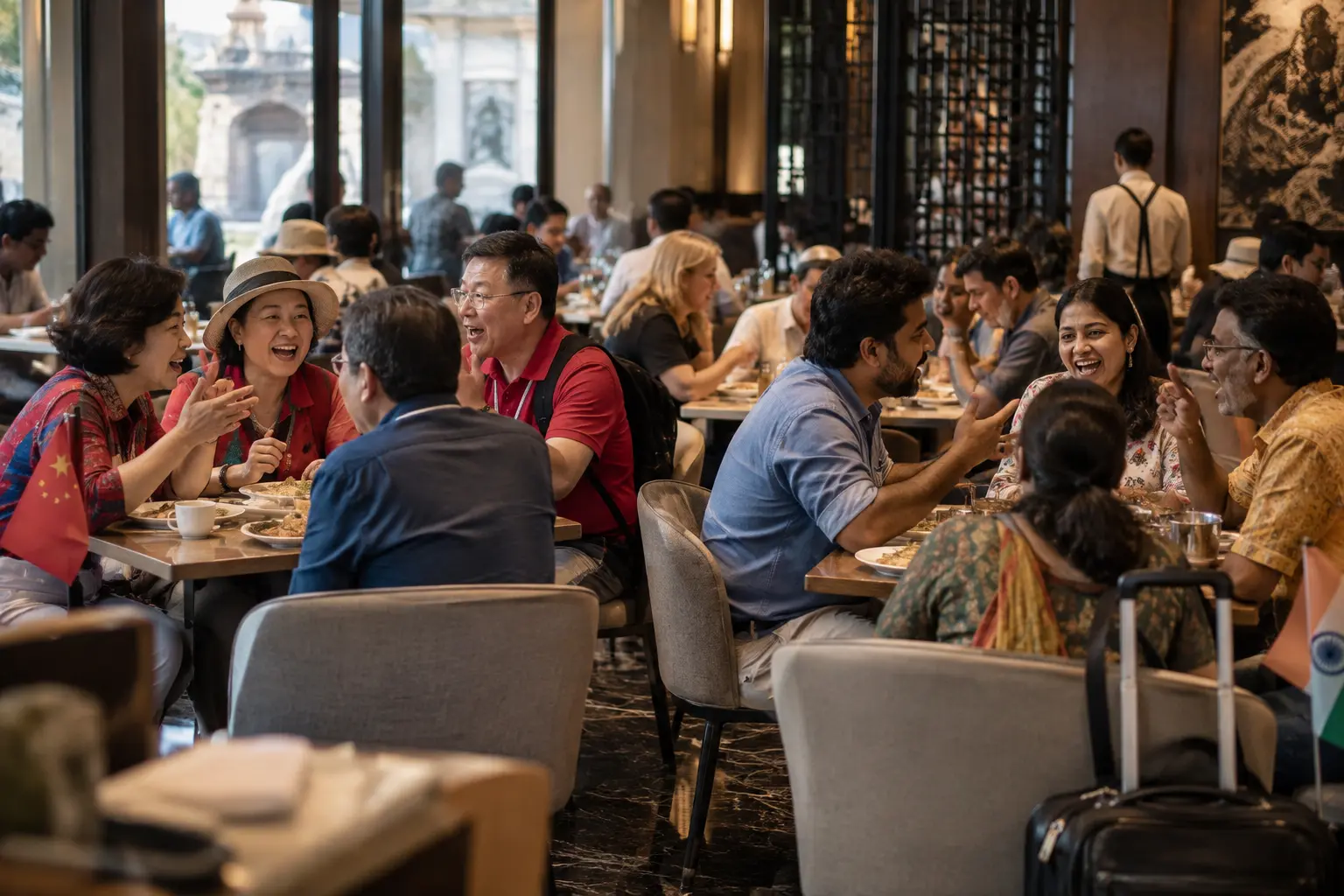
Chinese and Indian tourists sometimes attract attention at international tourist destinations because they tend to speak quite loudly. On public transport, in restaurants and hotels, or at tourist attractions, a group of visitors may chat so animatedly that people around them find them noisy. However, this does not simply result from a lack of awareness or manners, but is also related to differences in living environments, communication cultures, and everyday habits.
One of the most important reasons is the crowded environment. China and India are the two most populous countries in the world and are also home to many cities with very high population densities. In markets, train stations, streets, shopping malls, and on public transport, people often have to communicate amid a great deal of surrounding noise. As a result, raising their voices so that the other person can hear clearly may gradually become a habit. When travelling to countries where public spaces are quieter, they may maintain their usual volume and unintentionally stand out.
A lively communication culture also contributes to this difference. In many communities in China and India, family gatherings, meals, and meetings with friends are often quite lively. People may talk at the same time, laugh loudly, call out to one another from a distance, or express their emotions strongly. Speaking loudly in these situations is not necessarily understood as a sign of anger or rudeness. On the contrary, it can sometimes express excitement, closeness, and enthusiasm.
This becomes even more noticeable when tourists travel in large groups. Chinese and Indian tourists often travel in family groups, groups of friends, or organised tours. When a group has many members talking together, speakers naturally have to raise their voices so that those standing farther away can hear them. One person speaking loudly causes another to raise their voice as well, creating a kind of “sound competition.” A conversation that would otherwise be normal can therefore become quite noisy in the eyes of those around them.

Differences in norms regarding public spaces are another important factor. Every culture has different ideas about what level of volume is appropriate. In Japan or some Nordic countries, remaining quiet on trains, speaking softly in restaurants, or limiting phone calls in public places is highly valued. Meanwhile, in many crowded public spaces in China and India, loud conversations are more common. Therefore, the same level of volume may be considered normal in one place but too loud in another.
In addition, prolonged exposure to urban noise can affect the way people use their voices. Many large cities in China and India have heavy traffic, continuous construction, and huge numbers of people. In environments filled with car horns, machinery, and human voices, people tend to automatically speak louder so that their voices are not drowned out. This natural phenomenon is known as the Lombard effect. Once accustomed to this level of volume, a person may continue to speak relatively loudly even when they are in a quieter environment.
Another reason lies in the way emotions are expressed. In some communities, a strong and energetic voice may be associated with confidence, enthusiasm, or sincerity. A group of Chinese friends or a large Indian family speaking loudly over a meal may simply be having a very enjoyable time. However, to people from cultures that place a high value on quietness, such a conversation may easily be interpreted as an argument or a lack of consideration for others.
International travel makes these differences more apparent. When travelling abroad, people often bring with them communication habits formed in their own living environments and may not always realise that the norms at their destination are different from those at home. A tourist may not be aware that they are speaking too loudly because, to them, it is simply a normal speaking volume.
Of course, these observations cannot be used to conclude that all Chinese and Indian tourists speak loudly. These two countries have a combined population of more than 2.8 billion people, encompassing countless regions, languages, generations, and communication styles. The fact that some groups of tourists are more noticeable may also cause observers to remember them more readily than tourists who speak quietly.
Therefore, the perception that Chinese and Indian tourists tend to speak loudly can be explained by a combination of factors: crowded living environments, urban noise, the habit of travelling in groups, lively communication cultures, and differences in norms regarding appropriate volume in public spaces. Rather than simply regarding it as rude behaviour, looking at the issue from a cultural perspective helps explain why the same way of communicating may be completely normal at home but become much more noticeable when people travel abroad.
WORD BANK:
animatedly /ˈæn.ə.meɪ.t̬ɪd.li/ (adv): một cách sôi nổi, hào hứng
manner /ˈmæn.ɚ/ [B1] (n): cách thức; thái độ, cách cư xử
populous /ˈpɑː.pjə.ləs/ (adj): đông dân
population density /ˌpɑː.pjəˈleɪ.ʃən ˈden.sə.t̬i/ (n): mật độ dân số
unintentionally /ˌʌn.ɪnˈten.ʃən.əl.i/ (adv): một cách vô tình, không cố ý
stand out /stænd aʊt/ [B2] (phr v): nổi bật, dễ gây chú ý
lively /ˈlaɪv.li/ [B2] (adj): sôi nổi, náo nhiệt
gathering /ˈɡæð.ɚ.ɪŋ/ [B2] (n): buổi tụ họp, cuộc gặp mặt
call out to one another /kɑːl aʊt/ (phr v): gọi lớn với nhau, gọi nhau từ xa
not necessarily /ˌnes.əˈser.əl.i/ (adv): không nhất thiết
rudeness /ˈruːd.nəs/ (n): sự thô lỗ, bất lịch sự
enthusiasm /ɪnˈθuː.zi.æz.əm/ [B2] (n): sự nhiệt tình, hào hứng
otherwise /ˈʌð.ɚ.waɪz/ [B2] (adv): nếu không; trong trường hợp khác; vốn, nhẽ ra
in the eyes of sb /aɪz/ (phrase): trong mắt, theo quan điểm của ai
norm /nɔːrm/ [C1] (n): chuẩn mực, quy tắc được coi là bình thường
regarding sth /rɪˈɡɑːr.dɪŋ/ [B2] (prep): về, liên quan đến cái gì
appropriate /əˈproʊ.pri.ət/ [B2] (adj): phù hợp, thích hợp
Nordic country /ˈnɔːr.dɪk ˈkʌn.tri/ (n): quốc gia Bắc Âu
speak softly /spiːk ˈsɑːft.li/ (phrase): nói nhỏ, nói nhẹ nhàng
prolonged /prəˈlɑːŋd/ [C1] (adj): kéo dài
exposure to sth /ɪkˈspoʊ.ʒɚ/ [B2] (n): sự tiếp xúc với cái gì
car horn /ˈkɑːr hɔːrn/ (n): còi xe ô tô
machinery /məˈʃiː.nɚ.i/ [B2] (n): máy móc
drown out sth /draʊn aʊt/ (phr v): át đi, lấn át âm thanh
phenomenon /fəˈnɑː.mə.nɑːn/ [B2] (n): hiện tượng
accustomed to sth /əˈkʌs.təmd/ (adj): quen với cái gì
relatively /ˈrel.ə.t̬ɪv.li/ [B2] (adv): tương đối
lie in sth /laɪ/ (v): nằm ở, bắt nguồn từ cái gì
sincerity /sɪnˈser.ə.t̬i/ (n): sự chân thành
place a high value on /ˈvæl.juː/ (phrase): coi trọng, đánh giá cao
interpret sth as sth /ɪnˈtɝː.prət/ [B2] (v): hiểu, diễn giải cái gì là cái gì
consideration for others /kənˌsɪd.əˈreɪ.ʃən/ [B2] (n): sự quan tâm, ý thức nghĩ đến người khác
apparent /əˈper.ənt/ [B2] (adj): rõ ràng, dễ nhận thấy
encompass sth /ɪnˈkʌm.pəs/ (v): bao gồm, bao hàm cái gì
countless /ˈkaʊnt.ləs/ (adj): vô số, không đếm xuể
rude /ruːd/ [B1] (adj): thô lỗ, bất lịch sự
from a cultural perspective /ˈkʌl.tʃɚ.əl pɚˈspek.tɪv/ (phrase): từ góc độ văn hóa
ỦNG HỘ READ TO LEAD!
Chào bạn! Có thể bạn chưa biết, Read to Lead là một trang giáo dục phi lợi nhuận với mục đích góp phần phát triển cộng đồng người học tiếng Anh tại Việt Nam. Chúng tôi không yêu cầu người đọc phải trả bất kỳ chi phí nào để sử dụng các sản phẩm của mình để mọi người đều có cơ hội học tập tốt hơn. Tuy nhiên, nếu bạn có thể, chúng tôi mong nhận được sự hỗ trợ tài chính từ bạn để duy trì hoạt động của trang và phát triển các sản phẩm mới.
Bạn có thể ủng hộ chúng tôi qua 1 trong 2 cách dưới đây.
– Cách 1: Chuyển tiền qua tài khoản Momo.
Số điện thoại 0947.886.865 (Chủ tài khoản: Nguyễn Tiến Trung)
Nội dung chuyển tiền: Ủng hộ Read to Lead
hoặc
– Cách 2: Chuyển tiền qua tài khoản ngân hàng.
Ngân hàng VIB chi nhánh Hải Phòng
Số tài khoản: 012704060048394 (Chủ tài khoản: Nguyễn Tiến Trung)
Nội dung chuyển tiền: Ủng hộ Read to Lead
Lớp luyện thi IELTS online
Bạn đang có nhu cầu thi chứng chỉ IELTS cho đầu vào đại học, đi du học, xin việc hay xin cư trú và đang phân vân chưa biết học ở đâu?
Nếu bạn đang tìm kiếm dịch vụ luyện thi IELTS online với giáo viên uy tín và chất lượng, cũng như học phí phải chăng, thì lớp học online của thầy Trung (Admin và dịch giả chính của Read to Lead) có thể là một lựa chọn phù hợp dành cho bạn.
Hãy liên hệ (nhắn tin) tới trang Facebook cá nhân của mình (https://www.facebook.com/nguyen.trung.509) để tìm hiểu về lớp học và được tư vấn cũng như được học thử nha!


