


[Reading level: B2 – Upper Intermediate]
Russia is developing a plasma engine that uses hydrogen fuel to accelerate charged particles such as electrons and protons to speeds of up to 100 km/s. The technology is expected to be ready by 2030.
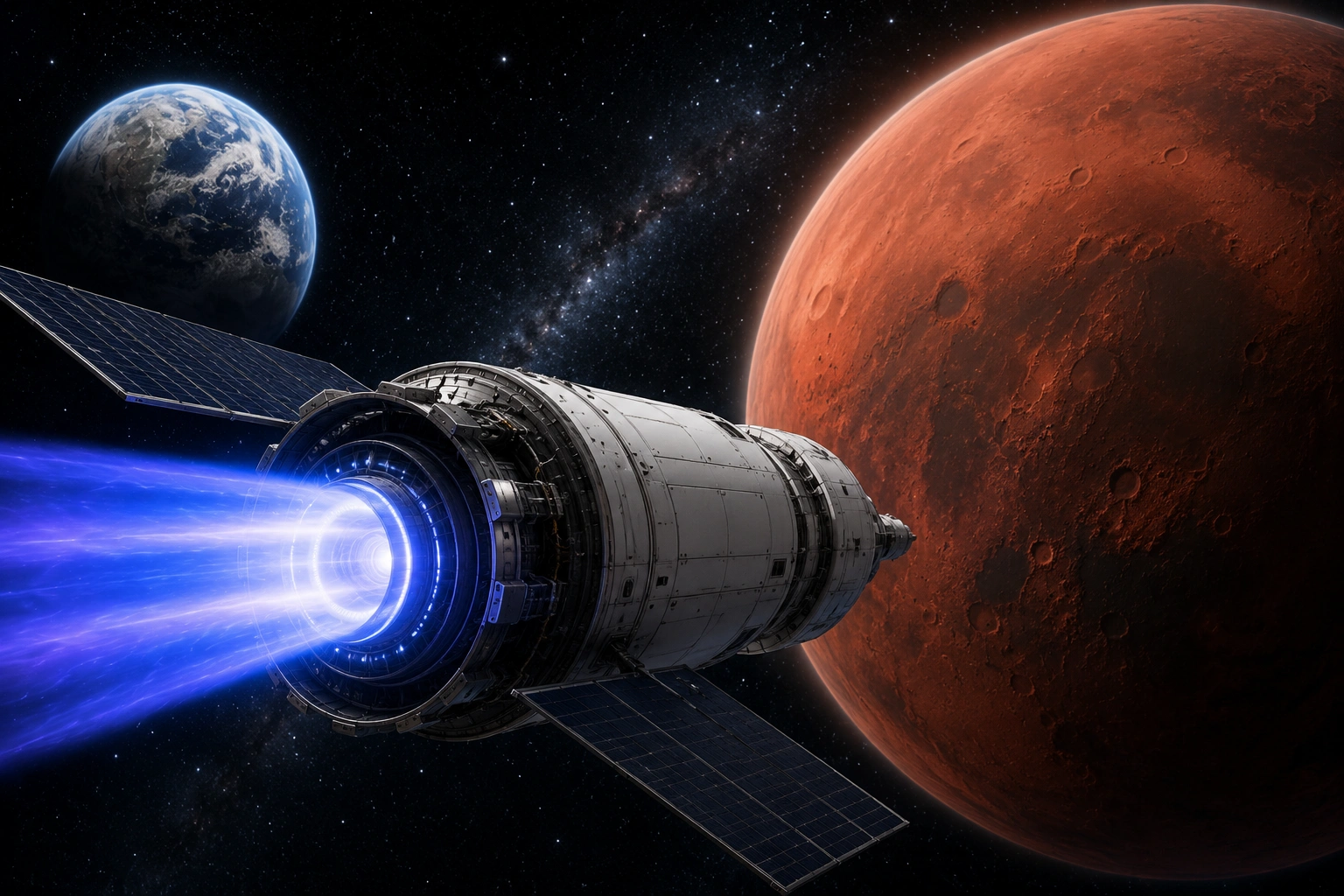
Scientists at Russia’s nuclear energy corporation have introduced an electric plasma rocket engine that could send spacecraft to Mars in just one or two months. Unlike traditional rocket engines that rely on fuel combustion, this advanced propulsion system could significantly reduce interplanetary travel time.
“A plasma rocket engine is a type of electric motor based on two electrodes. Charged particles move between them while a high voltage is applied,” explained researcher Egor Biriulin. “The resulting electric current creates a magnetic field that pushes the particles out of the engine. As a result, the plasma gains directed motion and produces thrust.”

Using this approach, the engine runs on hydrogen fuel and accelerates electrons and protons to speeds of up to 100 km/s. According to the researchers, conventional systems can only achieve speeds of about 4.5 km/s because of the limits of fuel combustion. In contrast, the new engine relies on electromagnetic fields to accelerate particles.
A faster journey to Mars would not only improve efficiency but also reduce the risks astronauts face from long-term exposure to cosmic radiation. Researchers have already developed a laboratory prototype of the engine. It will undergo ground testing before a flight version is produced, which is expected by 2030.
The engine operates in a pulse-cycle mode and has a power output of around 300 kW. According to the project’s scientific adviser, its operating lifetime of more than 2,400 hours is sufficient for transportation missions to Mars.
To support testing, a special chamber has been built to simulate space conditions. The facility is equipped with advanced sensors, vacuum pumps, and heat-removal systems. It measures four meters in diameter and fourteen meters in length.
After a spacecraft is launched into orbit by a chemical rocket, the plasma engine will be activated. The technology could also be used in space tug vehicles that transport cargo between planets. Since plasma does not require extreme heating, the engine avoids thermal overload and converts most of its electrical energy into motion. With an estimated thrust of about six newtons, it can accelerate and decelerate smoothly during interplanetary travel.
Source: https://vnexpress.net/dong-co-plasma-giup-bay-toi-sao-hoa-trong-30-ngay-4847569.html
WORD BANK:
proton /ˈproʊ.tɑːn/ (n): proton
charged particle /tʃɑːrdʒd ˈpɑːr.tɪ.kəl/ (n): hạt tích điện
accelerate /əkˈsel.ə.reɪt/ (v): tăng tốc
fuel combustion /ˈfjuː.əl kəmˈbʌs.tʃən/ (n): sự đốt cháy nhiên liệu
propulsion system /prəˈpʌl.ʃən ˈsɪs.təm/ (n): hệ thống đẩy
voltage /ˈvoʊl.tɪdʒ/ (n): hiệu điện thế
electric current /ɪˈlek.trɪk ˈkɝː.ənt/ (n): dòng điện
directed motion /dəˈrek.tɪd ˈmoʊ.ʃən/ (n): chuyển động theo hướng xác định
conventional /kənˈven.ʃən.əl/ [B2] (adj): thông thường, truyền thống
astronaut /ˈæs.trə.nɑːt/ (n): phi hành gia
exposure to sth /ɪkˈspoʊ.ʒɚ tuː/ (n): sự tiếp xúc với cái gì
cosmic radiation /ˈkɑːz.mɪk ˌreɪ.diˈeɪ.ʃən/ (n): bức xạ vũ trụ
prototype /ˈproʊ.t̬ə.taɪp/ (n): nguyên mẫu
undergo /ˌʌn.dɚˈɡoʊ/ [B2] (v): trải qua
sufficient for sth /səˈfɪʃ.ənt fɔːr/ (adj): đủ cho cái gì
chamber /ˈtʃeɪm.bɚ/ (n): buồng, khoang
vacuum pump /ˈvæk.juːm pʌmp/ (n): bơm chân không
orbit /ˈɔːr.bɪt/ (n): quỹ đạo
thermal overload /ˈθɝː.məl ˌoʊ.vɚˈloʊd/ (n): quá tải nhiệt
motion /ˈmoʊ.ʃən/ (n): chuyển động
decelerate /diːˈsel.ə.reɪt/ (v): giảm tốc
interplanetary /ˌɪn.t̬ɚˈplæn.ə.ter.i/ (adj): liên hành tinh
ỦNG HỘ READ TO LEAD!
Chào bạn! Có thể bạn chưa biết, Read to Lead là một trang giáo dục phi lợi nhuận với mục đích góp phần phát triển cộng đồng người học tiếng Anh tại Việt Nam. Chúng tôi không yêu cầu người đọc phải trả bất kỳ chi phí nào để sử dụng các sản phẩm của mình để mọi người đều có cơ hội học tập tốt hơn. Tuy nhiên, nếu bạn có thể, chúng tôi mong nhận được sự hỗ trợ tài chính từ bạn để duy trì hoạt động của trang và phát triển các sản phẩm mới.
Bạn có thể ủng hộ chúng tôi qua 1 trong 2 cách dưới đây.
– Cách 1: Chuyển tiền qua tài khoản Momo.
Số điện thoại 0947.886.865 (Chủ tài khoản: Nguyễn Tiến Trung)
Nội dung chuyển tiền: Ủng hộ Read to Lead
hoặc
– Cách 2: Chuyển tiền qua tài khoản ngân hàng.
Ngân hàng VIB chi nhánh Hải Phòng
Số tài khoản: 012704060048394 (Chủ tài khoản: Nguyễn Tiến Trung)
Nội dung chuyển tiền: Ủng hộ Read to Lead
Lớp luyện thi IELTS online
Bạn đang có nhu cầu thi chứng chỉ IELTS cho đầu vào đại học, đi du học, xin việc hay xin cư trú và đang phân vân chưa biết học ở đâu?
Nếu bạn đang tìm kiếm dịch vụ luyện thi IELTS online với giáo viên uy tín và chất lượng, cũng như học phí phải chăng, thì thầy Trung và Cô Thủy (Admin và dịch giả chính của Read to Lead) có thể là một lựa chọn phù hợp dành cho bạn.
Hãy liên hệ (nhắn tin) tới trang Facebook cá nhân của mình (https://www.facebook.com/nguyen.trung.509) để tìm hiểu về lớp học và được tư vấn cũng như được học thử nha!


