


[Reading level: B2 – Upper Intermediate]
When opening a website and having to wait a long time for images to load, many people assume the problem is a slow internet connection. In reality, in many cases the issue does not lie with the network but with the images on the page themselves. Images are the largest contributors to a website’s data size, and when they are stored in “heavy” formats, a website can become sluggish—especially on mobile phones or when using mobile data. WEBP emerged as a new approach designed to address this problem directly.
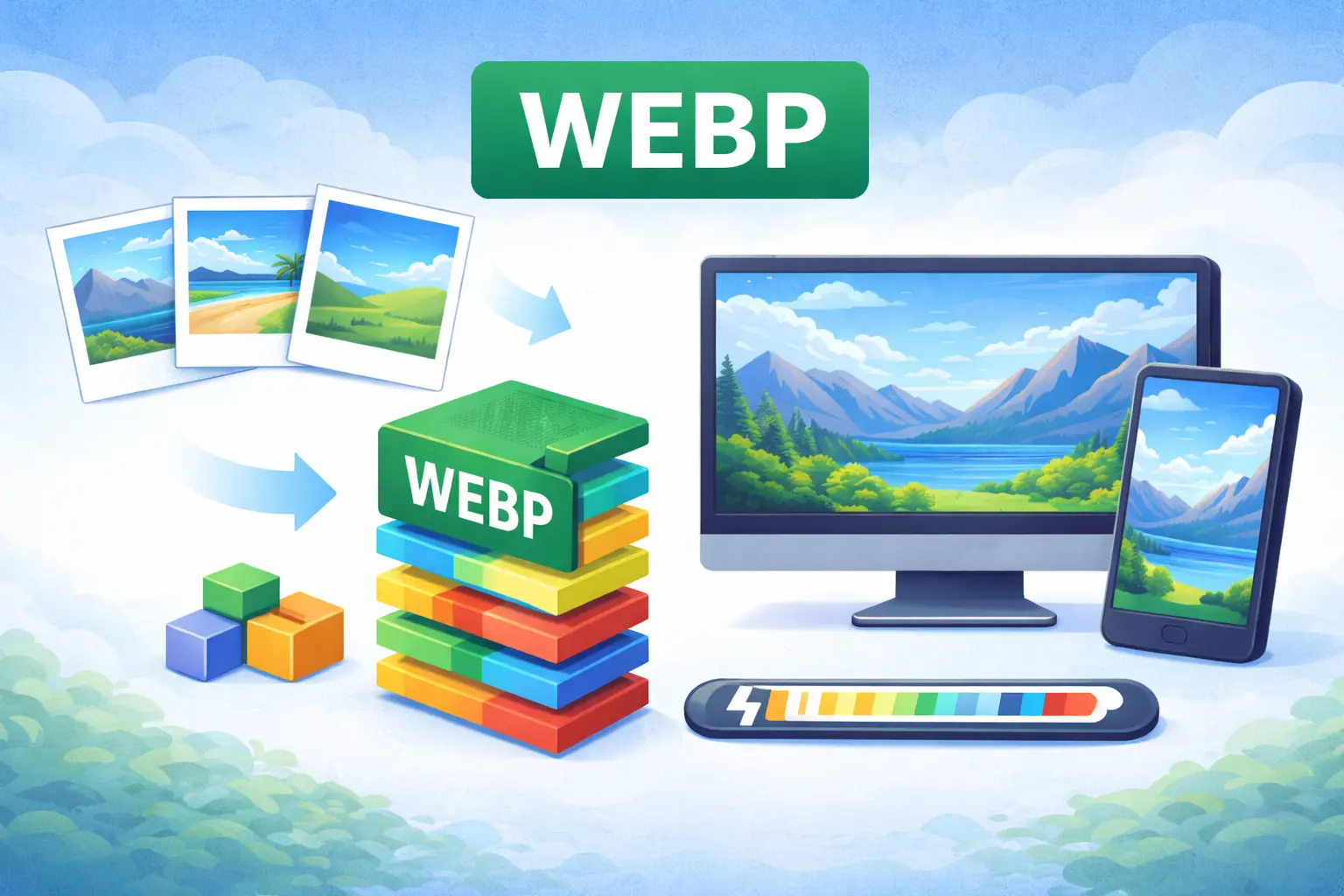
WEBP is an image format developed by Google and first introduced in 2010. At that time, the internet was entering a period of rapid growth in visual content, while popular formats such as JPEG, PNG, and GIF had been designed many years earlier, when internet speeds were slower, devices were simpler, and display demands were far less demanding than they are today. Google recognized that continuing to rely on these older formats for the modern web would turn images into a “burden” that slows down websites and wastes unnecessary data. WEBP was therefore created with a very clear goal: to keep images looking good to the human eye while making their file size significantly smaller.
To better understand how WEBP works, it can be compared to packing luggage. Two people may bring the same amount of clothing, but one knows how to fold neatly, use vacuum bags, and remove items that are not truly necessary, while the other simply stuffs everything randomly into a suitcase. The result is that the first suitcase is much smaller and lighter, even though it contains enough clothing for all basic needs. WEBP does the same thing with images: it does not remove important content, but repackages it in a smarter way.
One of the key ideas behind WEBP is that it takes advantage of the limits of human vision. In reality, the human eye cannot perceive every tiny difference in color or detail, especially in areas with smooth color transitions or flat surfaces. WEBP preserves the parts that are easy for the eye to notice while reducing extremely fine details that people can hardly distinguish. As a result, when viewed with the naked eye, the image looks almost the same as the original, but the amount of data that needs to be stored is significantly reduced.
In addition, WEBP avoids storing repeated information. In many images, there are areas with similar colors, such as the sky, walls, or plain backgrounds. Older formats often store each pixel separately, causing the same information to be recorded again and again. WEBP, by contrast, recognizes these similar regions and stores them in a grouped way, much like writing a color once and then describing how it should be reproduced, instead of repeating it hundreds of times. This approach reduces file size without changing how the image is perceived by the viewer.
WEBP was also designed from the beginning for display on computer and phone screens rather than for printing. For this reason, it keeps only the data that is truly necessary for images to appear clear and natural on digital devices. Information that a computer can store but that humans cannot actually perceive is removed, making image files even lighter.
Thanks to these approaches, WEBP images are typically about 25 to 35 percent smaller than JPEG images and about 20 to 30 percent smaller than PNG images, while the visual quality for viewers remains almost unchanged. When a website contains many images, this difference allows pages to load much faster, saves mobile data, and provides a smoother user experience—even when users are completely unaware of the existence of the WEBP format or the technology behind it.
WORD BANK:
assume /əˈsuːm/ [B1] (v): cho rằng, giả định
sluggish /ˈslʌɡ.ɪʃ/ (adj): chậm chạp, ì ạch
mobile data /ˈmoʊ.baɪl ˈdeɪ.t̬ə/ (n): dữ liệu di động
emerge /ɪˈmɝːdʒ/ [B2] (v): xuất hiện, nổi lên
visual content /ˈvɪʒ.u.əl ˈkɑːn.tɛnt/ (n): nội dung hình ảnh
display /dɪˈspleɪ/ (v/n): hiển thị; màn hình
demanding /dɪˈmæn.dɪŋ/ (adj): đòi hỏi cao
burden /ˈbɝː.dən/ (n): gánh nặng
luggage /ˈlʌɡ.ɪdʒ/ (n): hành lý
neatly /ˈniːt.li/ (adv): gọn gàng
vacuum bag /ˈvæk.juːm bæɡ/ (n): túi hút chân không
stuff sth into sth /stʌf ˈɪn.tuː/ (phr v): nhét cái gì vào cái gì
package /ˈpæk.ɪdʒ/ (v): đóng gói
take advantage of sth /teɪk ədˈvæn.tɪdʒ əv/ [B2] (phr): tận dụng
human vision /ˈhjuː.mən ˈvɪʒ.ən/ (n): thị giác con người
perceive /pɚˈsiːv/ [B2] (v): nhận biết, nhận thức
smooth /smuːð/ (adj): mượt, trơn
transition /trænˈzɪʃ.ən/ (n): sự chuyển tiếp
flat surface /flæt ˈsɝː.fɪs/ (n): bề mặt phẳng
fine /faɪn/ (adj): rất nhỏ, tinh
distinguish /dɪˈstɪŋ.ɡwɪʃ/ [B2] (v): phân biệt
with the naked eye /wɪð ðə ˈneɪ.kɪd aɪ/ (phr): bằng mắt thường
plain background /pleɪn ˈbæk.ɡraʊnd/ (n): nền trơn
pixel /ˈpɪk.səl/ (n): điểm ảnh
display /dɪˈspleɪ/ (n/v): sự hiển thị; hiển thị
smooth /smuːð/ (adj): mượt mà
unaware of sth /ˌʌn.əˈwɛr əv/ [B2] (adj): không nhận thức được điều gì
ỦNG HỘ READ TO LEAD!
Chào bạn! Có thể bạn chưa biết, Read to Lead là một trang giáo dục phi lợi nhuận với mục đích góp phần phát triển cộng đồng người học tiếng Anh tại Việt Nam. Chúng tôi không yêu cầu người đọc phải trả bất kỳ chi phí nào để sử dụng các sản phẩm của mình để mọi người đều có cơ hội học tập tốt hơn. Tuy nhiên, nếu bạn có thể, chúng tôi mong nhận được sự hỗ trợ tài chính từ bạn để duy trì hoạt động của trang và phát triển các sản phẩm mới.
Bạn có thể ủng hộ chúng tôi qua 1 trong 2 cách dưới đây.
– Cách 1: Chuyển tiền qua tài khoản Momo.
Số điện thoại 0947.886.865 (Chủ tài khoản: Nguyễn Tiến Trung)
Nội dung chuyển tiền: Ủng hộ Read to Lead
hoặc
– Cách 2: Chuyển tiền qua tài khoản ngân hàng.
Ngân hàng VIB chi nhánh Hải Phòng
Số tài khoản: 012704060048394 (Chủ tài khoản: Nguyễn Tiến Trung)
Nội dung chuyển tiền: Ủng hộ Read to Lead
Lớp luyện thi IELTS online
Bạn đang có nhu cầu thi chứng chỉ IELTS cho đầu vào đại học, đi du học, xin việc hay xin cư trú và đang phân vân chưa biết học ở đâu?
Nếu bạn đang tìm kiếm dịch vụ luyện thi IELTS online với giáo viên uy tín và chất lượng, cũng như học phí phải chăng, thì thầy Trung và Cô Thủy (Admin và dịch giả chính của Read to Lead) có thể là một lựa chọn phù hợp dành cho bạn.
Hãy liên hệ (nhắn tin) tới trang Facebook cá nhân của mình (https://www.facebook.com/nguyen.trung.509) để tìm hiểu về lớp học và được tư vấn cũng như được học thử nha!


