


[Reading level: B2 – Upper Intermediate]
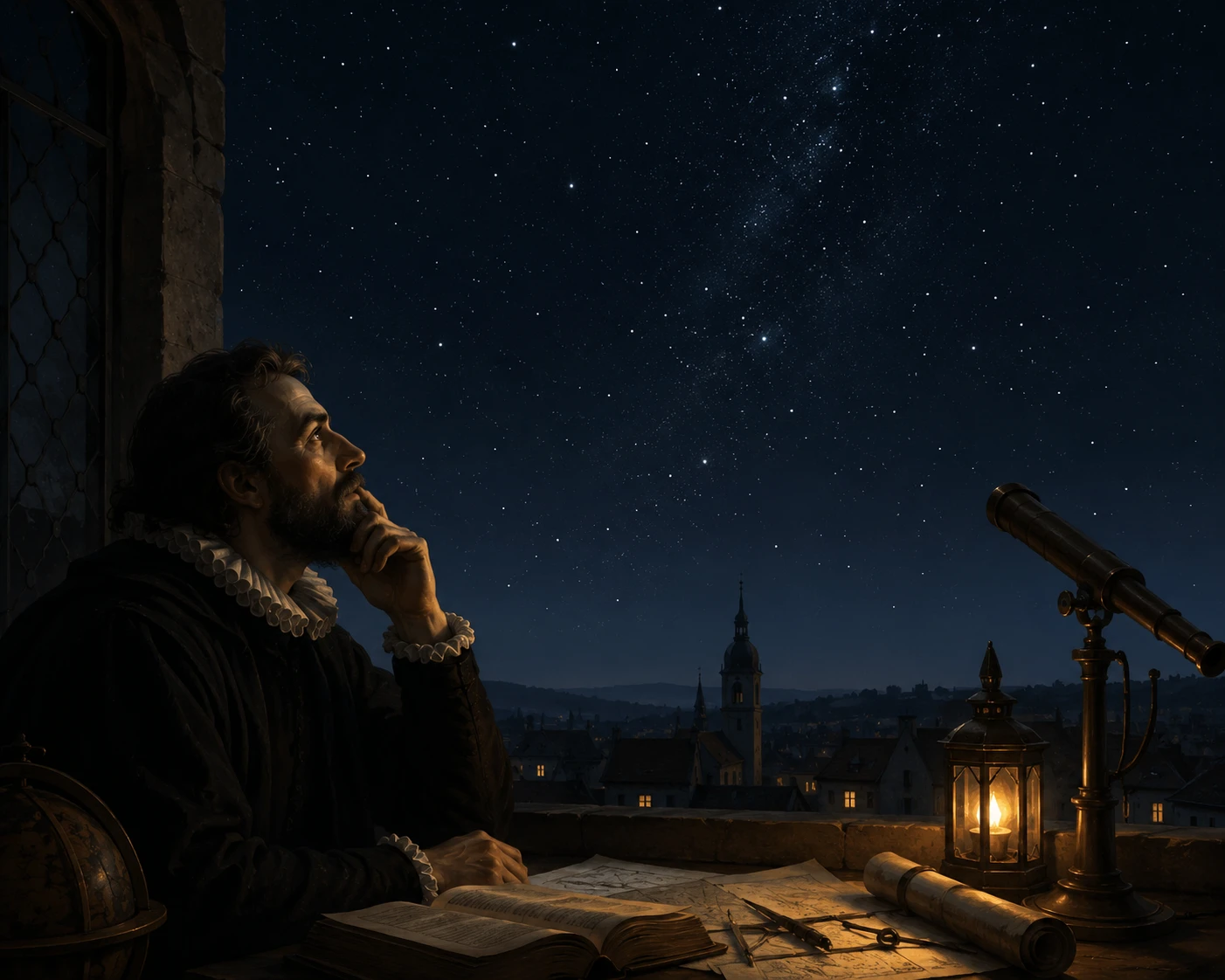
In 1610, the German astronomer Johannes Kepler looked up at the night sky and asked a question that seemed very simple:
“If the universe contains countless stars, why is the night sky still dark?”
That question later became one of the most famous mysteries in astronomy.
At first glance, it may not seem very special. But the more people thought about it, the stranger it became.
Imagine that you are standing in the middle of a dense forest, surrounded by trees. No matter which direction you look, your eyes will eventually meet the trunk of a tree.
Many scientists believed the universe should be the same. If stars stretch infinitely throughout space, then no matter where we look in the sky, our line of sight should eventually meet the light of a star.
According to that logic, the entire night sky should be glowing brightly like the surface of the Sun. Most of the sky remains pitch-black, with only a few scattered stars visible. For centuries, scientists tried to explain this paradox.
Some people believed that perhaps light from distant stars was blocked by enormous clouds of dust in space. However, this idea quickly ran into a problem. If dust absorbed light for millions of years, it would eventually heat up and glow itself. In that case, the sky would still end up bright.
Later, some suggested that the number of stars in the universe might not actually be as large as people thought. But as telescopes became more advanced, astronomers discovered more and more galaxies. This made that explanation less convincing as well.
By the nineteenth century, the German astronomer Heinrich Wilhelm Olbers had analyzed the problem so famously that the mystery became known as “Olbers’ paradox.”
The real answer only appeared in the twentieth century, when humans began to understand the true nature of the universe more clearly.
Astronomer Edwin Hubble discovered that galaxies are moving away from one another. This showed that the universe is not static, but constantly expanding.
At the same time, the Big Bang theory revealed that the universe has not existed forever in the past, but is only about 13.8 billion years old.
This was the crucial key. It means that light from many extremely distant stars has simply not had enough time to reach Earth yet. Those stars exist, but their light has not yet reached our eyes.
For example, if a star is located 20 billion light-years away from us, its light would need 20 billion years to travel to Earth, even while moving at the speed of light — the fastest speed in the universe. But the universe itself is only about 13.8 billion years old. That means the light from that star is still traveling through space, and humans today still cannot see it.
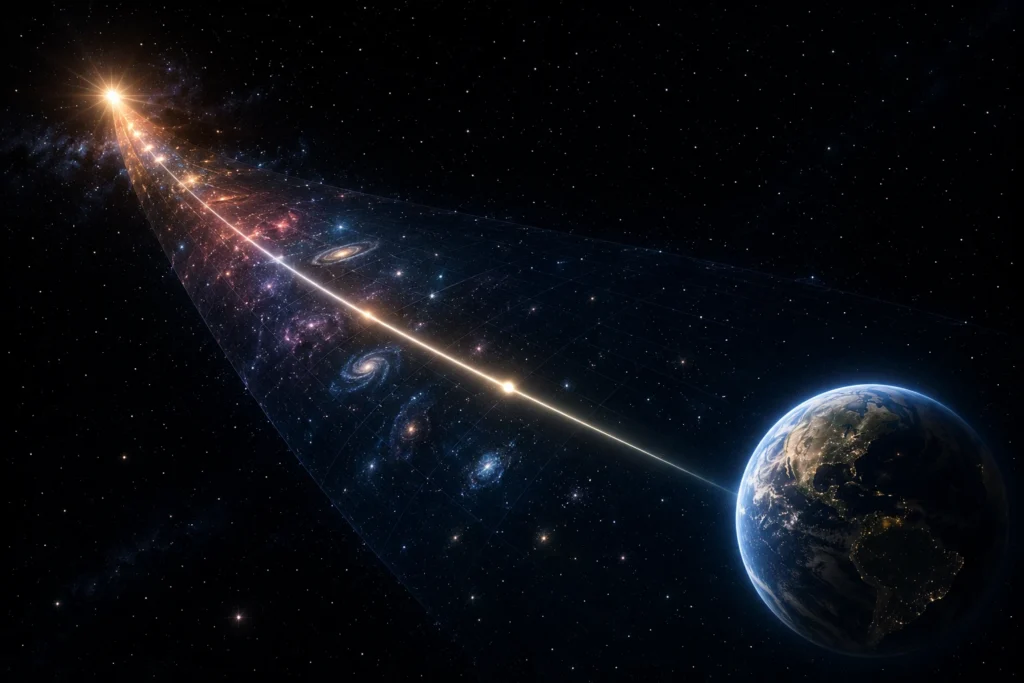
In other words, when we look up at the night sky, we are not only looking into space, but also looking at the limits of time itself.
Not only that, but the universe is continuously expanding. This means that very distant galaxies are moving farther and farther away from us at tremendous speeds. As a source of light moves away, the wavelengths of the light it emits become “stretched,” much like a rubber band being pulled apart.
Visible light – the part human eyes can detect – occupies only a very small part of the electromagnetic spectrum. But when wavelengths are stretched too much by the expansion of the universe, visible light from distant galaxies gradually shifts into infrared waves, microwaves, or radio waves. These are all forms of radiation that human eyes cannot see at all.
In other words, many extremely distant galaxies are still emitting enormous amounts of light, but that light has been “redshifted” so much that it has become invisible to us. As a result, regions of the sky that appear completely dark are not truly empty. They are still filled with light, but that light has been stretched beyond the range visible to human eyes.
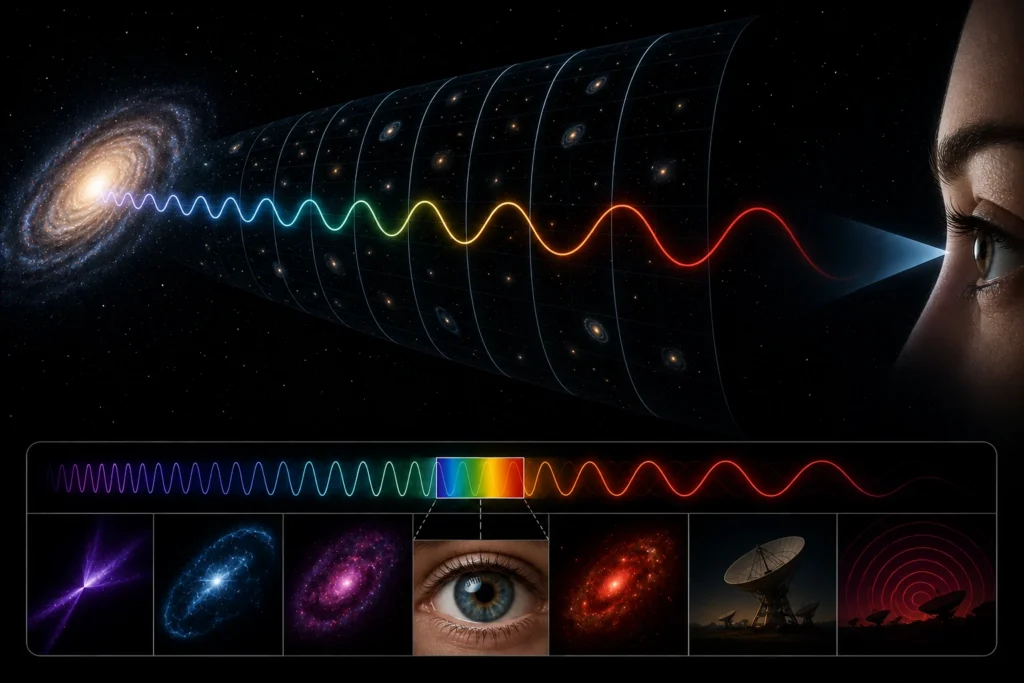
Today, infrared telescopes and radio telescopes can detect this invisible light. Thanks to them, scientists know that behind the pitch-black night sky lie countless galaxies, stars, and ancient radiation silently filling the universe.
And so, the darkness of the night sky itself has become evidence that the universe had a beginning, has a history, and is still continuing to expand even today.
WORD BANK:
astronomer /əˈstrɑː.nə.mɚ/ [B2] (n): nhà thiên văn học
mystery /ˈmɪs.tɚ.i/ [B1] (n): bí ẩn
astronomy /əˈstrɑː.nə.mi/ [B2] (n): thiên văn học
at first glance /ət fɝːst ɡlæns/ (phr): thoạt nhìn
dense /dens/ [B2] (adj): dày đặc
trunk /trʌŋk/ [B1] (n): thân cây
stretch /stretʃ/ [B2] (v): kéo dài
infinitely /ˈɪn.fə.nət.li/ [C1] (adv): vô hạn
line of sight /ˌlaɪn əv ˈsaɪt/ (n): tầm nhìn
eventually /ɪˈven.tʃu.ə.li/ [B1] (adv): cuối cùng
glow brightly /ɡloʊ ˈbraɪt.li/ (v): phát sáng rực rỡ
pitch-black /ˌpɪtʃ ˈblæk/ (adj): đen kịt
scattered /ˈskæt̬.ɚd/ [B2] (adj): rải rác
paradox /ˈper.ə.dɑːks/ [C1] (n): nghịch lý
block /blɑːk/ [B1] (v): chặn
cloud of dust /klaʊd əv dʌst/ (n): đám mây bụi
absorb /əbˈzɔːrb/ [B2] (v): hấp thụ
end up … /end ʌp/ [B1] (phr.v): cuối cùng trở nên / dẫn đến
convincing /kənˈvɪn.sɪŋ/ [B2] (adj): thuyết phục
static /ˈstæt̬.ɪk/ [C1] (adj): tĩnh, không thay đổi
tremendous /trəˈmen.dəs/ [B2] (adj): khổng lồ
wavelength /ˈweɪv.leŋθ/ [C1] (n): bước sóng
emit sth /iˈmɪt/ [C1] (v): phát ra cái gì
rubber band /ˈrʌb.ɚ bænd/ (n): dây thun
visible light /ˈvɪz.ə.bəl laɪt/ (n): ánh sáng nhìn thấy được
electromagnetic spectrum /ɪˌlek.troʊ.mæɡˈnet̬.ɪk ˈspek.trəm/ (n): phổ điện từ
infrared /ˌɪn.frəˈred/ [C1] (adj/n): hồng ngoại
microwave /ˈmaɪ.kroʊ.weɪv/ (n): sóng vi ba
radiation /ˌreɪ.diˈeɪ.ʃən/ [C1] (n): bức xạ
enormous /ɪˈnɔːr.məs/ [B2] (adj): khổng lồ
redshifted /ˈredˌʃɪf.tɪd/ (adj): bị dịch chuyển đỏ
invisible /ɪnˈvɪz.ə.bəl/ [B2] (adj): vô hình
ancient /ˈeɪn.ʃənt/ [B1] (adj): cổ xưa
ỦNG HỘ READ TO LEAD!
Chào bạn! Có thể bạn chưa biết, Read to Lead là một trang giáo dục phi lợi nhuận với mục đích góp phần phát triển cộng đồng người học tiếng Anh tại Việt Nam. Chúng tôi không yêu cầu người đọc phải trả bất kỳ chi phí nào để sử dụng các sản phẩm của mình để mọi người đều có cơ hội học tập tốt hơn. Tuy nhiên, nếu bạn có thể, chúng tôi mong nhận được sự hỗ trợ tài chính từ bạn để duy trì hoạt động của trang và phát triển các sản phẩm mới.
Bạn có thể ủng hộ chúng tôi qua 1 trong 2 cách dưới đây.
– Cách 1: Chuyển tiền qua tài khoản Momo.
Số điện thoại 0947.886.865 (Chủ tài khoản: Nguyễn Tiến Trung)
Nội dung chuyển tiền: Ủng hộ Read to Lead
hoặc
– Cách 2: Chuyển tiền qua tài khoản ngân hàng.
Ngân hàng VIB chi nhánh Hải Phòng
Số tài khoản: 012704060048394 (Chủ tài khoản: Nguyễn Tiến Trung)
Nội dung chuyển tiền: Ủng hộ Read to Lead
Lớp luyện thi IELTS online
Bạn đang có nhu cầu thi chứng chỉ IELTS cho đầu vào đại học, đi du học, xin việc hay xin cư trú và đang phân vân chưa biết học ở đâu?
Nếu bạn đang tìm kiếm dịch vụ luyện thi IELTS online với giáo viên uy tín và chất lượng, cũng như học phí phải chăng, thì thầy Trung và Cô Thủy (Admin và dịch giả chính của Read to Lead) có thể là một lựa chọn phù hợp dành cho bạn.
Hãy liên hệ (nhắn tin) tới trang Facebook cá nhân của mình (https://www.facebook.com/nguyen.trung.509) để tìm hiểu về lớp học và được tư vấn cũng như được học thử nha!


