


[Reading level: B2 – Upper Intermediate]
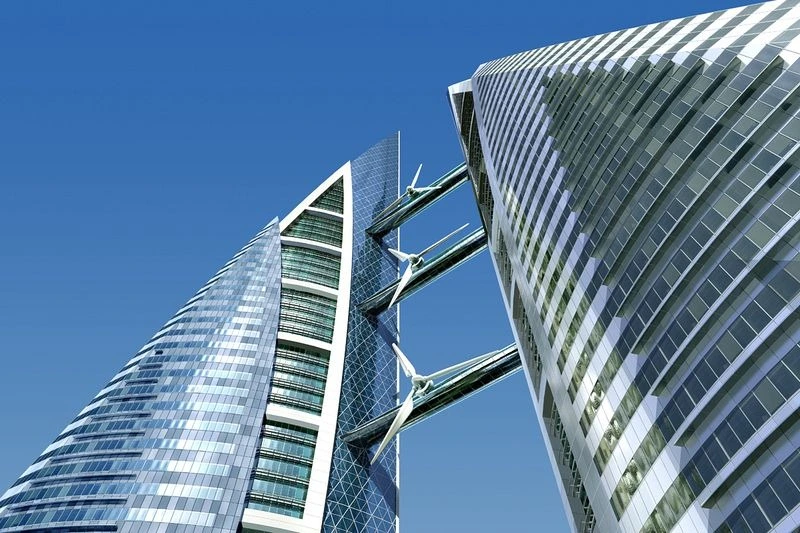
From a distance, the Bahrain World Trade Center looks like two giant sails rising in the middle of Manama, Bahrain. But the most remarkable feature of this building lies in the space between its two towers: three enormous wind turbines mounted on three bridges connecting the towers.
Completed in 2008, the Bahrain World Trade Center stands approximately 240 meters tall and became a pioneering building in the world to integrate large-scale wind turbines directly into the design of a commercial building. Each turbine has a diameter of 29 meters and a capacity of 225 kW, bringing the total installed capacity to 675 kW.
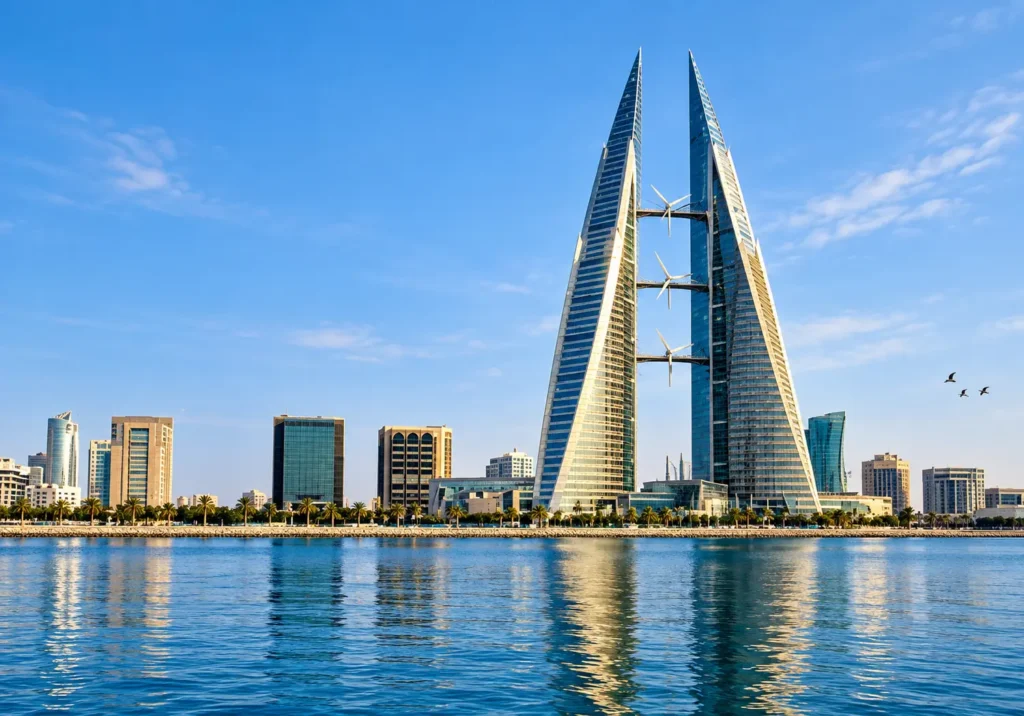
Interestingly, the architects did not simply place turbines between the two towers and wait for the wind to blow through. Instead, the very shape of the building was designed to help the turbines capture wind more effectively.
The two towers have curved surfaces and taper as they rise, resembling sails. When winds from the Persian Gulf blow toward the building, the aerodynamic shape of the towers helps direct and funnel the air into the space between them. As a result, wind speeds at the turbine locations can increase, allowing the turbines to harness energy more efficiently.
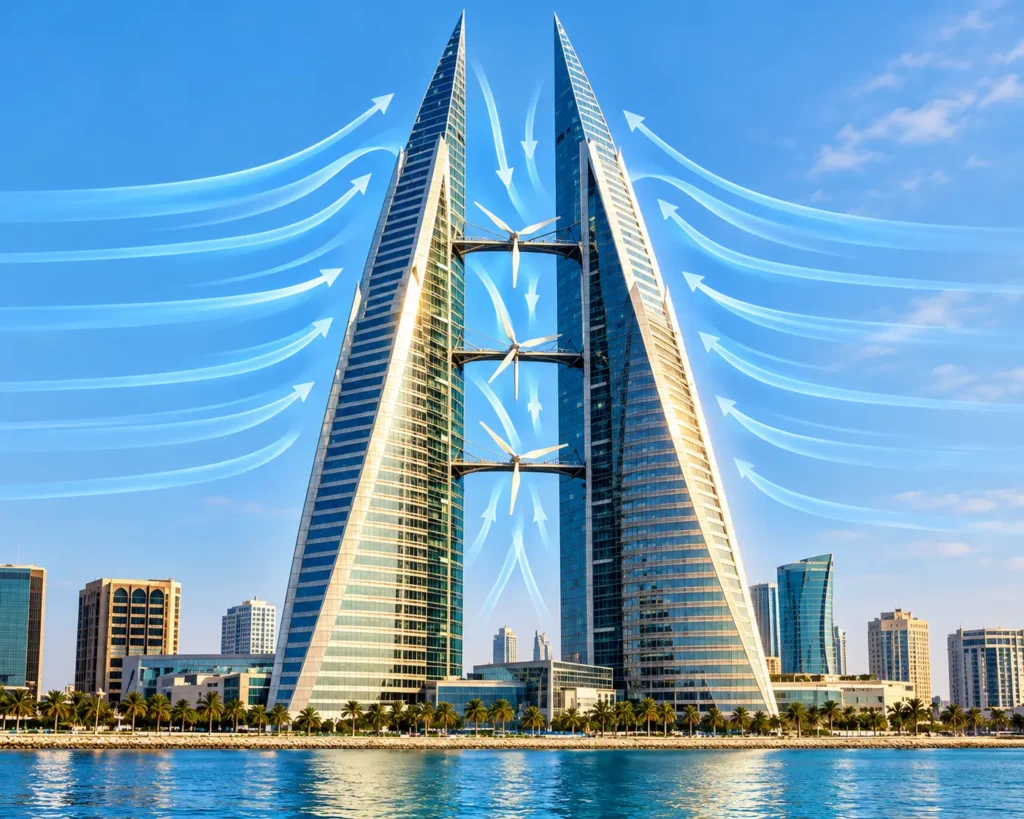
This design also addresses another problem. Normally, wind speed increases with height, meaning that a turbine positioned higher up may receive stronger winds than one below it. However, the distance between the two towers changes with height. The combination of the building’s shape and the characteristics of the airflow helps create relatively uniform wind conditions at all three turbines.
Before construction began, engineers conducted wind tunnel tests to study how air would move around the building. The results showed that the two towers could redirect and concentrate airflow toward the turbines across a relatively wide range of wind directions.
The three turbines are mounted on bridges connecting the two towers. Each turbine has a diameter almost equal to the length of a basketball court and weighs approximately 11 tonnes. According to the project’s initial calculations, the system could supply around 11–15% of the two towers’ electricity needs, depending on operating conditions and actual wind conditions.
The Bahrain World Trade Center, therefore, is not simply a building with wind turbines “added on.” Its innovation lies in the fact that the architecture and electricity generation system were designed as a unified whole: the shape of the building supports the turbines, while the turbines have become an inseparable part of its appearance.
This idea was also influenced by the traditional architecture of the Middle East. For centuries, Arab “wind towers” have been used to capture and channel air into buildings to cool their interiors. The Bahrain World Trade Center takes this principle of harnessing wind to an entirely different scale: instead of using wind merely for ventilation, the building converts it into electricity.
Today, in a city known for its oil industry and modern architecture, the three wind turbines rotating between the towers of the Bahrain World Trade Center still create a distinctive sight. They demonstrate a relatively simple yet inspiring idea: rather than fighting against the wind, a building can be designed to transform the very air currents surrounding it into a source of energy.
WORD BANK:
sail /seɪl/ [B1] (n): cánh buồm
enormous /ɪˈnɔːr.məs/ [B1] (adj): khổng lồ, rất lớn
mount /maʊnt/ [C1] (v): lắp đặt, gắn lên
pioneering /ˌpaɪəˈnɪr.ɪŋ/ [C1] (adj): tiên phong, mang tính đột phá
integrate sth into sth /ˈɪn.t̬ə.ɡreɪt/ [C1] (v): tích hợp cái gì vào cái gì
diameter /daɪˈæm.ə.t̬ɚ/ [C1] (n): đường kính
capacity /kəˈpæs.ə.t̬i/ [B2] (n): công suất, khả năng chứa
total installed capacity /ˈtoʊ.t̬əl ɪnˈstɑːld kəˈpæs.ə.t̬i/ (n): tổng công suất lắp đặt
architect /ˈɑːr.kə.tekt/ [B1] (n): kiến trúc sư
capture /ˈkæp.tʃɚ/ [B2] (v): thu giữ, đón, khai thác
taper /ˈteɪ.pɚ/ (v): thuôn dần, nhỏ dần
resemble /rɪˈzem.bəl/ [B2] (v): giống, trông giống
Persian Gulf /ˌpɝː.ʒən ˈɡʌlf/ (n): Vịnh Ba Tư
aerodynamic /ˌer.oʊ.daɪˈnæm.ɪk/ (adj): có tính khí động học
funnel sth /ˈfʌn.əl/ (v): dồn, dẫn hoặc hướng cái gì qua một lối hẹp
harness /ˈhɑːr.nəs/ [C1] (v): khai thác, tận dụng (năng lượng, sức mạnh)
address sth /əˈdres/ [C1] (v): giải quyết, xử lý (vấn đề)
position sth somewhere /pəˈzɪʃ.ən/ (v): đặt, bố trí cái gì ở vị trí nào đó
relatively /ˈrel.ə.t̬ɪv.li/ [B2] (adv): tương đối
uniform /ˈjuː.nə.fɔːrm/ (adj): đồng đều, thống nhất
conduct /kənˈdʌkt/ [B2] (v): tiến hành, thực hiện
wind tunnel test /ˈwɪnd ˌtʌn.əl test/ (n): thử nghiệm trong hầm gió
basketball court /ˈbæs.kɪt.bɑːl kɔːrt/ (n): sân bóng rổ
initial /ɪˈnɪʃ.əl/ [B2] (adj): ban đầu, đầu tiên
add on /æd ɑːn/ (phr v): bổ sung, gắn thêm
a unified whole /ə ˈjuː.nə.faɪd hoʊl/ (n): một thể thống nhất
inseparable /ɪnˈsep.ɚ.ə.bəl/ (adj): không thể tách rời
channel /ˈtʃæn.əl/ (v): dẫn, hướng (luồng khí, nước…)
interior /ɪnˈtɪr.i.ɚ/ [C1] (n): phần bên trong, không gian bên trong
merely /ˈmɪr.li/ [C1] (adv): chỉ, đơn thuần
ventilation /ˌven.t̬əlˈeɪ.ʃən/ (n): sự thông gió, sự thông thoáng
rotate /ˈroʊ.teɪt/ [C1] (v): quay, xoay
distinctive /dɪˈstɪŋk.tɪv/ [C1] (adj): đặc trưng, khác biệt, dễ nhận ra
inspiring /ɪnˈspaɪr.ɪŋ/ (adj): truyền cảm hứng, đầy cảm hứng
air current /ˈer ˌkɝː.ənt/ (n): luồng không khí, dòng khí
ỦNG HỘ READ TO LEAD!
Chào bạn! Có thể bạn chưa biết, Read to Lead là một trang giáo dục phi lợi nhuận với mục đích góp phần phát triển cộng đồng người học tiếng Anh tại Việt Nam. Chúng tôi không yêu cầu người đọc phải trả bất kỳ chi phí nào để sử dụng các sản phẩm của mình để mọi người đều có cơ hội học tập tốt hơn. Tuy nhiên, nếu bạn có thể, chúng tôi mong nhận được sự hỗ trợ tài chính từ bạn để duy trì hoạt động của trang và phát triển các sản phẩm mới.
Bạn có thể ủng hộ chúng tôi qua 1 trong 2 cách dưới đây.
– Cách 1: Chuyển tiền qua tài khoản Momo.
Số điện thoại 0947.886.865 (Chủ tài khoản: Nguyễn Tiến Trung)
Nội dung chuyển tiền: Ủng hộ Read to Lead
hoặc
– Cách 2: Chuyển tiền qua tài khoản ngân hàng.
Ngân hàng VIB chi nhánh Hải Phòng
Số tài khoản: 012704060048394 (Chủ tài khoản: Nguyễn Tiến Trung)
Nội dung chuyển tiền: Ủng hộ Read to Lead
Lớp luyện thi IELTS online
Bạn đang có nhu cầu thi chứng chỉ IELTS cho đầu vào đại học, đi du học, xin việc hay xin cư trú và đang phân vân chưa biết học ở đâu?
Nếu bạn đang tìm kiếm dịch vụ luyện thi IELTS online với giáo viên uy tín và chất lượng, cũng như học phí phải chăng, thì lớp học online của thầy Trung (Admin và dịch giả chính của Read to Lead) có thể là một lựa chọn phù hợp dành cho bạn.
Hãy liên hệ (nhắn tin) tới trang Facebook cá nhân của mình (https://www.facebook.com/nguyen.trung.509) để tìm hiểu về lớp học và được tư vấn cũng như được học thử nha!


